


BY: Matthew Kimbrough
Portfolio Manager
The Time Has Come
This August, at the Jackson Hole Economic Symposium, Fed Chair Jerome Powell officially signaled that rate cuts would begin in September. “The time has come for policy to adjust,” he said.
What he didn’t say is how much the FOMC would lower the Fed Funds rate. Since that speech, expectations have fluctuated wildly about whether they would begin with a 50 basis point rate cut or merely 25 basis points. How wildly? Well, exactly one week ago, CME’s FedWatch tool placed the odds of a 25bp rate cut at 86%, versus 14% for 50bp. As of this morning, the same probability tool reads only a 39% chance of 25bp and a 61% chance of 50bp. It’s remarkable that as of the morning of the FOMC meeting, we really don’t know which one will happen.
But even more remarkable are the new market-based expectations of faster monetary policy activity in 2025 and the extent to which the U.S. Treasury curve has adjusted in order to conform with them. Recall, the last time we received an updated Statement of Economic Projections (in June), the Fed projected only 125bp of cuts by year-end 2025. Now, the market expects up to 125bp of cuts in 2024(!!), and another 125bp by the 3rd quarter of 2025. If that were to transpire, these actions would bring the Fed Funds rate from its current range of 5.25 – 5.50% all the way to 2.75 – 3.00%.
Over the past 3 months, the whole yield curve has adjusted lower in a “bull steepener” move. The yield on the 2-year U.S. Treasury Note has declined 110bp since the June FOMC meeting, and the yield on the 10-year has declined around 62bp. A significant portion of this move occurred in response to the uptick in unemployment this August, when a reading of 4.3% was high enough to trigger the notorious “Sahm Rule,” a recessionary indicator. Although at the last meeting, Powell was somewhat dismissive of the Sahm Rule, referring to it as merely a “statistical regularity,” this new unemployment data was nevertheless sufficient enough to cause the FOMC to officially acknowledge a new level of attentiveness to the other side of their dual mandate.
Fortunately, this month, in addition to the announcement of a slightly less restrictive monetary policy, we will receive a new SEP, which will allow us to ascertain the extent to which FOMC member projections align with (or differ from) these new market-based expectations of future policy activity. We will also receive updated projections on GDP, inflation, unemployment, and (potentially) the terminal Fed Funds rate.
The Decision
At the conclusion of today’s FOMC meeting, the Fed Funds rate was cut by 50 basis points, moving the range from 5.25 – 5.50% down to 4.75 – 5.00%. This represents the first change to the Fed Funds rate since July 2023.
The Statement
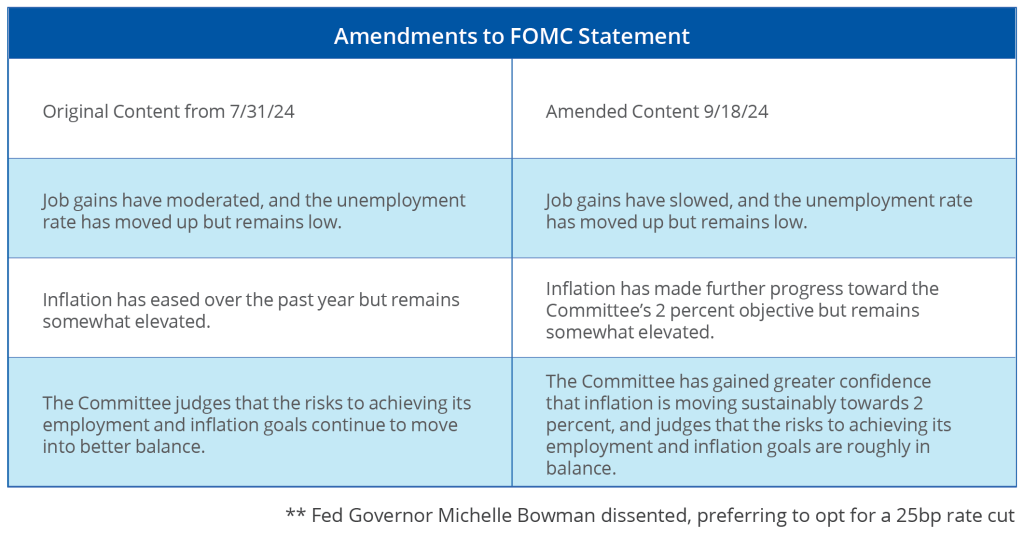
This meeting’s Statement contained several amendments that are highlighted in the below chart.
New Economic Projections
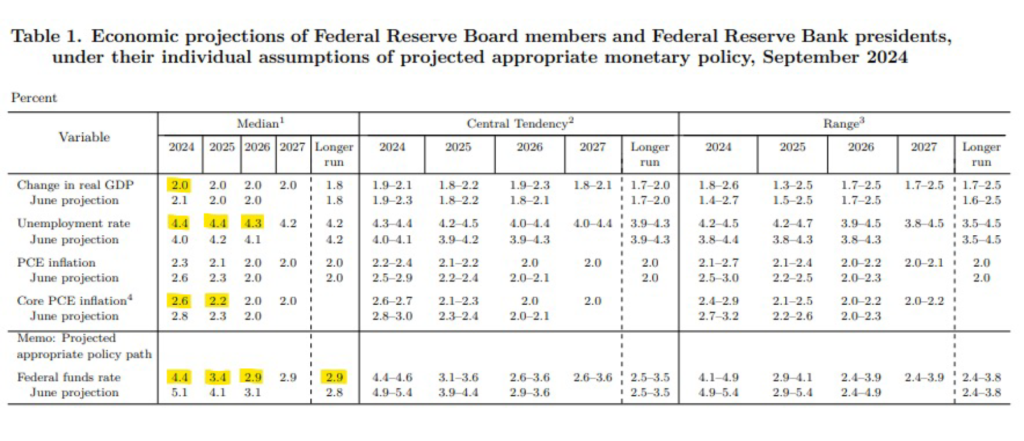
The most significant changes to (or facets of) this quarter’s Statement of Economic Projections (SEP) document have been highlighted below:
- The median Dot Plot projection shows 100bp total (and 50bp more) rate cuts in 2024, then 100bp of rate cuts in 2025 and 50bp in 2026
- The long-run Fed Funds target rate estimate increased again to 2.9%, with 4 FOMC members remaining at 3.5% or higher
- Unemployment projections were increased to 4.4% in 2024 and 2025
- Core PCE inflation expectations fell 0.2% to 2.6% in 2024, and 0.1% to 2.2% in 2025
The Press Conference
In his pre-conference remarks, Powell stated that “upside risks to inflation have diminished and downside risks to employment have increased.” However, these risks are “roughly balanced” and “policy is well-positioned to deal with the risks and uncertainties that we are dealing with on both sides of the dual mandate.”
When asked why 50 basis points today, Powell responded that it was an informed decision based on the totality of the data. He added, “There’s nothing in the SEP stating that the Committee is in a rush to get this done. We will move as fast or as slow as we think is appropriate.” Later, he added, “No one should look at this 50bp cut and say this is the new pace.”
When asked whether continuing QT was consistent with rate cuts, Powell said that both the balance sheet and the Fed Funds rate are in the process of normalization and that it was possible for the two things to happen concurrently.
About half of the questions during today’s press conference addressed the labor market. Powell detailed his impression of the whole labor market dashboard… labor force participation is high, vacancies are headed back to a strong level, the ratio of job openings to job seekers has moved from 2:1 to 1:1, which is still a good number. He also defended 4.2% (and even 4.4%) as a healthy unemployment rate – still pretty close to maximum employment.
The Market Reaction
Treasury yields fell after the Statement was released, with the 2-year yield declining by as much as 10bp. At the end of the press conference, much of this move had reversed. All told, the Treasury market curve steepened on the day, with longer yields rising 6-8bp and shorter yields 1-4bp.
Not Investment Advice or an Offer | This information is intended to assist investors. The information does not constitute investment advice or an offer to invest or to provide management services. It is not our intention to state, indicate, or imply in any manner that current or past results are indicative of future results or expectations. As with all investments, there are associated risks and you could lose money investing.

