

BY: Matthew Kimbrough
Portfolio Manager
Monetary Policy During a Government Shutdown
How should the FOMC manage monetary policy during a government shutdown? Well, to borrow a couple of wise words from the band Run-DMC, “It’s tricky.”
It’s tricky because of the lack of data available during a time when the Fed has repeatedly emphasized their data-dependency rather than choosing to provide forward guidance.
The BLS, the Treasury Department, and the Bureau of Economic Analysis have all stated that they will not be releasing their regularly scheduled economic data reports during this government shutdown. Fortunately, an exception was made recently for CPI, due to its use in determining social security benefits.
It’s also particularly tricky because many of the data points that are not being released are employment-related (such as weekly jobless claims and Non-Farm Payrolls). In one of the recent Fed statements, it was acknowledged that “downside risks to unemployment have risen,” which has led the committee to become more attentive to the employment side of its dual mandate.
Recent employment-related data, and the accompanying shift in the balance of risks, are precisely what was referenced when the FOMC decided to lower the Fed Funds rate in September by 25 basis points.
So, what now? How can the Fed forge ahead with rate cuts and claim to maintain their data-dependent stance when they are not only operating without a complete set of data, but arguably missing the most critical subset of data, the same subset that was used to justify the current rate cut cycle? How does the Fed rock around this government shutdown?
It’s tricky.
The Decision
At the conclusion of today’s FOMC meeting, the Fed Funds rate was reduced by 25 basis points, lowering the current range to 3.75% –4.00%. This is the 5th cut in the current easing cycle, following the 100bp of cuts that were announced from September through December of 2024 and the 25bp rate cut in September of this year.
Today’s decision was once again NOT unanimous. Stephen Miran voted against this action, and would have preferred to lower the target range for the Fed Funds rate by 50 basis points. Additionally, Jeff Smith, Kansas City Fed President, dissented in favor of no rate cut at this time.
The Statement
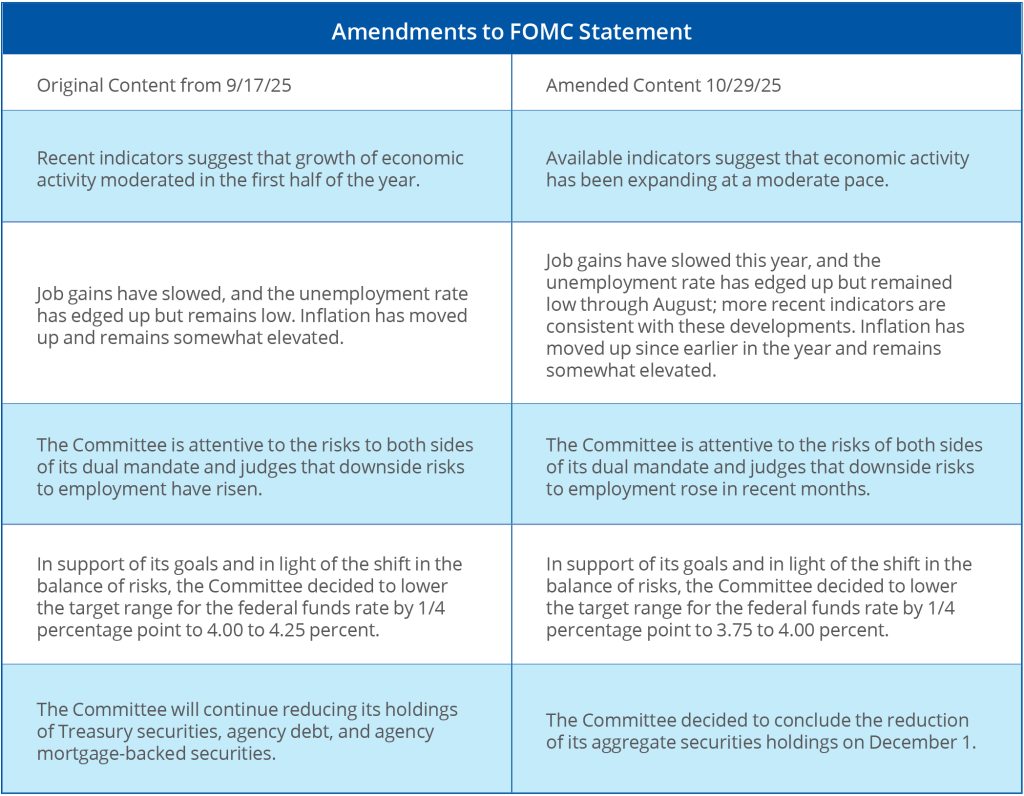
This meeting’s statement contained several amendments, which are highlighted in the chart below.
Economic Projections
The next Statement of Economic Projections will be released at the December FOMC meeting.
Powell’s Press Conference
A December rate cut decision is not a foregone conclusion. “What do you do if you’re driving in a fog? You slow down.” Powell stated that while he was not committing to the rationale of slowing down, he could potentially see that as a justification for a pause in December. Fogginess, in this instance, refers to a continuation of the state of sparse economic data releases due to the government shutdown.
In the meantime, Powell emphasized that private market indicators do exist on both the employment and inflation fronts, and that the FOMC members will continue to look at the totality of data that is available to them. He posited that if there were material changes to the employment or inflation picture, the Committee would still be able to catch these changes.
The Market Reaction
Treasury yields rose 2-4bp across the curve after the announcement of the Fed’s decision. However, after the press conference, yields rose further, to the tune of 8-10bp in total.
Not Investment Advice or an Offer | This information is intended to assist investors. The information does not constitute investment advice or an offer to invest or to provide management services. It is not our intention to state, indicate, or imply in any manner that current or past results are indicative of future results or expectations. As with all investments, there are associated risks and you could lose money investing.


