


BY: Matthew Kimbrough
Portfolio Manager
An Update on Tariffs, Inflation, and the U.S. Economy
In a mid-April address to The Economic Club of Chicago, Fed Chair Jerome Powell stated that he wasn’t expecting to make further progress towards the Fed’s dual mandate for the balance of 2025. (!!!)
Earlier in April, President Trump announced a 90-day pause on the reciprocal tariff rates that were initially published, dialing these tariffs back to 10% until later this summer (except for tariffs against China, Canada, and Mexico). Still, the levels of announced tariffs were considerably higher than anticipated, so the effects of tariff policies on both inflation and economic growth could be larger than initially anticipated as well.
Additionally, the length of time that it takes for tariff policy to feed back into goods inflation is unknown, but the longer it takes, the more likely it is that increases in inflation expectations will linger, which may cause actual inflation to become anchored at a higher rate than intended. As it currently stands, Core PCE Inflation sits at 2.6% and Core CPI is 2.8%, but as per Apollo’s Chief Economist Torsten Slok (as quoted recently in the Washington Post), “The bottom line is that inflation will be rising significantly over the next six months.”
This weekend, officials from the United States and China are meeting in Switzerland to discuss a potential de-escalation of tariff policy between the two countries. The United States currently has 145% tariffs on Chinese goods, and China has 125% tariffs on U.S. goods. Hopefully, this meeting will at least lay the groundwork for a larger deal between Trump and Xi.
The first estimate of Q1 2025 GDP (released late April) came in at -0.3%, a far cry from the prior quarter’s 2.4% growth. While unemployment has yet to increase significantly (still at 4.2%), other economic data releases have also pointed towards declining economic activity…
Consumer Confidence fell to 86 (from over 112 in Q4)
Dallas Fed Services Activity -19.4
Dallas Fed Manufacturing Activity -35.8 (lowest since 2020)
Philadelphia Fed Non-Manufacturing Activity -42.7 (also lowest since 2020)
How will Fed Chair Powell respond to the potential of an ongoing stagflationary environment (marked by higher inflation and lower growth) in today’s press conference?
The Decision
At the conclusion of today’s FOMC meeting, the Fed Funds rate was held steady, as expected, maintaining the current range at 4.25 – 4.50%.
The Statement
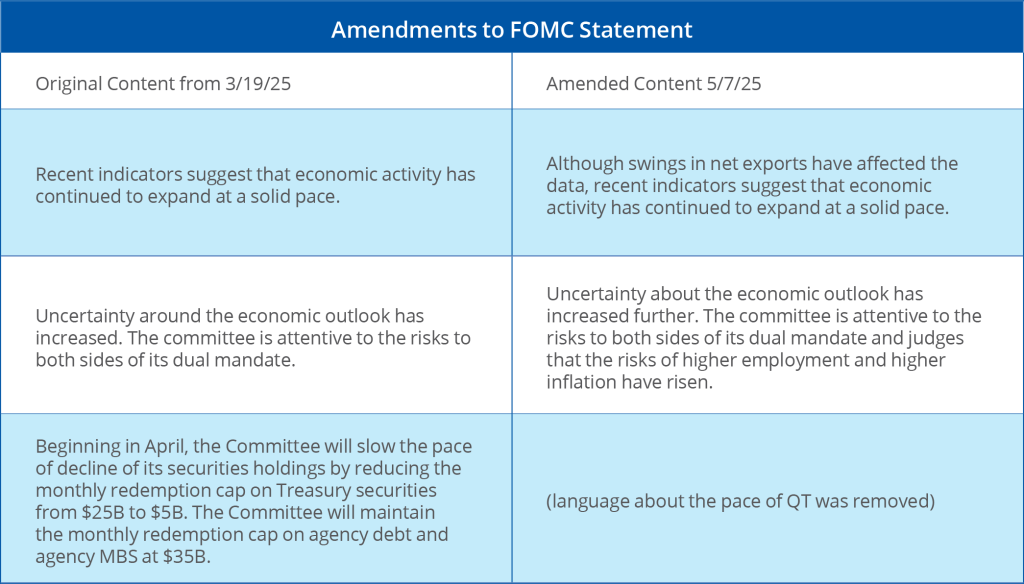
This meeting’s statement contained several amendments, which are highlighted in the chart below.
Notes and Quotes from Powell’s Press Conference
Fed Chair Powell seemed to downplay the Q1 GDP reading of -0.3%, as it was skewed by a surge in Q1 imports in anticipation of increased tariffs. He further stated that Private Domestic Final Purchases grew at 3% in Q1, which was the same as last year.
“Surveys of households and businesses, however, report a sharp decline in sentiment and elevated uncertainty about the economic outlook, largely reflecting trade policy concerns.”
“The new administration is in the process of implementing substantial policy changes in four distinct areas: trade, immigration, fiscal policy, and regulation. The tariff increases announced so far have been significantly larger than anticipated. All of these policies are still evolving, however, and their effects on the economy remain highly uncertain.”
“We may find ourselves in the challenging scenario in which our dual mandate goals are in tension. If that were to occur, we would consider how far the economy is from each goal, and the potentially different time horizons over which those respective gaps would be anticipated to close. For the time being, we are well-positioned to wait for greater clarity before considering any adjustments to our policy stance.”
Several times Powell reiterated that “we’re in a good position,” “we don’t need to be in a hurry,” and “there’s so much uncertainty right now.”
When asked why the Fed needs to wait for soft data weakness to translate into hard data, Powell responded, “Look at the state of the economy – the labor market is solid, inflation is low, and we can afford to be patient as things unfold. There’s no real cost to our waiting at this point.”
“There are cases in which it would be appropriate for us to cut rates this year, and there are cases in which it wouldn’t. We just don’t know. Until we know more about how this is going to settle out and what the economic implications are for employment and inflation, it’s hard to say what the appropriate path would be.
The Market Reaction
Treasury yields fell 0-2 basis points following today’s press conference. Equity markets were up less than 1%.
Not Investment Advice or an Offer | This information is intended to assist investors. The information does not constitute investment advice or an offer to invest or to provide management services. It is not our intention to state, indicate, or imply in any manner that current or past results are indicative of future results or expectations. As with all investments, there are associated risks and you could lose money investing.

