

BY: Matthew Kimbrough
Senior Portfolio Manager
The Decision
At the conclusion of today’s FOMC meeting, the Fed Funds rate was held steady at the current range of 3.50%–3.75%.
Today’s decision was once again not unanimous, but there was only one dissenting vote. Stephen Miran would have preferred a Fed Funds rate cut of 25 basis points.
Leptokurtic Outcomes & The Fed’s Seesaw
In statistics, a leptokurtic distribution has a less reliable average outcome (higher peak) and a greater amount of extreme outlier events on both sides (fatter tails).
It could be argued that today’s Federal Reserve faces a similar set of circumstances.
The Fed’s dual mandate tasks FOMC members with the goals of both stable prices and maximum employment, even though these goals are often in conflict with one another. Reducing the Fed Funds rate too low in order to combat high unemployment runs the risk of fostering higher inflation, but equally, raising the Fed Funds rate too high to stave off bouts of inflation is negative for economic conditions and for the prospect of achieving full employment in particular.
This creates a seesaw effect where the Fed winds up responding to whichever side of the mandate is most urgent at each FOMC meeting. Then, the Fed Chair communicates to the public where the Committee’s collective stance lies regarding the balance of risks present in the overall economy. For the past five years, this balance has tilted overwhelmingly in favor of post-pandemic inflationary concerns, and the actions taken during the present monetary policy cycle to both raise the Fed Funds rate into restrictive territory and to subsequently lower it back into a neutral range have been taken with the goal of bringing inflation back toward the Fed’s long-term 2% goal.
That being said, last summer, the focus began to shift back towards the employment side of the Fed’s mandate. A spike in unemployment caused some recessionary indicators to flash warning signs, most notably the Sahm Rule. This also played a significant role in the onset of the second round of Fed Funds rate cuts that began in September 2025.
One of the lines from the most recent FOMC statement reads that “The Committee is attentive to risks on both sides of its dual mandate.”
The issue seems to be that the risks to both sides are increasing, i.e., the tails are getting fatter. Unemployment is at 4.4%, and even though we were warned that some figures in Q1 might be choppy due to the government shutdown and seasonal adjustments, the data points have been quite volatile. Economic growth projections have also moderated. Meanwhile, recent geopolitical turmoil has raised the likelihood of a short-term increase in inflation due to a spike in oil prices and other commodities. Even if they prove to be transitory in nature, these new inflationary concerns could elongate expectations for further monetary policy activity in 2026.
The Statement
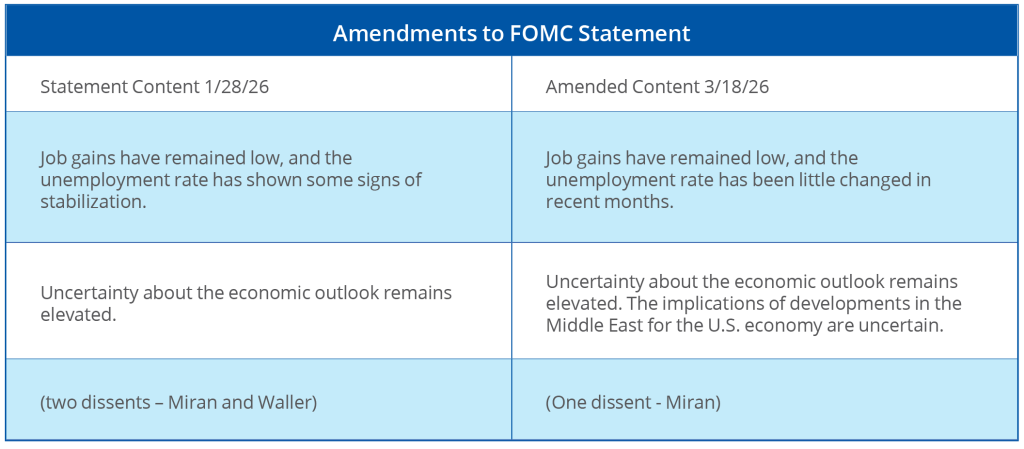
This meeting’s statement contained several amendments, which are highlighted in the chart below.
New Economic Projections
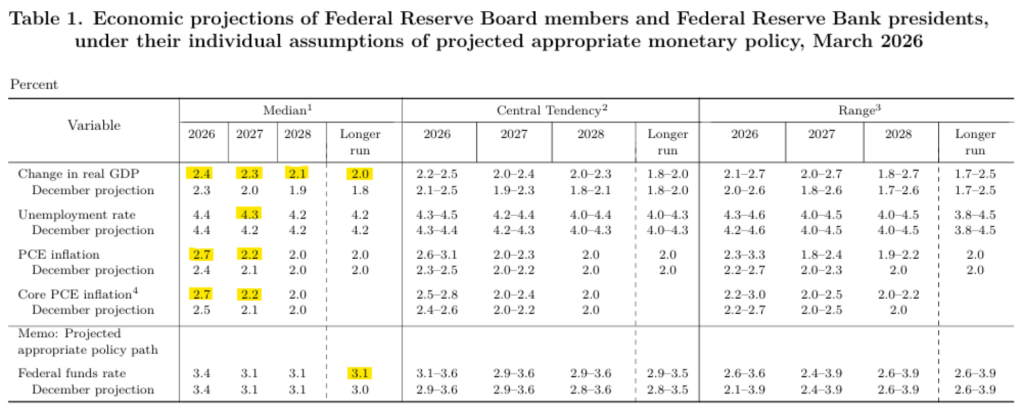
The most significant changes to, or facets of, this quarter’s Statement of Economic Projections (SEP) document are highlighted below:
1| The median Dot Plot projection continues to show one more 25bp cut in 2026 and one in 2027.
2| Unemployment projections held steady at 4.4% in 2026 but were raised slightly in 2027.
3| Core PCE inflation expectations for year-end 2026 were raised from 2.4% to 2.7%. Expectations for Core PCE inflation were also raised 0.1% in 2027.
4| Real GDP is expected to be 2.4% for 2025, 0.1% higher than projected in December. 2027 GDP is projected to be 2.3%, 0.3% higher than in December.
Fed Chair Jerome Powell’s Press Conference
Powell had several points to make during the press conference about the upcoming Fed Chair succession:
1| If his successor is not confirmed by the end of his term, he will stay until that takes place
2| He has no intention of leaving the board until the federal investigation is over
3| He hasn’t yet made a decision about whether he will remain a member of the FOMC after his term as Chair expires.
Given the onset of the conflict in the Middle East, Powell received several questions on inflation, but noted that FOMC members are still focused on the effects of one-time increases in goods-related prices due to tariffs, and how long it will take those to work their way through the economy (rather than the newer and more uncertain effects of commodities-related inflation due to the conflict). He added that “It was too soon to know the scope and duration of the potential effects (of the Iran conflict) on the economy.”
Powell reiterated that it was still not anyone’s base case that the next Fed action would be a hike instead of a cut, but he did admit that the possibility of hiking rates was discussed at each of the last two meetings.
Powell also cautioned against the use of the word ‘stagflation,’ saying that is a very different situation from the one we’re in, and he’d like to reserve that term for circumstances similar to what was faced in the 1970s.
The Market Reaction
After the press conference, Treasury yields were up 6-8bp, equity markets declined just over 1%, and the market-based projections of the next 25bp Fed Funds rate cut were pushed back to mid-2027.
Not Investment Advice or an Offer | This information is intended to assist investors. The information does not constitute investment advice or an offer to invest or to provide management services. It is not our intention to state, indicate, or imply in any manner that current or past results are indicative of future results or expectations. As with all investments, there are associated risks and you could lose money investing.


