


BY: Matthew Kimbrough
Portfolio Manager
Certain Uncertainties
Three months and two FOMC meetings ago, I wrote that “the onset of Donald Trump’s second Presidential term has coincided with an increase in policy-related uncertainty.”
We are now a full five months into this presidential term, and uncertainty abounds.
On the domestic front, President Trump’s Big Beautiful Bill is headed back to the House of Representatives after several key provisions were amended in the Senate. Economists on both sides of the aisle differ significantly on the potential long-term implications of this piece of legislation, to the tune of trillions of dollars.
Meanwhile, international policy has predominantly focused upon tariff-related negotiations. The 90-day pause on Liberation Day tariffs is set to expire in early July, and tariff discussions continue on many fronts simultaneously. A tariff-and-trade-related deal was struck with China, and the recent G-7 summit could have been an opportunity for further progress on tariffs—if not for an altogether new and rapidly escalating conflict between Israel and Iran. It remains unknown whether (or to what extent) U.S. involvement will be necessary in order for this new conflict to be resolved—and for Israel’s objective of dismantling Iran’s nuclear capabilities to be achieved.
So far, U.S. economic data has been slow to react to tariffs announced in April. While the unemployment rate remains at 4.2%, both initial jobless claims and continuing jobless claims have been rising. On top of this, inflation has yet to increase. In fact, Core PCE inflation, the Fed’s preferred measure, recently fell to 2.5%, its lowest reading since early 2021.
Normally, this would be cause enough to cut the Fed Funds rate again, and some economists have recently made the case that the Fed is already late in making this move. But for now—largely due to the uncertain implications of fiscal policy, tariff negotiations, and geopolitical tension—the Fed is on hold.
The Decision
At the conclusion of today’s FOMC meeting, the Fed Funds rate was held steady, as expected, maintaining the current range of 4.25%–4.50%. It was a unanimous decision.
The Statement
This meeting’s statement contained several amendments, which are highlighted in the chart below.

New Economic Projections
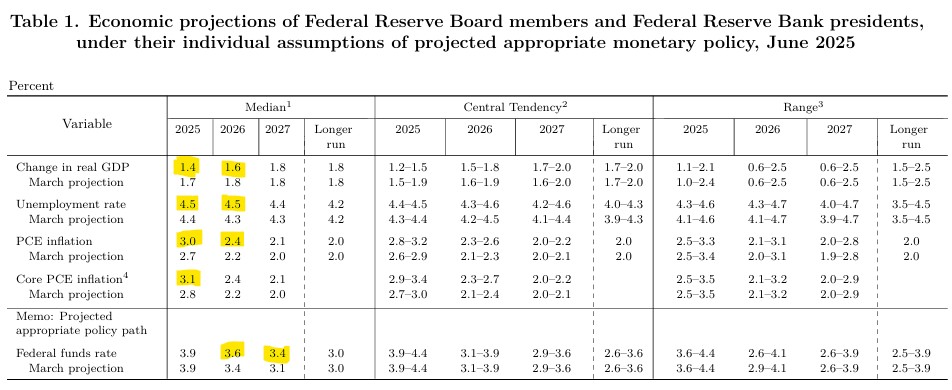
The most significant changes to (or facets of) this quarter’s Statement of Economic Projections (SEP) document have been highlighted below:
- The near-term median Dot Plot projection stayed the same, showing 50bps of rate cuts in 2025, yet it also shows one less rate cut in 2026 and 2027.
- Unemployment projections were raised to 4.5% in 2025, from 4.4%.
- Core PCE inflation expectations were raised 0.3% in 2025, from 2.8% to 3.1%.
- Real GDP is expected to be 1.4% for 2025, 0.3% lower than projected in March.
Quotes from Powell’s Press Conference
- “Uncertainty is unusually elevated.”
- On the spread of FOMC members’ Dot Plot projections – “With uncertainty as high as it is, no one holds these rate paths with high conviction.”
- “We will learn a great deal more about tariff implications over the summer.”
- “We take fiscal policy as fully exogenous.”
The Market Reaction
Treasury yields fell 1-5 bps after today’s statement was released, in the form of a mild bull steepener. Equity markets were relatively flat.
Not Investment Advice or an Offer | This information is intended to assist investors. The information does not constitute investment advice or an offer to invest or to provide management services. It is not our intention to state, indicate, or imply in any manner that current or past results are indicative of future results or expectations. As with all investments, there are associated risks and you could lose money investing.

