

Third Quarter 2025
Executive Summary
Investors face a complex environment with competing forces. Equity markets hover near record levels, supported by corporate earnings and consumer spending, while key economic indicators suggest slowing growth. The Federal Reserve’s September rate cut provides a supportive backdrop, though elevated valuations remind us that risks remain—particularly if economic and earnings growth slow more than expected. With major policy uncertainties, like tariff disruptions, largely behind us and midterm elections approaching, debates over fiscal and monetary policy will likely intensify. Our view: the positives currently outweigh the negatives, creating a cautiously constructive environment.
Third Quarter Performance
U.S. Equities
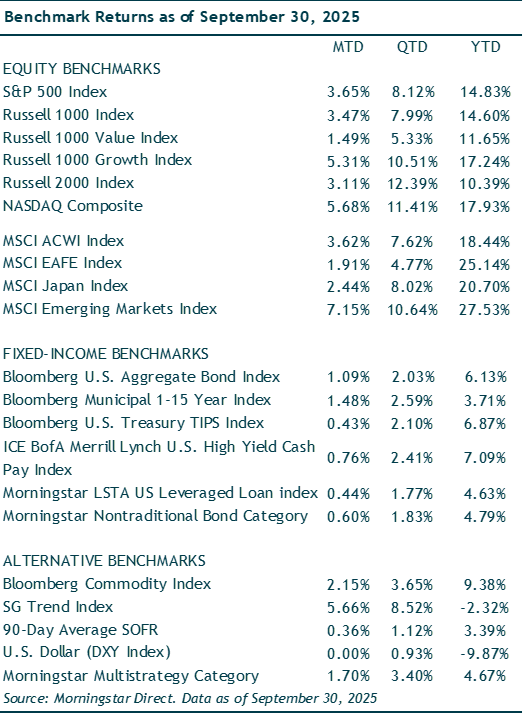
The S&P 500 gained 8.12% in Q3, bringing year-to-date returns above 14.83%. Corporate earnings resilience, particularly in technology and communication services, continues driving the index higher. The tech-heavy Nasdaq rose 11.41%, lifted by AI-driven productivity optimism and cloud infrastructure investment. Large-cap growth stocks (Russell 1000 Growth) gained 10.51%, nearly doubling value stocks’ (Russell 1000 Value) 5.33% return. Small-cap stocks (Russell 2000) had a strong quarter, up 12.39%, outperforming large-caps amid hopes that lower rates would benefit the asset class.
International Markets
Developed market stocks (MSCI EAFE) gained 4.77%, lagging the S&P 500. Emerging markets rose 10.64% (MSCI EM), driven by easing global financial conditions, attractive valuations, and AI optimism in key markets, especially China. Year to date, both developed international and emerging market stocks outperform domestic equities, thanks to a roughly 10% decline in the U.S. dollar.
Fixed Income
After holding rates steady for eight months, the Federal Reserve cut rates in September, describing the move as “risk management” given slowing growth and softening labor conditions. The path forward remains uncertain. While the Fed emphasizes data dependency and balancing inflation versus growth risks, markets price in more aggressive easing. Yields moved unevenly across the curve. Credit markets remain strong with spreads near multi-decade lows, though fiscal pressures continue influencing long-term rates. Investment-grade bonds ended the quarter up 2.03% (Bloomberg U.S. Aggregate Bond), while high-yield bonds gained 2.41% (ICE BofA U.S. High Yield).
Investment Outlook and Portfolio Positioning
Why We Remain Cautiously Optimistic
Markets react constantly to news, but today’s sensitivity feels heightened. Every data release, policy comment, or geopolitical headline carries outsized influence. This seems justified as investors determine the path forward: will the economy slow under tighter financial conditions, or can momentum continue?
Several factors support optimism:
- Monetary Policy Tailwind
The Fed’s recent rate cut provides a constructive backdrop for both equities and bonds. Lower rates reduce borrowing costs for consumers and corporations, potentially fueling investment and spending. - Consumer Strength
The U.S. economy is primarily consumption-driven. Spending has held up well, even after adjusting for inflation. While income and spending levels vary meaningfully across households, overall consumption benefits from real wage growth that has outpaced inflation in many segments. Balance sheets remain generally healthy, supported by higher brokerage accounts and stable housing values. Despite higher mortgage rates, housing continues supporting household wealth and consumer confidence. - Corporate Fundamentals
Earnings growth reached 11.7% in Q2, marking the third consecutive quarter of double-digit growth. Many companies reported expanding margins, improved efficiency, and positive forward guidance—providing a foundation for higher equity valuations. - Broadening Market Leadership
While attention has focused on a handful of large-cap technology companies, gains have recently extended across more sectors. This improved breadth suggests a healthier rally, less reliant on a narrow cohort of stocks.
Labor Market Concerns
We’re closely monitoring the labor market. Key indicators—quit rates, layoff rates, and initial unemployment claims—have flatlined. We appear at stall speed, and conditions could shift either way.
Since April, job gains have averaged around 53,000 per month, aligning with estimates of breakeven levels needed to keep unemployment steady. We’re not yet seeing broad-based layoffs or deterioration that typically signals a downturn.
Deciphering Labor Market Complexity
Immigration has led to large swings in labor supply, distorting the relationship between payroll growth and unemployment. When labor supply expanded quickly in 2023–2024, job gains looked strong but were outpaced by labor force growth, leading to higher unemployment. Conversely, when supply growth slowed in late 2024 and early 2025, job growth weakened but unemployment held steady. More recently, employment growth has slowed further, yet job seekers remain roughly aligned with available jobs. The key insight: payroll growth can look strong when conditions deteriorate and appear weak when the market is balanced. Today’s modest job growth combined with stable unemployment suggests the labor market is slowing but not collapsing.
U.S. Equities: Understanding Today’s Valuations
At year start, consensus return expectations for U.S. equities aligned with the historical average of about 8%. Year to date, U.S. stocks have exceeded those assumptions, reaching all-time highs driven by earnings growth, AI enthusiasm, and an improving macroeconomic backdrop.
The Valuation Question
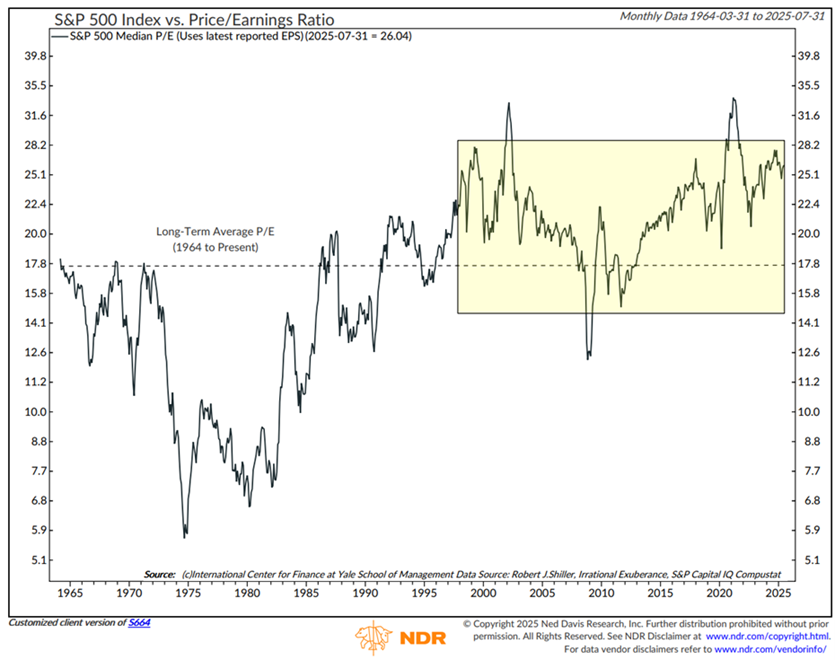
The S&P 500 currently trades at roughly 26x trailing 12-month earnings versus a long-term average of 17.8x. These elevated levels remain a critical factor we monitor. Yet context matters: the market has traded above its long-term average for most of the past 25 years.
Why Historical Averages Miss the Mark
We believe the historical 17x average is too low for today’s market. A higher fair-value multiple is warranted given structural changes:
Structural Shift in Business Models
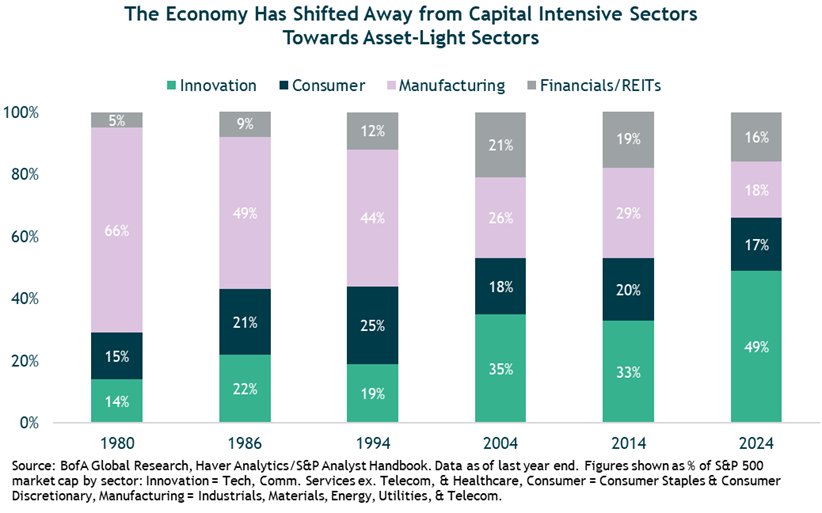
The economy has shifted from capital-intensive industries toward asset-light business models with stronger balance sheets, durable competitive moats, and higher, more resilient profit margins. Since the mid-1990s, S&P 500 margins have nearly doubled.

Today’s economy looks vastly different from past decades. In 1980, capital-intensive businesses comprised two-thirds of the index, while asset-light firms represented less than 15%. Today, roughly half the index consists of innovation-driven companies, while manufacturing has shrunk below 20%. Investors naturally apply different multiples to cyclical, capital-intensive firms versus high-margin, scalable businesses.
Changed Market Dynamics
The rise of passive investing has fundamentally altered equity flows. Defined contribution plans replacing defined-benefit pensions mean most workers invest steadily regardless of valuations. Morningstar data show passive assets overtook active assets for the first time in late 2023. These consistent, valuation-agnostic inflows provide support for higher multiples.

Simultaneously, equity supply has shrunk. Publicly listed U.S. companies have fallen by about half since 1996, and corporations consistently repurchase shares. Preliminary estimates put S&P 500 Q2 2025 buybacks at $235 billion, bringing the trailing 12-month total to roughly $1 trillion. This supply reduction, combined with steady demand, sustains higher valuations.
Valuations and Near-Term Returns
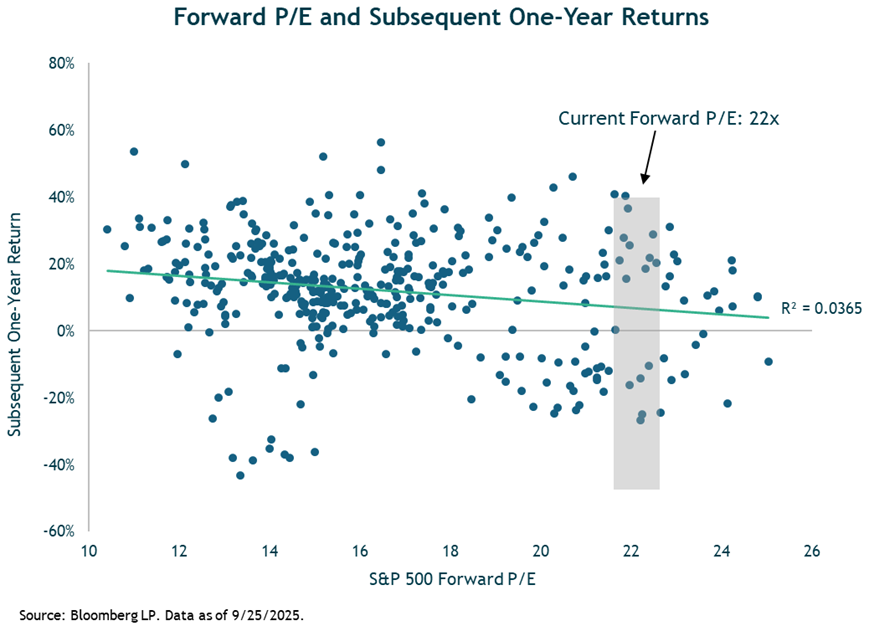
Today, valuations sit at about 22x forward earnings—high relative to history. Past periods at similar valuations show subsequent 12-month returns ranging from significant losses to strong gains. This wide dispersion highlights that while valuations inform long-term expected returns, they’re poor tools for short-term market timing. Earnings growth, monetary policy, and investor sentiment play much larger roles over a one-year horizon.
Fixed Income: Navigating Policy Uncertainty
The Fed reinitiated rate cuts in late September, lowering the federal funds target range by 0.25% to 4.00%–4.25%—the first cut this year but not of this cycle. The Fed previously eased three times from September to December 2024 (totaling 100 basis points) but paused over concerns that inflation remained stubbornly above its 2% target and policy might be loosening too quickly.
Fed Policy Debate
Fed Chair Powell positioned the recent cut as “risk management” given softening labor data and slowing growth. The Fed has left the door open for additional cuts but emphasizes data dependency, balancing inflation risk with growth support.
Divergence is increasing among Fed governors regarding the appropriate easing pace. Newly appointed Governor Miran has advocated for much lower rates, suggesting the Fed Funds rate should be two percentage points lower. Other members have signaled a preference for a measured approach, warning that cutting too quickly could undermine inflation progress and introduce instability. This debate underscores policy path uncertainty.
Assessing Policy Stance
We assess Fed policy accommodation using the real (inflation-adjusted) fed funds rate. Today, it stands at roughly 1.2%. In prior cycles, levels of 3.5% or higher proved too restrictive, ultimately choking growth and leading to a recession.

Today, the real rate needed to cool an overheated economy is lower than in past cycles due to a slower-growing economy. Growth has slowed from an average of 3.2% between 1965-2008 to 2.1% since the 2008 financial crisis, driven by demographics, a shrinking labor force participation, and increasing federal transfer payments.
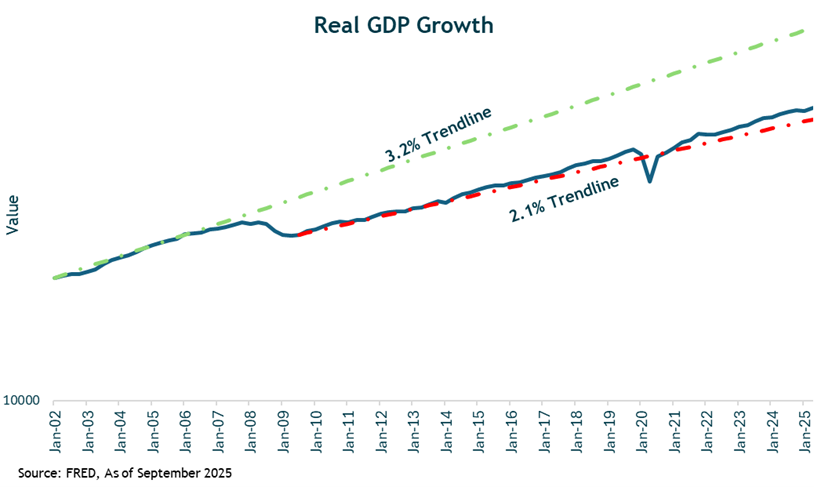
With trend growth now closer to 2.0%, the economy is less able to absorb high real rates without stalling. That means a 1.2% real rate, while modest in absolute terms, sits above neutral today and applies more restraint than the same level would have historically.
Against this backdrop, comments from Governor Miran suggesting rates should be two full percentage points lower appear disconnected from current conditions. Such a stance would only be warranted if the economy were already in a recession. Instead, we’ve posted GDP growth north of 3% and a labor market that, while slowing, remains stable. Today’s rate levels reflect a cautious but appropriate stance rather than a policy error requiring immediate correction.
Market Expectations vs. Reality
Futures markets are pricing in more aggressive cuts—four to five additional moves (to around 2.75%) through 2026. This divergence highlights the risk that if inflation remains sticky, the Fed may disappoint markets by cutting less than anticipated.
There’s also the possibility of bonds reacting counterintuitively to further easing. We saw this after the September cut when short-term yields declined modestly, but longer maturities edged higher, steepening the yield curve. Rising long-term yields likely reflect persistent inflation concerns, elevated fiscal deficits, and increased term premiums.
Credit Markets
Credit markets remain resilient, with investment-grade and high-yield spreads tightening toward cycle lows, underscoring strong fundamentals and persistent yield demand. We believe tighter-than-average spreads are warranted. Over recent years, many corporations have deleveraged, extended maturities, and improved balance sheet quality, positioning them to withstand higher rates and slower growth. By contrast, the federal government has moved in the opposite direction, taking on significantly more debt and sustaining elevated spending. This divergence highlights that corporate credit risk differs from sovereign credit dynamics, and investors appear comfortable with this distinction. While spreads may have limited room to tighten further, current levels reflect both healthy corporate fundamentals and yield demand.
Today’s environment demands flexibility, credit selectivity, and close monitoring of economic data that are shaping market expectations.
Conclusion
We enter the final quarter with both opportunity and uncertainty. Equities are supported by resilient earnings, healthy consumer demand, and a more accommodative Fed, yet valuations remain elevated and policy debates loom large. In fixed income, tight spreads reflect strong corporate fundamentals even as fiscal pressures and policy divergence create risks at the long end. Labor markets are softening but not collapsing, reinforcing that growth is slowing rather than stalling.
This is a moment for discipline. Near-term volatility and policy noise will likely continue, but fundamentals—healthy balance sheets, consumer spending, and improving equity market breadth—provide a constructive backdrop. We maintain diversified portfolios, balancing risk and opportunity, and positioning to benefit from long-term secular trends while staying alert to evolving macro and policy risks.
We thank you for your continued confidence.
Certain material in this work is proprietary to and copyrighted by Litman Gregory Analytics and is used by Argent Financial Group with permission. Reproduction or distribution of this material is prohibited, and all rights are reserved.


