

Executive Summary
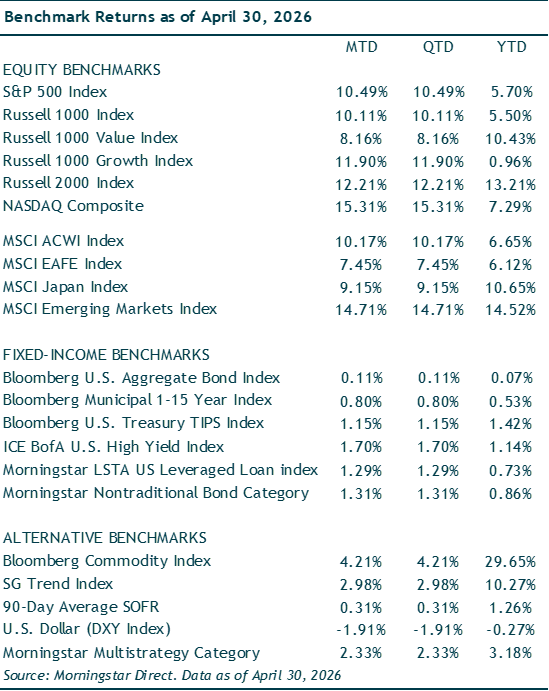
- Risk assets staged a sharp rebound in April. The S&P 500 climbed 10.5% in the month and went on to set a fresh all-time high in early May. It was the best monthly return since November 2020, and leadership rotated back toward mega-cap technology after a strong start to the first quarter earnings season.
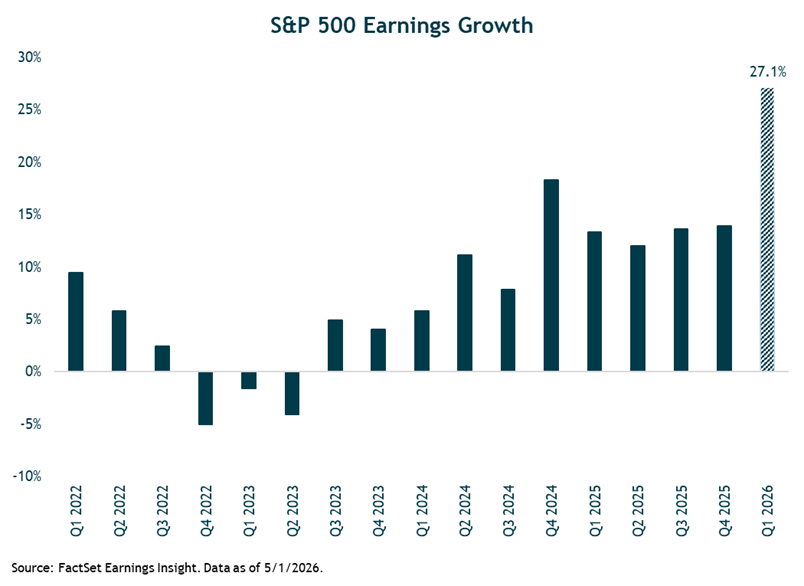
- FactSet data shows first-quarter earnings season tracking toward 27% year-over-year growth, with an even stronger result for the Magnificent 7 companies. The hyperscalers raised their combined 2026 CAPEX guidance to roughly $725 billion, reaffirming the AI investment cycle.
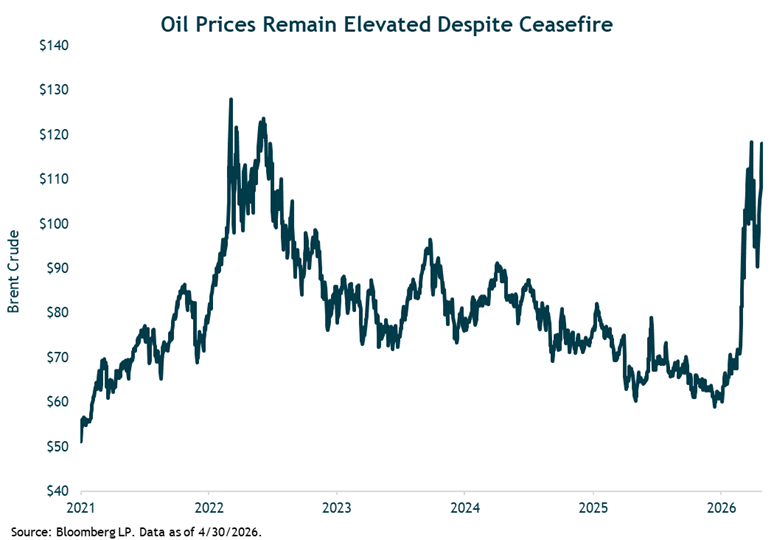
- A two-week U.S.-Iran ceasefire in early April calmed energy markets at the margin, though the Strait of Hormuz remained effectively closed for most of the month. Brent crude finished April at $114/barrel after touching $118 late in the month.
- Jerome Powell chaired his final FOMC meeting in April. The Committee held the federal funds rate at 3.5%-3.75% by an 8-4 vote, the most dissents at a meeting since 1992. Kevin Warsh cleared the Senate Banking Committee and is expected to be confirmed as the new Fed Chairman in mid-May.
Market Performance
After a difficult first quarter, U.S. equities mounted a remarkable comeback in April. The S&P 500 returned 10.5%, its strongest monthly return since November 2020, and set a new all-time high in early May. The Nasdaq Composite jumped 15.3%, its best month since April 2020, while the Russell 2000 gained 12.2%. Growth stocks reasserted leadership over value, though the broader year-to-date rotation remains intact (Russell 1000 Value is up 10.4% versus Russell 1000 Growth’s 1%).
Sector dispersion was wide during the month. Communication services (up 18.4%) and information technology (up 17.5%) led the index. Alphabet alone gained roughly 33% in April after a strong earnings report. Industrials, financials, and consumer discretionary also posted solid gains. Energy and healthcare sectors were the lone detractors, falling 3.5% and 0.5%, respectively. Oil prices retreated from peak levels even as a ceasefire calmed energy markets for the time being. The energy sector remains a clear year-to-date leader, but April is a good reminder that the energy market is trading in lockstep with any incremental geopolitical news.
International equities also participated in the rally but trailed U.S. equities. The MSCI ACWI ex-U.S. gained 9.7% in April, with emerging markets (MSCI EM, up 14.7%) outpacing developed markets (MSCI EAFE, up 7.5%). Asian tech stocks were a key driver, particularly in South Korea, where the MSCI Korea Index surged 38.2%, lifting Korean equities to more than 60% year-to-date. Samsung Electronics gained 37%, and SK Hynix gained 64.8% (in U.S. dollar terms), as memory pricing continued to benefit from AI demand.
Fixed income markets were comparatively quiet given the size of the equity move. The 10-year Treasury yield traded in a narrow range of 4.26%-4.42% before drifting toward the top end of the range following the FOMC meeting. The two-year Treasury yield finished the month at 3.88%. The Bloomberg U.S. Aggregate Bond Index posted a modest positive return of 0.1% in April. Credit markets remain remarkably calm. The ICE BofA U.S. High Yield Index option-adjusted spread closed April at 283 basis points, in the tightest decile of the past 25 years, and investment grade spreads remain near 80 basis points. Spreads narrowed throughout April, helping credit outperform. The ICE BofA U.S. High Yield index returned 1.7% in April.
Iran and Energy Markets
The conflict in the Middle East continued to dominate the market narrative in April, but with a different rhythm than in February and March. A two-week conditional ceasefire mediated by Pakistan began on April 8th and has been extended in pieces through month-end. A separate Israel-Lebanon ceasefire was extended in late April. Direct U.S.-Iran talks held in Islamabad in mid-April ended without an agreement, and President Trump canceled a planned follow-up trip later in the month.
The Strait of Hormuz remained effectively closed for most of the month. The U.S. imposed a naval blockade on Iranian ports in mid-April, while Iran continues to control transit through the strait itself. Brent crude finished April at $114/barrel after spiking to $118 late in the month on news that the U.S. would extend the blockade.
Q1 Earnings Season: Don’t Fight the Fundamentals
With nearly two-thirds of S&P 500 companies having reported, blended earnings growth for the first quarter is tracking around 27.1% according to FactSet data. At the start of earnings season, estimates called for 13.1% growth; companies are exceeding that by a wide margin, driving meaningful upward revisions to full-year estimates. S&P 500 earnings are on pace to be the sixth consecutive quarter of double-digit growth and its highest growth rate since 2021. Beat rates are running at 84% for EPS and 81% for revenue, both above the five- and ten-year averages. The breadth of contribution also looks better than it has been in some time with seven sectors currently reporting double-digit earnings growth.
The most consequential reports came from the largest technology companies last week. Alphabet beat on revenue and raised its 2026 CAPEX plan to as much as $190 billion. Microsoft also lifted its 2026 CAPEX guidance to $190 billion, including an incremental allowance for higher memory pricing. Meta raised its 2026 CAPEX estimates to $125–$145 billion. Apple, while less central to the AI capex story, beat on both lines and authorized an additional $100 billion in share repurchases. Aggregating across the hyperscalers, expected 2026 AI infrastructure spending now stands at roughly $725 billion. That is a meaningful step up from the $670 billion estimate heading into earnings season.
In our January commentary, we flagged that hyperscaler capex was bumping into questions around return on investment, with credit spreads on some of these issuers widening. April’s reports have not resolved that question; if anything, the dollar amounts continue to climb. For now, the market is reading rising capex as confirmation of demand rather than as a warning sign. Stock reactions were uneven (Meta and Microsoft both fell on their results despite beating), and we continue to think this dynamic deserves close attention.
The Fed: Powell’s Final Meeting and the Warsh Transition
Jerome Powell chaired his final FOMC meeting on April 29th before his term as Chair expires on May 15th. The Committee held the federal funds target at 3.5%-3.75% by an 8-4 vote, the most dissents at a single meeting since 1992. Governor Stephen Miran preferred a 25-basis point cut, while three other governors dissented in the other direction, preferring to remove the Committee’s easing bias language. The unusual split says a lot about how genuinely difficult the policy backdrop has become. Headline inflation is moving in the wrong direction because of energy, while the underlying economy is sending mixed signals.
The bigger headline was Powell’s announcement that he will remain on the Board of Governors after stepping down as Chair. His governor’s seat runs through early 2028, and he cited the ongoing administration probe of Federal Reserve renovations as a factor in his decision. It is a noteworthy break from recent precedent. Interestingly, it will also likely result in the removal of Stephen Miran, who was appointed on a temporary basis. With Powell retaining a permanent seat and the likely addition of Kevin Warsh as the new Chairman, there is no longer room for Miran on the FOMC.
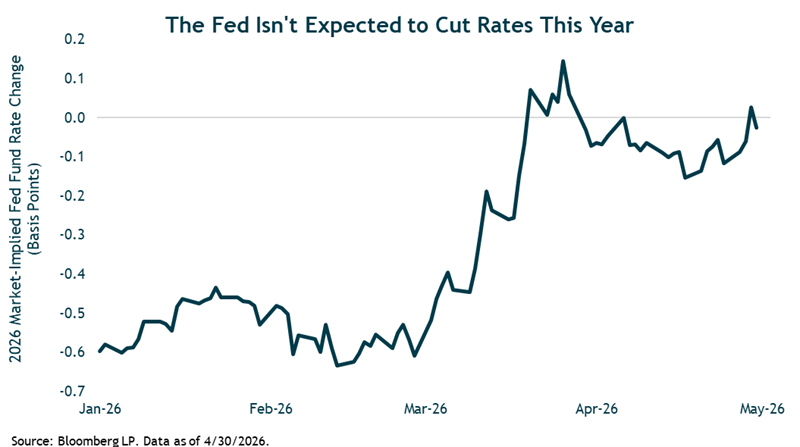
Kevin Warsh cleared the Senate Banking Committee along party lines (13–11 vote) and is expected to be confirmed by the full Senate in the coming weeks. Assuming confirmation, Warsh will preside over his first FOMC meeting in June, which will also feature an updated Summary of Economic Projections. The handoff comes at an awkward moment for monetary policy. Markets entered the April meeting pricing essentially zero rate cuts in 2026 and remain essentially unchanged. We continue to think the bar for hikes is high in this environment, and that policy will likely remain on hold until the inflation impact of higher energy and tariffs becomes clearer.
Investment Implications
Equity markets are once again at all-time highs despite an effectively closed Strait of Hormuz, oil at $114/barrel, the most divided FOMC vote in over thirty years, and a forward P/E above 20x. The earnings story has been strong enough, and the AI capex commitments large enough, to overwhelm what looked like a mounting set of macro headwinds at the end of March. We have noted in previous commentaries that geopolitical events rarely cause bear markets in isolation. April provided another illustration of that dynamic.
That said, we are cautious about adding risk at this time. Valuations are no longer cheap on any reasonable measure. The forward P/E ratio remains elevated, a level only seen at two other peaks (dot-com and post-COVID). Credit spreads sit in the tightest decile of the past 25 years across both investment grade and high yield, leaving little compensation for incremental credit risk. The dispersion of forward-looking paths from here is unusually wide. A peaceful resumption of oil flows through Hormuz, a quick Warsh confirmation, and continued earnings momentum could plausibly take the index higher into the summer. A re-escalation of the conflict in the Middle East, a CPI print that ratchets higher again, or any softening in the AI capex narrative could reverse a meaningful portion of April’s gains in short order.
Our positioning continues to favor diversification across regions, market caps, and styles. We continue to like the broadening earnings story we wrote about in January, the higher starting yields available in fixed income, and the offsetting characteristics within alternatives. We remain alert to the inflation picture, the labor market, and the Iran situation. We view periods of volatility as opportunities rather than reasons to retrench.
Certain material in this work is proprietary to and copyrighted by Litman Gregory Analytics and is used by Argent Financial Group with permission. Reproduction or distribution of this material is prohibited, and all rights are reserved.


