

Market Overview
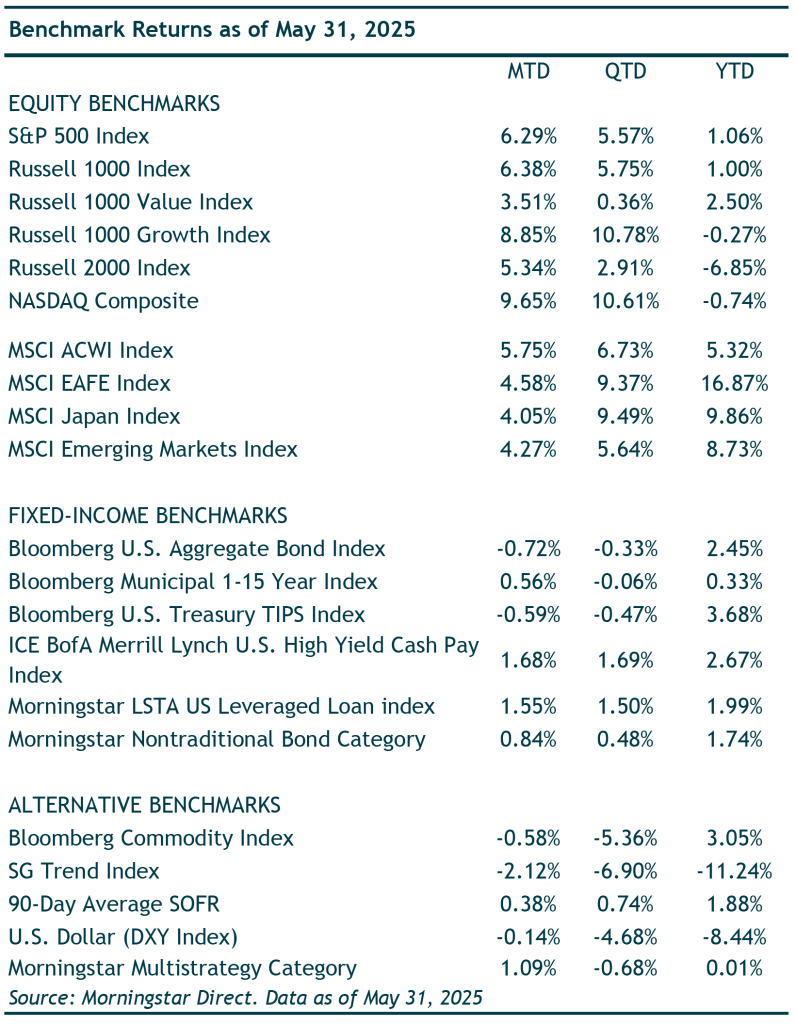
U.S. equity markets rebounded strongly in May, with the S&P 500 gaining 6.3%—its strongest May since 1990—and the Nasdaq advancing 9.6% driven by AI leaders like Nvidia. However, markets lost momentum in the final two weeks, trading sideways near 6,000 amid investor uncertainty.
Bond markets faced pressure from fiscal concerns surrounding Trump’s proposed “One Big Beautiful Bill” tax and spending package, which raised deficit worries. The 10-year Treasury yield rose from 4.17% to 4.41%, while the 30-year reached 5.1%—its highest since 2023.
On May 16, Moody’s downgraded the U.S. credit rating from Aaa to Aa1, citing the $36 trillion debt load and unsustainable fiscal path. The agency warned deficits could widen to 9% of GDP by 2035, driven by rising interest costs and entitlement spending. This aligns Moody’s with S&P and Fitch’s previous downgrades, though we expect minimal material investment impact.
Economic Data
Economic indicators reflect stability without strength. The labor market remains resilient, with 4.2% unemployment and wage growth outpacing inflation for 24 consecutive months. Core PCE inflation eased to 2.5% year-over-year in April, down from March’s 2.7%, though it remains above the Fed’s 2% target. Services inflation—particularly healthcare and housing—continues driving elevated readings.
Trade policy developments injected volatility, as conflicting court rulings emerged on Trump’s tariffs, and tensions with China resurfaced. Markets have become highly reactive to political developments over economic fundamentals.
The Federal Reserve remains on pause despite political pressure to cut rates. Market pricing implies just over two cuts (50 basis points) by year-end, bringing the Fed Funds rate to 3.75-4.00%.
Outlook
We remain cautious going forward. May’s rally appears sentiment-driven rather than fundamentally supported. With mounting fiscal concerns, resurfacing trade tensions, and potentially bottoming inflation, markets could face continued volatility as investors seek clarity on policy direction.
Investment Implications
In today’s policy-driven environment, diversification remains crucial for managing risk. Our equity positioning, while overweight domestically, maintains a broad global diversification. In fixed income, we maintain a shorter duration than benchmarks to reduce interest rate sensitivity while achieving attractive yields. Where appropriate, we continue to recommend private investments, with a particular emphasis on private equity secondaries and private credit, which offer compelling risk-adjusted return potential in the current environment.
Disciplined diversification and prudent portfolio construction are essential as we navigate this evolving landscape. Staying flexible will be key to managing investment strategies effectively moving forward.
Certain material in this work is proprietary to and copyrighted by Litman Gregory Analytics and is used by Argent Financial Group with permission. Reproduction or distribution of this material is prohibited, and all rights are reserved.


