

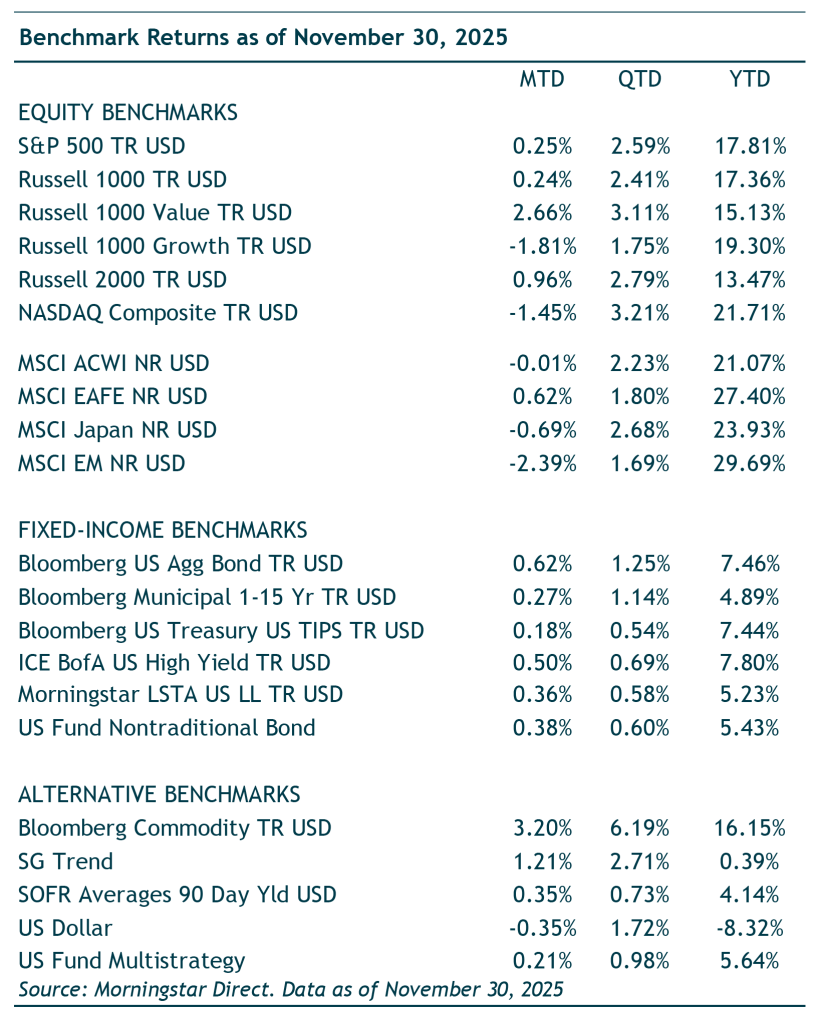
The rally in risk assets stalled in November as equity markets experienced their largest drawdown since April. Bubble concerns around AI investment and a repricing of December rate-cut expectations were the key drivers behind the retracement. Despite this volatility, global equities finished the month essentially flat.
Market Overview
The S&P 500 posted a modest 0.2% gain in November, bringing its year-to-date return to 17.8%. After reaching an all-time high in late October, the index declined over 5% before recovering most losses in the final week of the month. Concerns around AI-related valuations and ongoing spending pressured growth stocks, resulting in the Russell 1000 Growth Index falling 1.8%. Value stocks (Russell 1000 Value) outperformed with a 2.7% return, while small-cap stocks (Russell 2000 Index) returned nearly 1%, faring relatively better than their large-cap counterparts.
Foreign developed stocks (MSCI EAFE Index) gained 0.6% in the month, modestly ahead of domestic equities. Emerging market stocks (MSCI EM Index) declined 2.4% in November. The U.S. dollar has remained range-bound since summer, having minimal impact on international returns in recent months. The majority of year-to-date outperformance for international stocks occurred during the large dollar decline at the start of the year leading into Liberation Day.
Fixed Income
Investment-grade core bonds (Bloomberg US Aggregate Bond Index) rose 0.6% in November as the 10-year Treasury yield drifted lower toward 4%. Lower-quality high-yield bonds (ICE BofA US High-Yield Index) gained 0.5%. Despite equity market volatility, credit spreads remain historically tight, suggesting bond markets don’t anticipate a recession on the horizon. These tight spreads leave coupons as the main driver of credit returns going forward.
Fed Watching
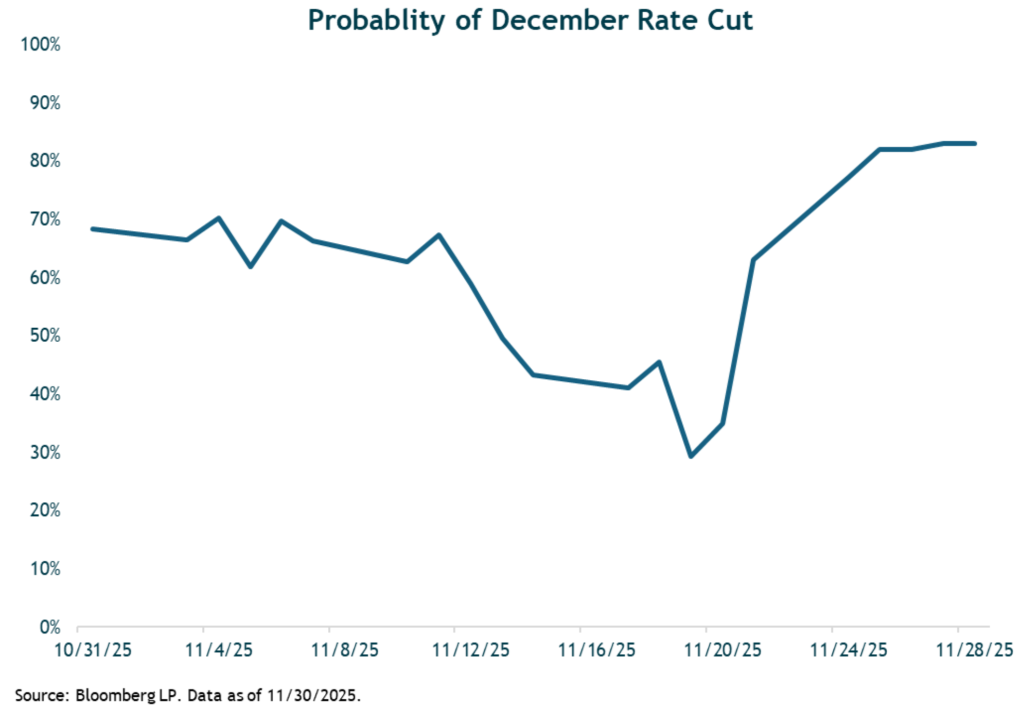
Expectations around a December rate cut shifted meaningfully throughout November. Immediately following the Fed’s 25 basis point rate cut in late October, markets priced in a two-thirds probability of a year-end cut. However, those odds fell below 30% following hawkish Fed commentary and the release of October Fed meeting minutes, which revealed a sharply divided committee. Some members supported additional cuts while others advocated holding rates steady amid higher-than-target inflation. Ultimately, dovish comments, a cooling labor market, and deteriorating consumer sentiment changed the narrative late in the month. A 25-basis- point rate cut in December is now highly likely, with markets pricing in nearly 90% probability.
Labor Market Dynamics
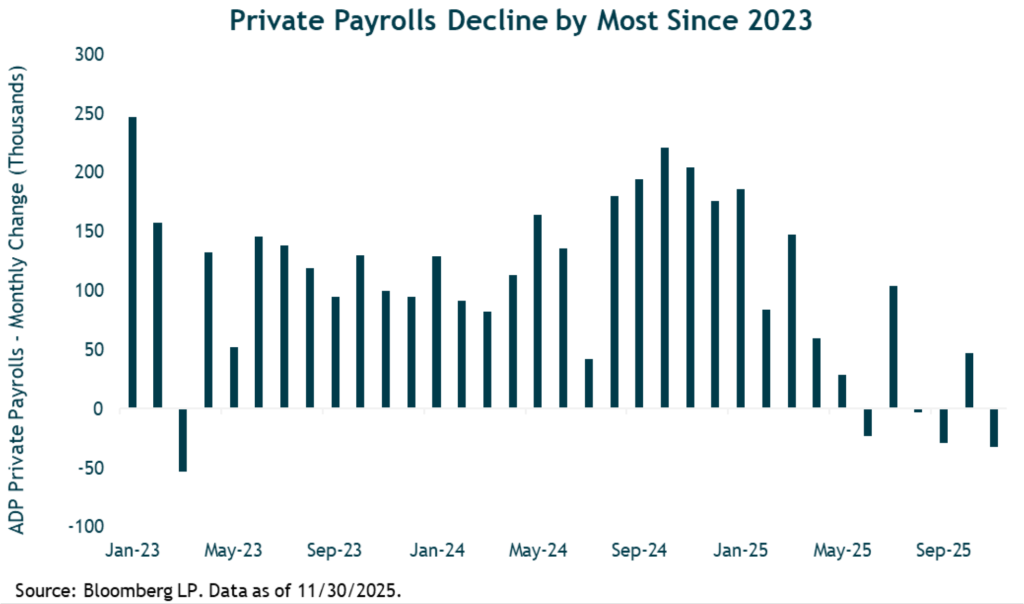
The labor market continues to send mixed signals. While October data will likely be omitted from historical records due to the government shutdown, the unemployment rate continued to climb in September, reaching nearly a four-year high of 4.4%. ADP jobless claims suggest hiring remains at somewhat of a standstill. Private employment in the U.S. has shown losses in four of the last six months, with only July and October posting payroll gains dating back to summer. Labor market data appears to support further easing from the Fed despite an inflation rate currently above its long-term 2% target.
Third Quarter Earnings Season Wrap-Up
Earnings season for S&P 500 companies has nearly concluded with 96% of companies having reported. Earnings continued their robust trend, with trailing 12-month GAAP earnings jumping 17.5% year-over-year, marking the third consecutive quarter of double-digit growth. A solid 81% of S&P 500 companies beat earnings expectations, exceeding the average beat rate of approximately 75% over the past decade.
According to FactSet data, the S&P 500 is expected to report its highest sales growth rate in three years at 8.4% year-over-year for the third quarter. All GICS sectors posted positive sales growth.
Looking forward, earnings growth estimates project mid-teens growth for 2026. While these estimates will likely be revised downward throughout next year, current market valuations require strong earnings growth to achieve double-digit returns. Overall, corporate America remains healthy despite an uncertain macroeconomic and geopolitical environment, with revenue growth continuing its positive trend, margins expanding to all-time highs, and profitability remaining healthy.
Concluding Comments
The economic backdrop remains complicated, but the U.S. economy continues to demonstrate resilience in absorbing shocks. While policy direction remains in flux, global tensions linger, and certain market segments appear overly enthusiastic, the broader economy has proven steady. Corporate results have generally been solid, the labor market—while cooling—has not frozen over, and the Federal Reserve has begun cutting rates after a multi-year pause. Taken together, these elements point to a slowdown rather than a slide into recession. Historically, a Fed easing cycle that doesn’t coincide with a recession serves as a tailwind for risk assets.
We continue to believe the current climate calls for a balanced approach. Positive factors include strong corporate fundamentals, continued capital expenditures, easier monetary policy, and fiscal support from the One Big Beautiful Bill. However, these must be weighed against geopolitical uncertainty, historically high valuations, and narrow market leadership concentrated in a handful of companies. Given the optimism currently priced into assets, we maintain our measured and diversified stance, avoiding excessive positioning in either direction. As always, we continue assessing the market environment for opportunities to capitalize on emerging trends.
Certain material in this work is proprietary to and copyrighted by Litman Gregory Analytics and is used by Argent Financial Group with permission. Reproduction or distribution of this material is prohibited, and all rights are reserved.


