

Market Commentary
July proved to be an eventful month for markets as investors weighed encouraging economic data against lingering uncertainties. The S&P 500 reached an all-time high during the month, buoyed by strong earnings reports—particularly from large technology companies—and growing confidence that the U.S. economy might sidestep a recession. Signs of resilient consumer spending and a healthy labor market supported this optimism. Additionally, inflation readings came in below expectations, though levels remain above the Federal Reserve’s long-term target. These positive developments, however, intensified speculation about how long the Fed may need to maintain elevated interest rates.
Trade policy remained a focal point, though investors appeared increasingly desensitized to related headlines. Late in July, the U.S. reached new trade agreements with both Japan and the European Union. Meanwhile, a critical deadline in U.S.–China trade relations was extended, as both nations agreed to prolong their current tariff pause for another 90 days. Markets interpreted these developments as constructive steps toward greater stability in global trade relationship
Equity Performance
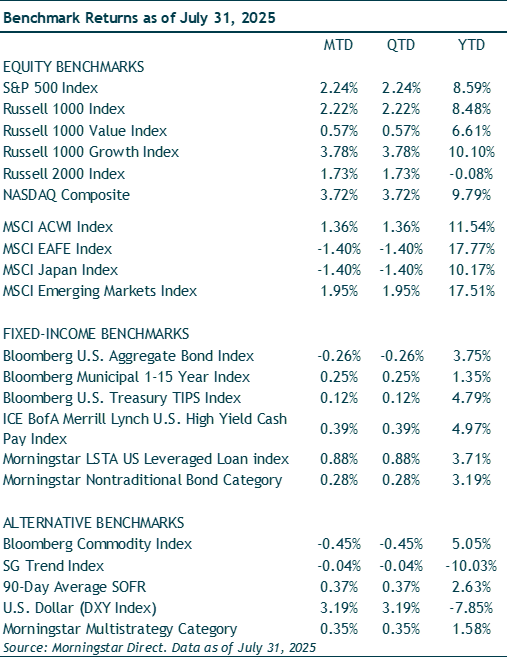
The S&P 500 advanced 2.2% in July, driven by continued earnings strength in the technology and communication services sectors. Year-to-date, the index has gained 8.59%. The Nasdaq delivered an even stronger 3.7% return for the month, supported by persistent optimism around AI-driven productivity gains and corporate infrastructure investment. Small-cap stocks also participated in the rally, rising 1.7% in July.
International markets presented a mixed picture. Developed international stocks retreated 1.4% in July, though they remain solidly positive with a 17.77% year-to-date return. Emerging market stocks posted a 1.9% gain for the month and are up 17.5% year-to-date through July.
Fixed Income Markets
Within fixed income, rates remained volatile and range-bound, as we had anticipated. The 10-year Treasury yield began July at 4.24% and closed slightly higher at 4.37%. Investment-grade core bonds declined 0.3% for the month, while lower-quality high-yield bonds posted a modest 0.4% gain.
Economic Environment: Three Key Themes
1| Trade Policy and Tariff Impact
Late July brought significant trade developments with new agreements reached with Japan and the European Union, providing welcome clarity after months of uncertainty. Both deals establish a 15% base tariff on most imports—up from the previous 10% but well below earlier threats of 25% or higher.
Trade Agreement Highlights:
- Japan: Reduced tariffs on U.S. autos and industrial goods, plus $550 billion in U.S. investment commitments.
- European Union: $600 billion investment pledge through 2028, focusing on energy and defense sectors.
- U.S.-China and Mexico: Existing agreements extended 90 days to allow for further negotiations.
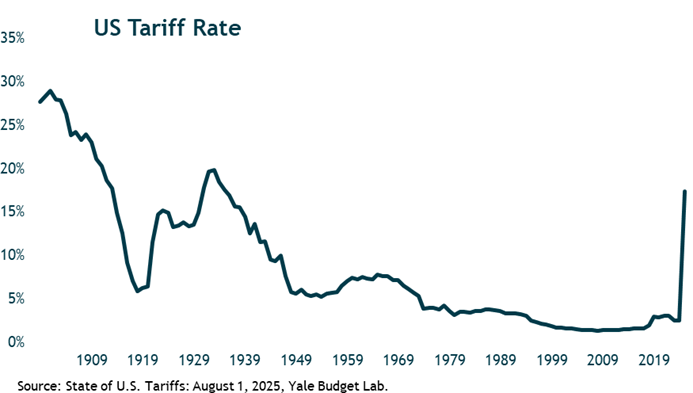
Tariff levels have surged from approximately 2% at the start of the year to 15-20% currently—a sharp, broad-based increase that functions as a tax on businesses and consumers. While some foreign suppliers are absorbing portions of these costs, the full pass-through impact remains uncertain.
Inflation Outlook: We expect tariffs to lift core inflation from the current 2.67% to potentially low-3% levels by year-end, as these costs filter through the economy over coming months.
2| Labor Market Dynamics
The labor market continues providing economic stability through July, though with mixed signals. Unemployment remains in the low-4% range over the past 12 months, with layoffs staying low despite softer hiring conditions. Wage growth has outpaced inflation for 26 consecutive months.
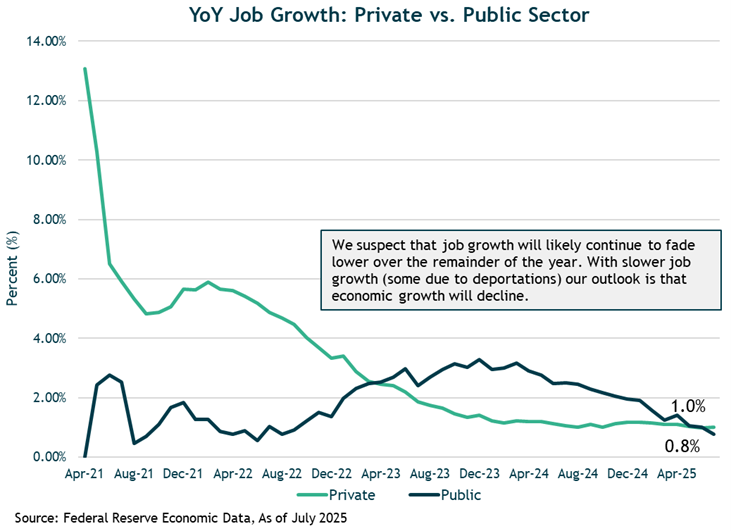
However, private sector job growth has decelerated sharply, hovering around just 1% year-over-year—levels suggesting only modest economic expansion ahead. We expect unemployment to rise gradually but avoid spiking.
3| Federal Reserve Policy
The Federal Reserve finds itself caught in an increasingly delicate balancing act. With inflation still elevated and emerging warning signs in the labor market, the central bank faces pressure on both sides of its dual mandate. While policymakers held rates steady at 4.25%–4.50% as expected, the dissent from two governors—the first such occurrence since 1993—signals growing internal pressure to act. Chair Powell’s shift in language, describing economic activity as having “moderated” rather than proceeding at a “solid pace,” hints that a September rate cut has moved from possibility to probability.
Currency and Consumer Trends
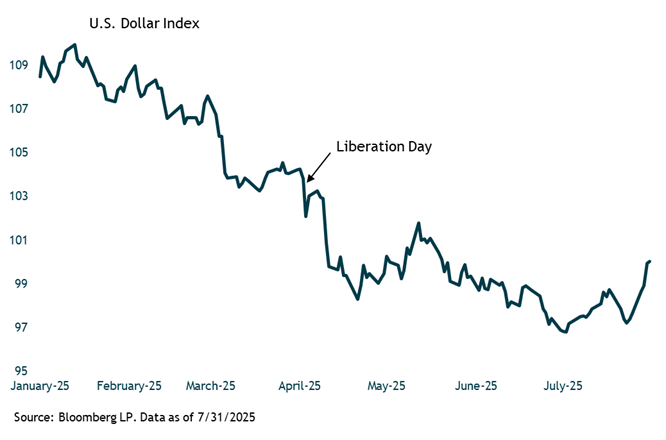
After declining over 10% in the first half of 2025, the U.S. dollar rebounded 3.2% in July despite intensifying tariff headlines. The dollar’s strength reflects higher relative interest rates and its safe-haven status during periods of uncertainty.
Consumer spending has held up despite some weakening in non-essential categories. Supporting factors include higher net worth from record-high financial assets (brokerage accounts, 401(k)s) and rising real estate values.
Investment Implications
Equity Markets: Despite macro uncertainty, markets continue reaching new highs, though valuations offer little cushion for disappointment. Recent gains remain concentrated in AI-driven technology sectors, while tariff-exposed industries remain under pressure. Small-cap stocks (Russell 2000) have not achieved a new high since November 2021, creating a 936-day drought that ranks as the third-longest in the index’s history. This divergence between large and small caps often signals that a cyclical bull market may not be as robust as headline indices suggest.
Fixed Income: Credit spreads remain tight, but yields are relatively attractive, particularly in non-traditional bond market segments. Our focus emphasizes high-quality instruments delivering attractive income without excessive credit or duration risk, maintaining discipline while monitoring for future opportunities.
Outlook
All told, the August 2025 landscape invites neither complacency nor panic. The base case remains one of slow but positive U.S. economic growth, modest inflation, and a likely Fed rate cut soon—conditions favorable to equities, especially large-cap growth, and select fixed income strategies. However, the narrowness of market leadership, long-running divergences in small caps, wobbly global momentum, and the ever-present threat of economic shocks argue for a disciplined, risk-managed approach.
Certain material in this work is proprietary to and copyrighted by Litman Gregory Analytics and is used by Argent Financial Group with permission. Reproduction or distribution of this material is prohibited, and all rights are reserved.


