

The Month At-A-Glance
• Global equities rose 1.6% during July, with developed international markets leading the way.
• Under the hood, a sharp rotation out of U.S. mega- cap growth stocks into smaller-cap and value stocks occurred in the second half of the month.
• The Federal Reserve held rates steady at their July meeting but set the stage for a cut in September.
• Longer-term rates steadily declined throughout the month—the key 10-year rate has fallen nearly 100 basis points from its high earlier in the year.
• An attempted assassination of former president Donald Trump and a new Democratic presidential nominee heightened political uncertainty.
Market Recap
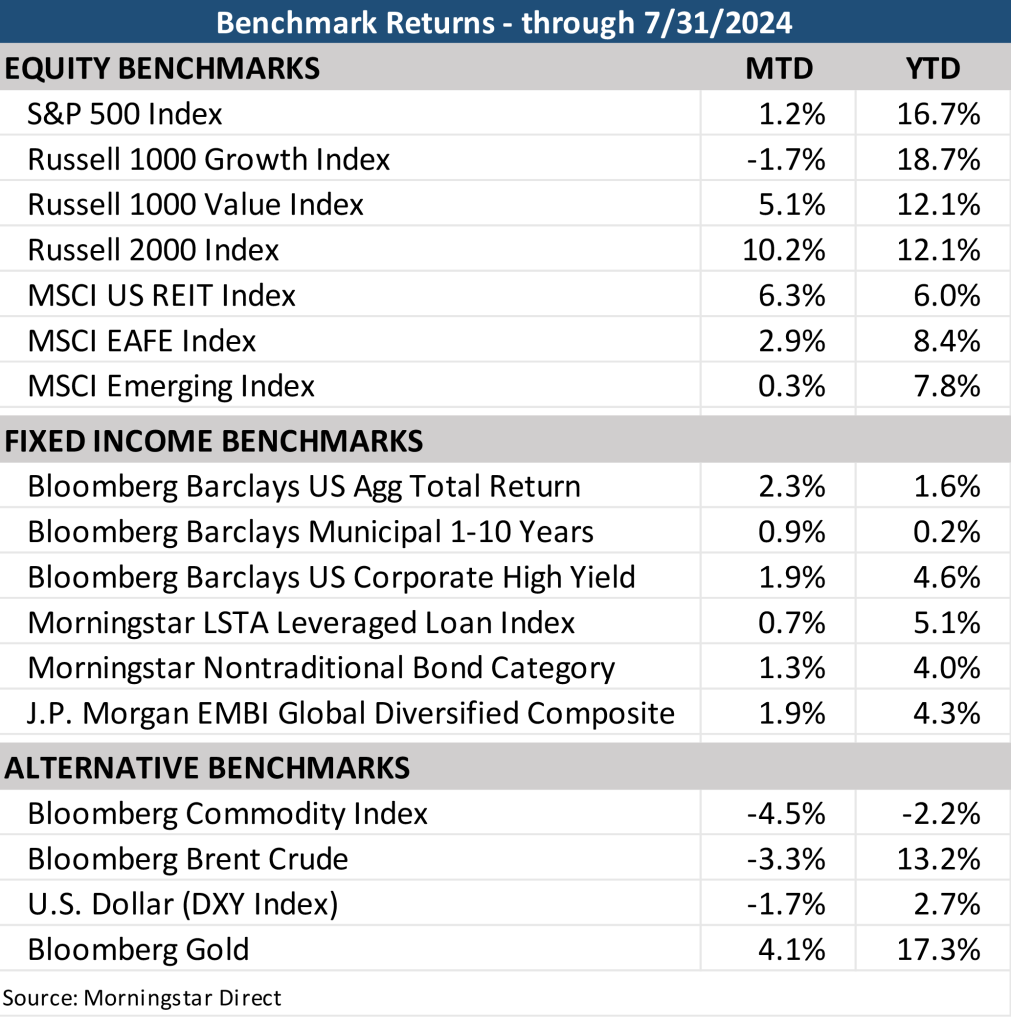
Stock markets hit record highs during the middle of the month. The S&P 500 climbed to a record high on July 16th of 5,667. Volatility then spiked, and the S&P 500 fell by 8.5% since that high point (through 8/5/2024). For the full month, the S&P 500 returned 1.2% and remains up a solid 16.7% on the year.
A weaker dollar, particularly against the Japanese yen, helped developed international equities outperform. The MSCI EAFE gained 2.9% in dollar terms and 0.8% in local currency. The yen appreciated nearly 7% versus the U.S. dollar during July. Emerging market stocks trailed with a return of 0.3%. Weakness in Chinese equities persisted in July.
The headline-grabbing market event in July had to do with the rotation out of U.S. mega-cap growth stocks into cheaper, smaller-cap stocks. As a proxy for the rotation, the Russell 1000 Growth Index fell 1.7% compared to the Russell 2000 Value Index, which gained 12.2%. It was the 3rd best relative month for small-cap value stocks versus large-cap growth stocks since the index inception in 1979 and the best since the tech bubble bust of the early 2000s.
Nine of 11 sectors within the S&P 500 were positive in the month. Only the communication services (down 4%) and technology (down 2.1%) sectors were in the red. However, these two sectors make up over 40% of the S&P 500 and have had a disproportionate impact on index returns in recent years.
The 10-Year U.S. Treasury bond yield continued to fall during the month as investors look forward to September rate cuts. Yields also dropped later in July as investors worried that economic data was softening faster than expected and that a recession may be on the horizon. The 10-year rate closed the month at 4.09% but fell further towards 3.8% in the early days of August. Falling rates help core bonds post their third straight positive month. The Bloomberg US Aggregate Bond index gained 2.3% in July.
Update on Current Thinking
In light of the market’s volatility, we want to share our current view. The market’s sharp decline seems to have been prompted by last Friday’s weaker-than-expected job report, which the market seemed to interpret as a clear sign that the Fed has waited too long to lower rates and that the U.S. economy is heading for a recession. At last week’s Fed meeting, the FOMC left the Fed Fund’s rate unchanged in a range of 5.25%-5.5%, and the subsequent jobs report fell short of expectations. Unemployment rose to 4.3%, a three-year high, with only 114,000 jobs being added in July, compared to the 175,000 that economists estimated. Job gains from the prior two months were also revised lower. July’s unemployment rate received extra attention because it triggered the Sahm Rule. This popular recession indicator states that the economy is either in or close to a recession when the unemployment rate increases 0.5% above the minimum three-month average over the previous 12 months. We should be cautious when drawing conclusions on the direction of the economy based on data from one month.
While we acknowledge some weakness in the jobs market, we are not yet shifting our outlook, and we are not ruling out the possibility of a “soft landing.” In our second quarter commentary, we pointed out some risks, including the high level of rates and cracks in the labor market. And with the Fed continuing to keep rates high, they are walking a fine line between risking economic weakness and fighting inflation. Our view has been that near-term inflation has been under control and that we’re likely to continue seeing the CPI decline over the remainder of the year. Looking ahead to the last few months of the year, it appears that the Fed will be cutting rates, the only questions are the timing and magnitude of cuts. Meanwhile, the economy is continuing to grow, albeit slower than the last two years, and corporate earnings are expected to finish the second quarter at a healthy 11% year-over-year rate.
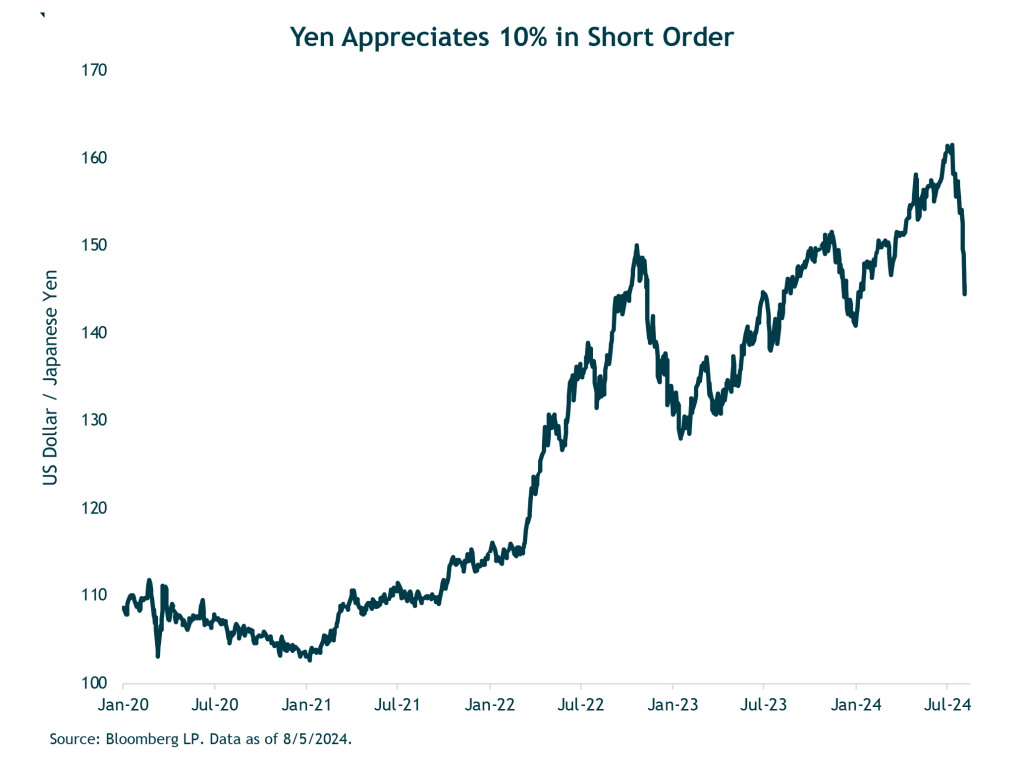
In addition to weaker jobs data and a disappointing Manufacturing ISM number on August 1st, we clearly also have to highlight the technical unwind of the Japanese Yen carry trade as another catalyst for recent losses on risky assets. For years, negative policy rates by the Bank of Japan encouraged investors (both Japanese investors and hedge funds) to borrow at low Japanese rates to purchase higher-returning assets overseas. The carry trade really started to gain momentum in 2022 as the Fed increased rates and the Bank of Japan kept their policy rate in negative territory. This pushed the US dollar/Yen rate to 161—seeing the Yen lose nearly 40% of its value versus the dollar since the start of 2022. Last week, the Bank of Japan increased its policy rate to 0.25% while at the same time, the Fed signaled cuts in upcoming meetings. The Yen has quickly appreciated 10% as investors repatriated assets back into Japan as policy rates converge. Increasing geopolitical tensions in the Middle East also placed a strong bid for the Yen. Japanese equities, as well as long positions on the Australian dollar or Mexican peso, have been the most affected by brutal capitulation, that have spread to other asset classes, especially those which has so far benefited from strong momentum.
Corrections are normal, and the recent volatility seems to us to be quite a strong reaction to one month of data. We have been observing a lot of volatility this year following the release of economic data points. Recall that at the beginning of the year, the Fed Funds market anticipated up to seven rate cuts, then went to almost no cuts, and now is expecting a rate at least 100 basis points lower at the end of 2024 with a close to 100% probability of a 50 basis point cut in September. We expect there will be more ups and downs in the main financial parameters in the coming months as the market attempts to forecast the outcome.
The current take on the recent volatility is that we have not yet seen sufficient evidence to shift our view of the economy, but we continue to keep a close eye on economic data and for opportunities that present themselves in the market.
Certain material in this work is proprietary to and copyrighted by Litman Gregory Analytics and is used by Argent Financial Group with permission. Reproduction or distribution of this material is prohibited, and all rights are reserved.

