


BY: Tom Stringfellow, CFA®, CPA®, CFP®
Chief Investment Strategist
MARKETS ARE PRICING RESOLUTION
Key Themes This Month
- Markets looked beyond the headlines. While investors focused on AI, geopolitics, and the Fed, market breadth quietly improved as leadership expanded beyond mega-cap technology into smaller companies and economically sensitive sectors, signaling a healthier market foundation.
- The next investment cycle is becoming an infrastructure story. Artificial intelligence is no longer just a software revolution—it is driving unprecedented investment in electricity, data centers, semiconductors, manufacturing, engineering, and energy, creating opportunities well beyond the technology sector.
- Credit markets continue to support expansion, not recession. Stable high-yield credit spreads, resilient economic growth, and improving manufacturing activity suggest the bond market is confirming moderation rather than signaling an imminent economic downturn.
- Consumer sentiment and economic reality remain disconnected. Confidence remains historically subdued, yet employment, spending, and overall economic activity continue to demonstrate resilience, highlighting the importance of distinguishing perception from underlying fundamentals.
- Successful investing requires identifying structural change before it becomes consensus. June’s central lesson is that capital is already migrating toward the physical foundation of the digital economy, and understanding where that capital is flowing may prove more valuable than reacting to tomorrow’s headlines.
The Quiet Reallocation of Capital
Some months answer old questions. Others quietly introduce entirely new ones. Financial markets spent much of June reacting to familiar headlines.
Artificial intelligence remained the dominant market narrative. Geopolitical tensions influenced commodity markets, and investors continued to debate the Federal Reserve’s next move. Individually, each story appeared important. Collectively, however, they masked a far more significant development quietly unfolding beneath the surface.
The defining characteristic of June was not a single economic report or market event. It was the continued migration of capital toward building the physical foundation required to support the next generation of economic growth. Electricity, transmission, manufacturing, engineering, semiconductors, natural gas, and data centers are increasingly becoming as important to investors as the software innovations they support.
The market itself quietly confirmed that transition. Through June 29, the S&P 500 gained 8.7%, while the Russell 2000 advanced 21.5% and the Equal Weight S&P 500 rose 11.2%. That broadening extended well beyond technology, as investors increasingly allocated capital toward utilities, industrials, financials, energy, and other sectors positioned to benefit from expanding infrastructure investment and improving economic activity.
At the same time, credit markets remained constructive, economic growth continued to expand, and manufacturing returned to expansion, despite consumer sentiment remaining historically subdued.
June reminds us that markets rarely wait for consensus. By the time the narrative becomes obvious, capital has often already begun moving. Understanding where capital is flowing—and, equally important, why it is flowing there—remains one of the most valuable disciplines available to long-term investors.
LOOKING BENEATH THE SURFACE
The Headlines Told One Story. The Market Told Another.
One of the more encouraging developments during June received surprisingly little attention. While investors focused on artificial intelligence, Federal Reserve policy, and geopolitical developments, the market itself was quietly becoming healthier. The evidence was found not in the major indexes alone, but in the expanding participation occurring beneath the surface.
Through June 29, the S&P 500 gained 8.7% year-to-date while the Nasdaq Composite advanced 11.1%. Those returns were impressive, but they only told part of the story. More revealing was the performance of the broader market. The Russell 2000 climbed 21.5%, and the Equal Weight S&P 500 gained 11.2%, indicating that investors were increasingly looking beyond the handful of mega-cap companies that have dominated returns over the past several years.
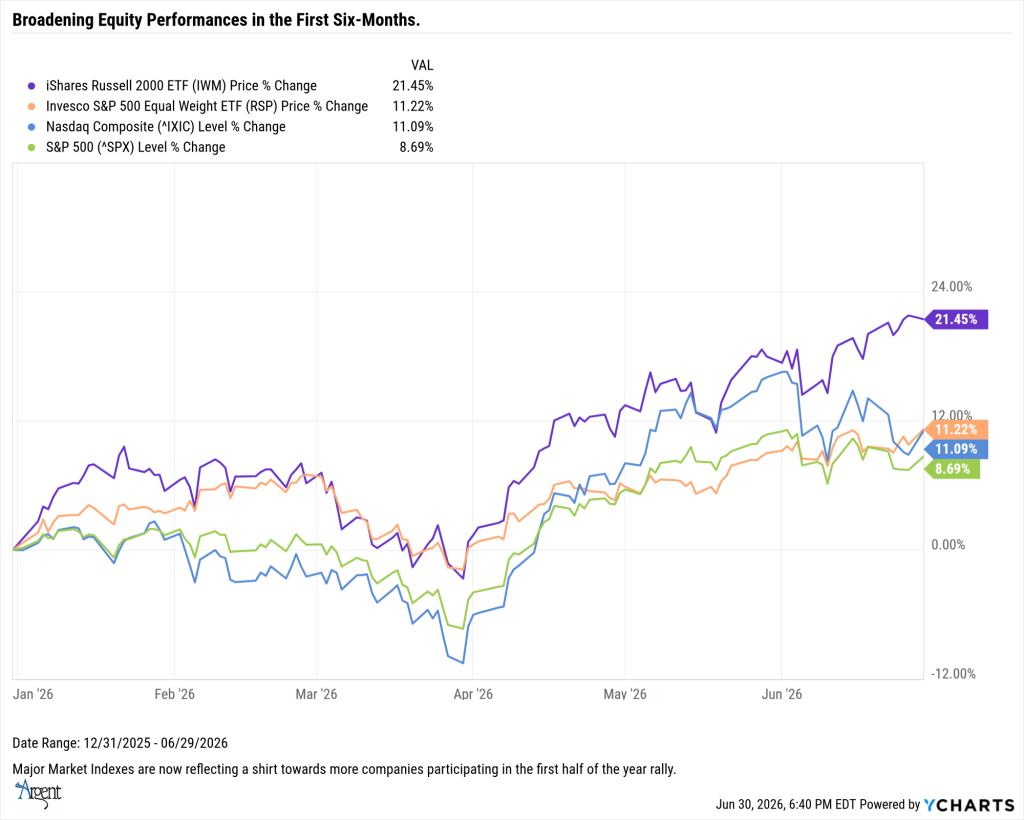
This broadening of participation is an important characteristic of healthy markets. Early in a bull market, leadership is often concentrated among companies with the strongest earnings momentum and the greatest investor enthusiasm. As confidence expands, capital begins migrating into industries that benefit from improving economic conditions and longer-term investment cycles. That appears to be exactly what developed during June.
The underlying economic data support this interpretation. The Atlanta Federal Reserve’s GDPNow model estimates second-quarter economic growth at approximately 2.5%, indicating continued economic expansion rather than recession. Manufacturing has quietly returned to expansion, with the June Flash Manufacturing PMI rising to 55.7, while the Services PMI remained positive at 51.3. These are not the characteristics of an economy preparing for contraction.
Perhaps equally important, the bond market has yet to validate many of the recession concerns frequently expressed in financial headlines. High-yield corporate bond spreads remain near 2.83%, suggesting credit investors continue to view corporate balance sheets and financing conditions as fundamentally healthy. Historically, credit markets have often identified deteriorating economic conditions before equity markets. At present, they continue to support a more constructive outlook.
Markets rarely move because today’s headlines become more interesting. They move because investors collectively begin discounting tomorrow’s opportunities. June offered another reminder that meaningful changes often begin quietly, long before they become conventional wisdom.
THE PHYSICAL ECONOMY RETURNS
Artificial Intelligence Has Become an Infrastructure Story
Every major technological revolution eventually extends beyond innovation and into infrastructure. Railroads required steel and financing. Electrification required utilities and transmission networks. The internet required fiber optics, telecommunications, and data centers. Artificial intelligence is proving no different.
While much of the public conversation continues to focus on increasingly capable AI models and software applications, investors are beginning to recognize that the next phase of this transformation will be defined by the physical assets required to support it. The opportunity has expanded well beyond technology companies themselves. It now encompasses the industries responsible for generating power, manufacturing semiconductors, constructing data centers, expanding electric transmission, engineering new facilities, and financing one of the largest capital- investment cycles in decades.
The magnitude of this buildout is difficult to overstate. Every new generation of AI models demands exponentially greater computing power. Those processors require sophisticated semiconductor fabrication, enormous quantities of electricity, advanced cooling systems, high-capacity networking equipment, and purpose-built facilities capable of operating around the clock. The digital economy is increasingly dependent upon very tangible assets.
Commodity markets offer an important window into this transition. Copper, often referred to as the metal of electrification, ended in June near $6.13 per pound. While below recent highs, prices remain historically elevated, reflecting sustained demand from electric transmission, semiconductor manufacturing, renewable energy, and data-center construction. Gold closed the month near $4,089 per ounce and remains elevated despite recent consolidation as investors continue to hedge against geopolitical uncertainty, fiscal imbalances, and long-term inflation risks.
Energy markets are sending a similarly nuanced message. Following the geopolitical volatility earlier in the month, crude oil prices have largely normalized, with WTI crude trading near $79 per barrel. Rather than reflecting immediate supply concerns, oil has resumed behaving primarily as an economic indicator. Meanwhile, natural gas has quietly emerged as one of the strategic fuels supporting the expansion of electric generation needed to power hyperscale computing facilities and the nation’s growing energy demands.
This changing investment landscape extends well beyond commodities. Utilities are planning significant capacity expansions. Industrial companies are experiencing increasing demand for engineering services, automation, and electrical equipment. Construction firms, equipment manufacturers, and specialized technology suppliers all stand to benefit from a capital-spending cycle that may extend well beyond the current business cycle.
The implications for investors are significant. For much of the past decade, technology leadership was concentrated within companies developing software platforms and digital services. Increasingly, however, investment opportunities are emerging across businesses supplying the physical foundation upon which those technologies depend. The market is gradually recognizing that building the future often proves just as profitable as inventing it.
History suggests that transformative technologies rarely create only one class of winners. More often, they generate broad ecosystems of companies providing the infrastructure, financing, materials, and services necessary to sustain long-term growth. Artificial intelligence appears well on its way to following that same pattern.
For investors, that distinction may prove to be one of the most important lessons of 2026. The question is no longer whether artificial intelligence will reshape the economy. The more relevant question is where capital will continue flowing as that transformation accelerates.
CREDIT, CONSUMERS & CONFIDENCE
Listening to the Economy’s Quietest Messengers
Equity markets often receive the greatest attention, but some of the most valuable economic signals originate elsewhere. Credit markets, consumer behavior, and confidence surveys frequently reveal changes in economic conditions well before they become evident in corporate earnings or headline market performance. During June, these indicators collectively painted a picture that was more balanced—and more encouraging—than many investors may have expected.
Credit markets remain one of our preferred leading indicators because they directly reflect investors’ willingness to extend capital. Companies borrow before they invest, expand, hire, or acquire. When lenders become increasingly concerned about future economic conditions, credit spreads typically widen well before equity markets fully recognize the risks. Today, that warning signal has yet to appear.
The ICE BofA High Yield Option-Adjusted Spread ended in June near 2.83%, remaining well below levels historically associated with recessionary environments. Corporate borrowers continue to enjoy access to capital markets, financing remains available, and credit investors have not materially increased the premium demanded for assuming additional risk. While this does not eliminate the possibility of slower economic growth, it suggests that credit markets continue to view the underlying economy as fundamentally resilient.
Economic growth supports that assessment. The Atlanta Federal Reserve’s GDPNow estimate of approximately 2.5% points toward continued second-quarter expansion, while manufacturing has quietly regained momentum. The June Flash Manufacturing PMI of 55.7 reflects expanding industrial activity, complemented by a Services PMI of 51.3, indicating that the largest segment of the U.S. economy continues to grow as well. These are not the characteristics of an economy entering recession; rather, they describe an economy transitioning toward a more sustainable pace of expansion following several years of extraordinary volatility.
Consumers, however, present a more complicated picture.
The University of Michigan Consumer Sentiment Index rose to 49.5, a level that still reflects considerable caution among households. Elevated interest rates, persistent inflation over the past several years, housing affordability challenges, and ongoing geopolitical uncertainty have clearly weighed on consumer confidence. Yet confidence alone has not dictated consumer behavior.
Household balance sheets continue to deserve close attention. Total household debt has risen to approximately $18.8 trillion, while credit card, auto loan, and mortgage delinquencies have gradually increased from historically low levels. These trends warrant monitoring, particularly if labor market conditions were to weaken. At present, however, aggregate delinquency rates remain manageable and do not suggest broad-based financial distress.
This divergence between sentiment and activity is one of the more intriguing developments of the current expansion. Consumers report feeling cautious, yet employment remains relatively stable, spending has moderated rather than collapsed, and economic growth continues. Such divergences rarely persist indefinitely, but they often characterize periods in which households are adjusting expectations following years of elevated inflation rather than responding to immediate financial hardship.
For investors, this distinction is important. Weak confidence does not automatically translate into recession, just as strong confidence does not guarantee sustained growth. Markets benefit most from evaluating both perception and behavior. Today, consumer surveys reflect understandable caution, while the broader economic data continues to indicate resilience.
The months ahead will likely determine whether confidence begins improving as inflation moderates and incomes gradually recover purchasing power, or whether prolonged uncertainty eventually begins affecting spending decisions. For now, the evidence continues to support an economy that is slowing toward normality, not one falling into contraction.
THE FEDERAL RESERVE’S NEXT CHALLENGE
From Fighting Inflation to Managing Uncertainty
For much of the past three years, the Federal Reserve’s mission was clear. Inflation had accelerated well beyond its long-term objective, requiring one of the most aggressive tightening cycles in decades. Markets understood the objective, even if they questioned the pace. Today, that challenge has become considerably more complex.
Inflation has moderated meaningfully from its peak, economic growth has slowed toward a more sustainable pace, and labor markets remain relatively resilient. Rather than asking whether the Federal Reserve will continue fighting inflation at any cost, investors are increasingly asking how policymakers will balance growth, inflation, employment, and financial stability during the next phase of the economic cycle.
Current market conditions suggest the Federal Reserve has earned the luxury of patience. The 10-year Treasury ended in June near 4.49%, remaining elevated enough to encourage valuation discipline without materially restricting economic activity. As mentioned earlier, the Atlanta Federal Reserve’s GDPNow estimate of approximately 2.5% suggests the economy continues expanding despite higher borrowing costs. This combination provides policymakers with additional flexibility while allowing incoming economic data to guide future decisions.
An additional source of uncertainty that has received relatively little attention is beginning to emerge: leadership. The eventual transition to a new Federal Reserve Chair introduces an entirely different layer of market risk. Financial markets have become accustomed to interpreting the communication style, policy framework, and reaction function of current leadership. A change at the top inevitably creates a period during which investors reassess how future policy decisions may be made.
History suggests that markets generally adapt quickly to new leadership. Nevertheless, transition periods often produce elevated uncertainty as investors attempt to understand whether the new Chair will place greater emphasis on inflation, employment, financial stability, or broader economic growth. Even subtle changes in communication can influence expectations for interest rates, bond yields, and equity valuations.
The Federal Reserve therefore faces a more nuanced challenge than it did just two years ago. The objective is no longer simply slowing down inflation. It is maintaining credibility while navigating an economy that appears to be normalizing rather than deteriorating. Markets will likely reward consistency, transparency, and patience far more than aggressive policy shifts in either direction.
For investors, this reinforces an important principle. Monetary policy remains an influential driver of markets, but it is no longer the only story. Corporate earnings, capital investment, technological innovation, fiscal policy, and structural shifts in global capital allocation are increasingly sharing that stage. Successful investment decisions will require evaluating all these forces together rather than viewing monetary policy in isolation.
The Federal Reserve’s next chapter is likely to be defined less by crisis management and more by careful stewardship. If that proves correct, markets may increasingly shift their attention from the cost of capital toward how effectively businesses deploy it.
Investing in the Builders, Not Just the Dreamers
Every investment cycle eventually reaches a point where investors must distinguish between compelling narratives and durable opportunities. June suggests that distinction is becoming increasingly important.
The first phase of the artificial intelligence revolution rewarded the companies developing the technology. The next phase may increasingly reward those enabling its widespread adoption. History demonstrates that transformational innovations create entire ecosystems of beneficiaries extending well beyond the original innovators. Railroads enriched steel producers, equipment manufacturers, and financiers. Electrification transformed utilities, industrial companies, and infrastructure providers. The internet created opportunities far beyond software developers alone.
This does not suggest that technology leadership is ending. Rather, leadership is expanding. The companies designing increasingly capable AI models remain central participants in this transformation. At the same time, a growing number of businesses responsible for generating electricity, manufacturing semiconductors, engineering infrastructure, constructing facilities, supplying specialized materials, and financing long-term investment are becoming equally important participants in the value chain.
June’s market performance appears consistent with that evolution. Broader market participation, improving performance among smaller companies, expanding manufacturing activity, and resilient credit markets collectively suggest investors are beginning to recognize opportunities extending beyond the narrow concentration of mega-cap technology companies that have dominated recent years.
Diversification may therefore become increasingly valuable—not because technology has lost its importance, but because the opportunity set has become considerably broader. Investors who remain focused exclusively on one segment of the market risk overlooking industries benefiting from the same structural forces through different business models.
Risk management remains equally important. Elevated equity valuations, ongoing geopolitical uncertainty, significant fiscal deficits, and the eventual transition in Federal Reserve leadership all warrant continued discipline. While the evidence assembled throughout this report supports continued economic expansion, markets rarely move in straight lines. Periods of volatility should be expected rather than feared.
Long-term investing has always required balancing conviction with humility. Conviction allows investors to recognize structural trends before they become universally accepted. Humility reminds us that markets continually reassess assumptions as new information emerges. The most successful investment strategies rarely depend upon predicting every short-term market movement. Instead, they focus on identifying enduring economic forces and allocating capital toward businesses positioned to benefit from them over many years.
If June ultimately proves memorable, it may not be because markets reached new highs or because one technology captured investor attention. It may be remembered because it marked the period during which investors increasingly recognized that the next generation of economic growth will require an equally significant investment in the physical economy supporting it.
In our view, that transition has only begun.
WHAT WE’RE WATCHING
As we enter the second half of 2026, several developments deserve particularly close attention:
Broadening Market Leadership. We will continue monitoring whether participation extends beyond mega-cap technology into industrials, financials, utilities, healthcare, and smaller capitalization companies. Sustained broadening would reinforce the constructive outlook that emerged during June.
Capital Investment. Corporate commitments toward data centers, electrical generation, transmission infrastructure, semiconductor manufacturing, and engineering projects remain one of the clearest indicators that the current investment cycle continues gaining momentum.
Credit Markets. High-yield credit spreads remain among our preferred leading indicators. A material widening would warrant a reassessment of the economic outlook, while continued stability would reinforce expectations for ongoing expansion.
Consumer Behavior. The divergence between weak consumer confidence and resilient economic activity cannot persist indefinitely. Whether confidence improves or spending slows will help shape the second-half outlook.
Federal Reserve Communication. Markets are likely to focus less on individual policy meetings and more on how policymakers communicate the path forward as inflation moderates and leadership transition discussions gradually become more prominent.
CLOSING THOUGHTS
June reminded investors that markets rarely spend much time looking in the rearview mirror. While headlines often encourage us to focus on today’s events, markets continuously attempt to discount tomorrow’s opportunities.
Our responsibility as investors is not simply to interpret economic reports or react to daily market movements. It is to identify the larger structural forces quietly reshaping the investment landscape before they become universally recognized.
This month, the evidence consistently pointed toward one conclusion. Capital is no longer flowing solely toward technological innovation. It is increasingly flowing toward the physical foundation required to sustain it —Utilities. Manufacturing. Infrastructure. Engineering. Energy. Credit. Capital formation. Those themes may ultimately prove every bit as important as artificial intelligence itself.
As always, we will continue following the evidence wherever it leads, challenging our own assumptions, and sharing both the opportunities and the risks we believe deserve the greatest attention.
Until next month…
Not Investment Advice or an Offer -This information is intended to assist investors. The information does not constitute investment advice or an offer to invest or to provide management services. It is not our intention to state, indicate, or imply in any manner that current or past results are indicative of future results or expectations. As with all investments, there are associated risks and you could lose money investing.


