


BY: Tom Stringfellow, CFA®, CPA®, CFP®
Chief Investment Strategist
Oil, Inflation, and the Delicate Balance of the Expansion
Financial markets entered the final weeks of February in relatively stable condition. Economic growth in the United States remains steady, the labor market continues to support consumer spending, and corporate earnings growth remains positive across many sectors. At the same time, investors are navigating an environment that has become increasingly complex. Inflation pressures remain uneven, interest rates remain elevated compared to Fed expectations, and geopolitical tensions have once again reintroduced uncertainty into global energy markets.
The recent escalation involving Iran therefore arrives at a moment when the global economy continues to expand but is operating with a narrower margin for error than during earlier phases of the post-pandemic recovery. The interaction between geopolitical risk, inflation pressures, and monetary policy now sits at the center of the market narrative.
Key Themes This Month:
- The market reaction to the escalation involving Iran reflects concern about energy supply disruption rather than geopolitical headlines alone, with the Strait of Hormuz representing the most important oil chokepoint in the global economy.
- The U.S. economy continues to expand modestly, with manufacturing returning to growth and the labor market remaining resilient, though inflation pressures remain uneven and continue to complicate the Federal Reserve’s policy outlook.
- Housing remains structurally constrained. Mortgage rates near 6 percent, combined with limited supply and elevated home prices, continue to suppress housing turnover while preventing a broad decline in home values.
- Market leadership is gradually broadening beyond mega-cap technology stocks, with improving relative strength emerging in small-cap equities, equal-weight indices, and selected cyclical sectors.
- Credit markets remain stable and do not currently signal recession risk, suggesting inflation dynamics and energy prices remain the most important variables shaping the economic outlook.
Geopolitical Risk Returns: Energy Markets at the Center
Financial markets have long demonstrated an ability to absorb geopolitical shocks, but the economic implications of those events often depend on whether they affect global energy supply. The recent military escalation involving Iran illustrates this dynamic clearly. Futures declined sharply in overnight trading following the strikes, oil prices surged in early electronic markets, and safe-haven assets such as gold moved higher as investors reacted (and continued to react) to the uncertainty.
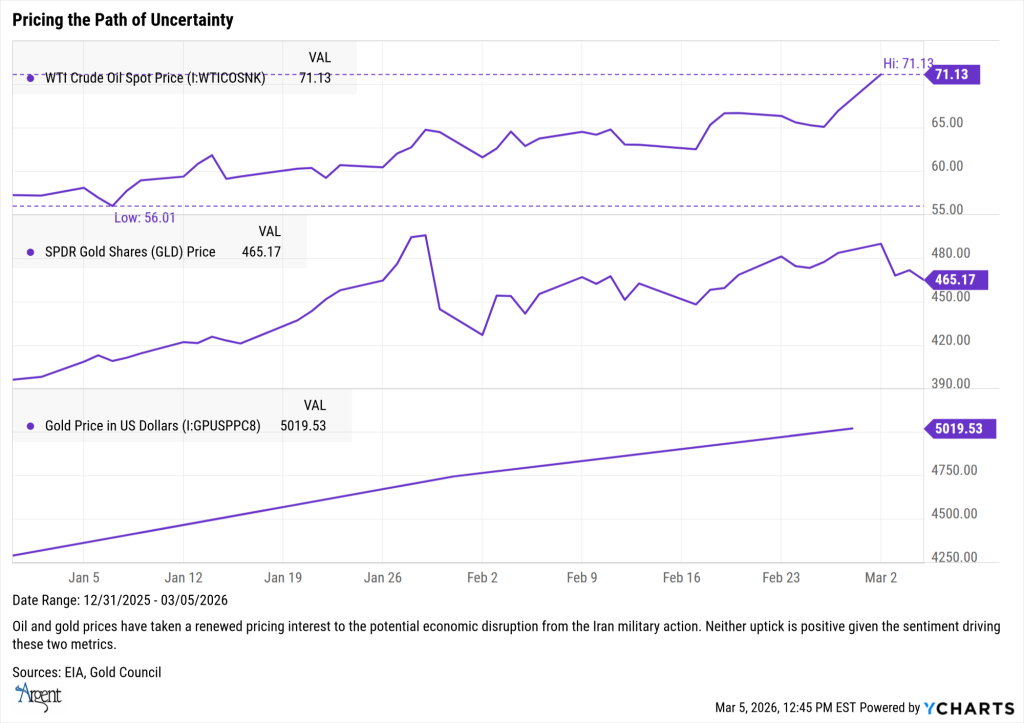
This pattern has occurred repeatedly during previous geopolitical events. Markets typically respond less to the political shock itself than to the economic transmission channels through which that shock may influence inflation, interest rates, or economic growth.
In this case, the primary transmission channel is oil. Iran produces roughly 3 million barrels of crude oil per day, representing less than five percent of global supply. While the loss of Iranian production alone could be absorbed by the global energy system, the larger concern lies in the geographic concentration of oil transportation in the Persian Gulf region.
Data compiled by the U.S. Energy Information Administration shows that approximately 20 million barrels of crude oil and petroleum products move through the Strait of Hormuz each day. making the narrow shipping corridor between the Persian Gulf and the Arabian Sea the most important energy chokepoint in the global economy.
Any sustained disruption to shipping traffic in the region would therefore have the potential to affect global energy prices and inflation expectations. Even modest interruptions to tanker traffic can produce significant volatility in crude oil markets, which explains the sharp reaction in energy prices following the escalation.
Energy markets, therefore, remain the most immediate channel through which geopolitical events can influence the broader global economy.
Oil, Inflation, and the Federal Reserve
Higher energy prices influence the economy through several channels. Oil prices directly affect gasoline costs for consumers, transportation expenses for businesses, and input prices for manufacturers. Sustained increases in crude oil prices can therefore feed into broader inflation measures over time.
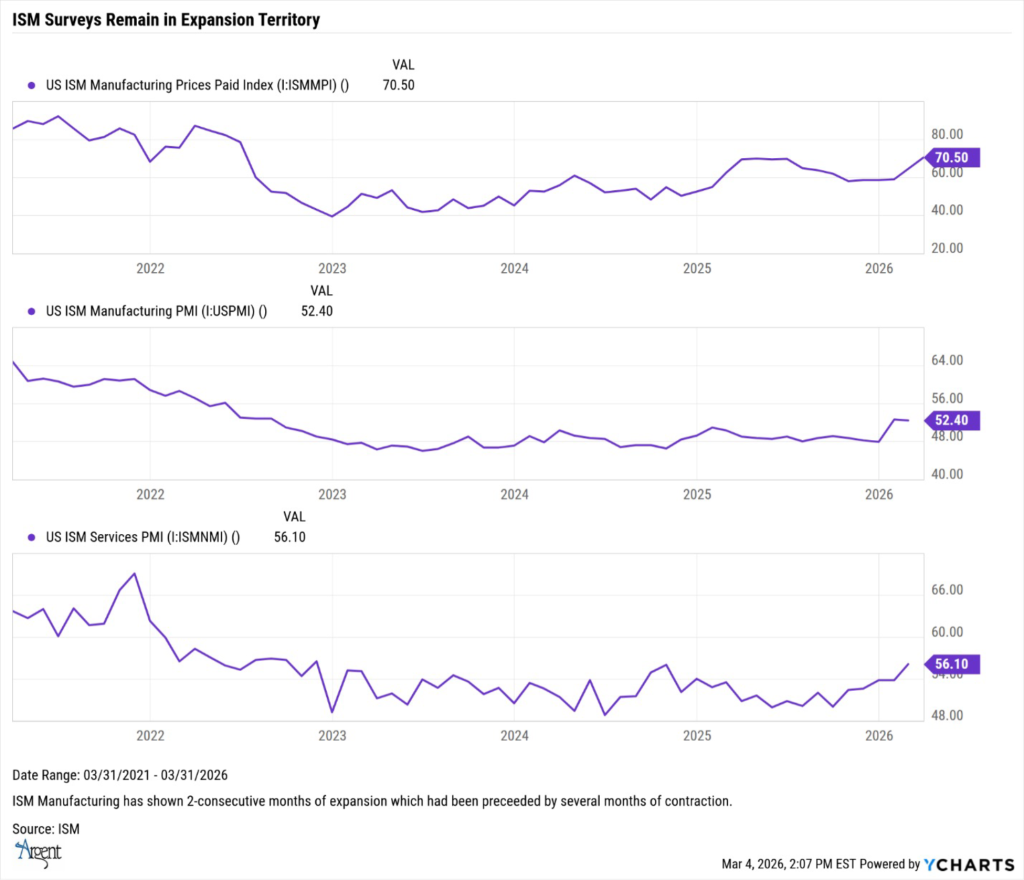
Recent economic data already suggests that inflation pressures remain uneven. The Institute for Supply Management reported that the ISM Manufacturing Index registered 52.4 in February, indicating that U.S. manufacturing activity has now expanded for two consecutive months following an extended period of contraction.
While the return to expansion reflects improving demand conditions within the industrial sector, the survey also revealed rising input costs. The ISM Prices Index climbed to roughly 70 during the same period, signaling that manufacturers are once again experiencing higher prices for raw materials and intermediate goods.
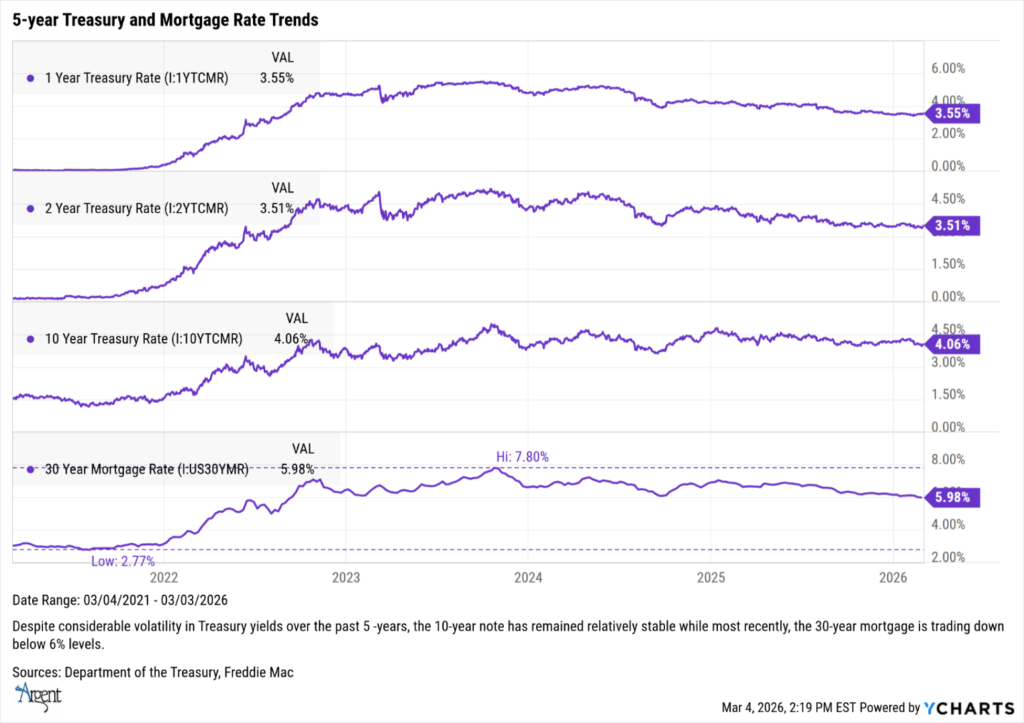
Bond markets are sensitive to these developments. The yield on the 10-year U.S. Treasury has fluctuated near the 4 percent level in recent weeks, reflecting a market that continues to balance moderate economic growth against uncertainty regarding the future path of inflation.
Mortgage rates have followed a similar trajectory. Freddie Mac’s Primary Mortgage Market Survey indicates that the average 30-year fixed mortgage rate has declined modestly in recent months and currently stands near 6 percent. While this represents an improvement from the levels above 7 percent that prevailed during 2023, borrowing costs remain far above the sub-3 percent rates that fueled the housing boom during the pandemic.
For policymakers at the Federal Reserve, the path forward therefore remains delicate. Inflation has moderated significantly from its peak, but renewed pressure from energy prices could complicate the timing of any potential easing in monetary policy.
The Consumer and the Labor Market Foundation
Despite higher interest rates and lingering inflation concerns, the U.S. consumer continues to provide the primary foundation for economic growth. Employment conditions remain relatively stable, wage growth continues to support household income, and consumer spending has remained resilient even as borrowing costs have increased.
The unemployment rate remains historically low, and payroll growth continues across several sectors of the economy. Hiring has been particularly strong in healthcare, government, and education, reflecting both demographic demand and continued expansion in public-sector employment.
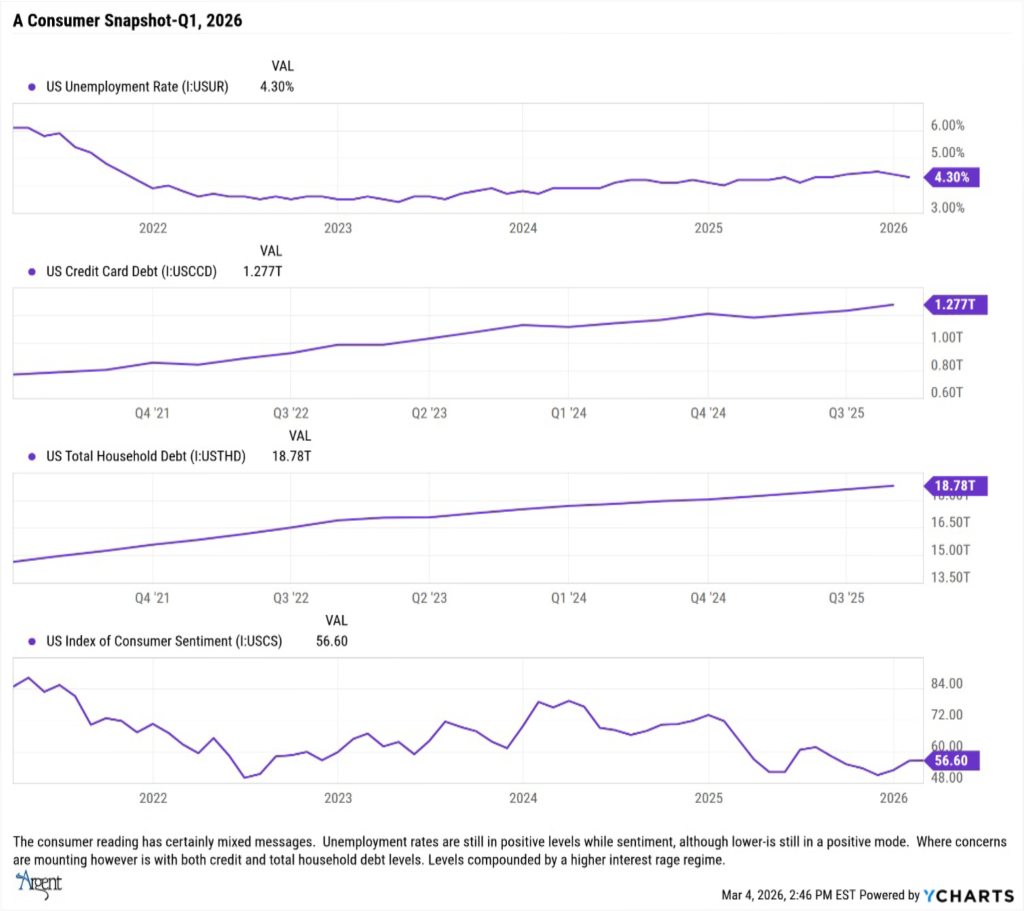
Consumer sentiment has bounced off the most recent November 2025 lows of 51, as the University of Michigan Consumer Sentiment Index recently registered near 56, which is still well off its highs near 80 back in March 2024. While sentiment remains below long-term historical averages, the current level remains consistent with continued economic expansion.
Household balance sheets remain broadly healthy, though financial conditions have begun to tighten modestly. Data compiled by the Federal Reserve Bank of New York in its Household Debt and Credit report shows that total U.S. household debt reached approximately $18.7 trillion at the end of 2025, compared with roughly $18.1 trillion one year earlier.
Mortgage balances remain the largest component of household debt. At the same time, revolving consumer credit has increased gradually as households continue spending in the face of higher borrowing costs. Credit card balances now total roughly $1.3 trillion, up from approximately $1.2 trillion one year earlier, according to the same New York Federal Reserve report.
Delinquency rates remain relatively contained by historical standards, though they have begun to edge higher from the unusually low levels recorded during the pandemic period. The gradual increase suggests that some households are beginning to feel the impact of higher borrowing costs, even as overall consumer spending continues to support economic growth.
Housing: Constrained but Stable
Housing remains one of the sectors most directly affected by the Federal Reserve’s interest rate policy. Mortgage rates that averaged below 3% during the pandemic housing boom have now stabilized near 6%, a level that continues to challenge affordability for many prospective homebuyers.
Yet the housing market has not experienced the widespread price declines that many analysts predicted when interest rates began rising in 2022. Instead, the sector has entered a prolonged adjustment period defined by limited inventory, reduced transaction volumes, and constrained affordability.
Millions of homeowners refinanced their mortgages during the pandemic period at interest rates well below current levels. Housing research from Freddie Mac and other industry studies suggests that roughly seventy percent of existing mortgage holders now carry interest rates below five percent.
Because of this dynamic, many homeowners have little incentive to sell existing properties and replace those mortgages with loans carrying significantly higher borrowing costs. The result has been a housing market characterized by extremely limited supply.
Rather than triggering widespread price declines, the adjustment has occurred primarily through lower transaction volumes. Existing home sales remain well below pre-pandemic levels, while pending home sales have fluctuated near multi-year lows.
The housing market is therefore not collapsing, but it remains clearly constrained by higher borrowing costs and limited inventory.
Market Performance Through February: Signs of Broadening Leadership
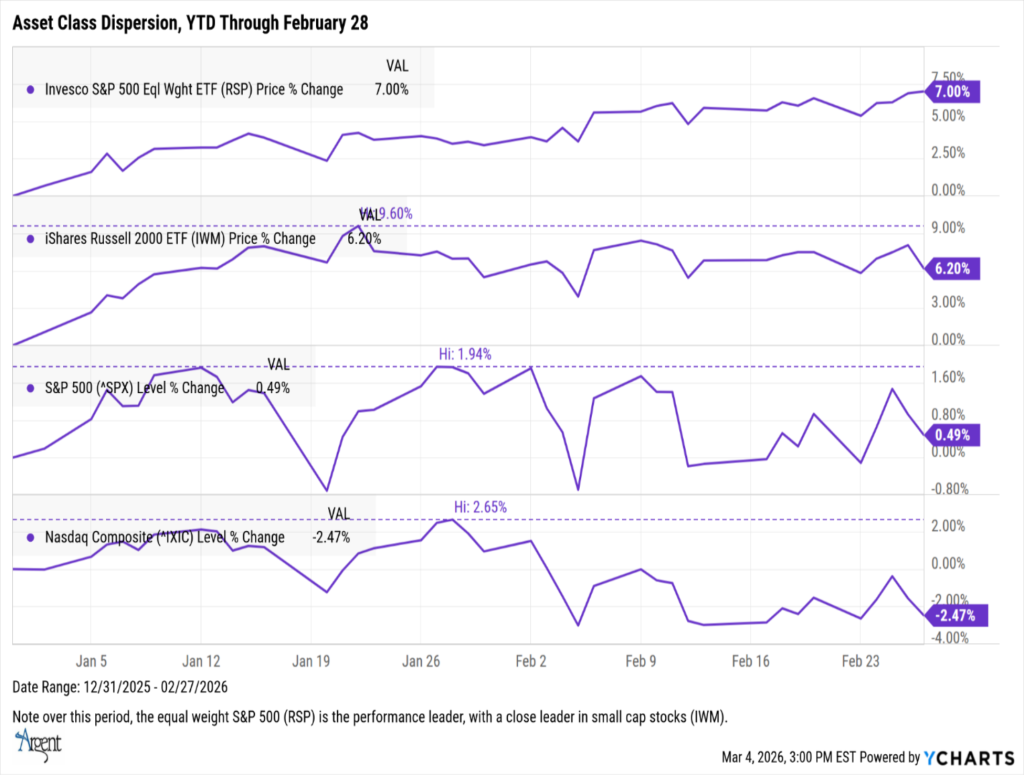
Equity markets through the end of February reflected steady but uneven progress across asset classes. While the S&P 500 advanced a more nominal 0.4% through February 28, other markets moved higher, supported primarily by continued earnings growth among a broader category of companies, many still benefiting from ongoing investment in artificial intelligence infrastructure.
The Dow Jones Industrial Average posted gains of roughly 2% during the same period, while the S&P 500 (equal-weight RSP ETF) rose approximately 7%, according to market data compiled by S&P Dow Jones Indices. The small-cap index, Russell 2000 (IWM ETF), rose by 6.2% over the first two-month period of 2026, after lagging large-cap benchmarks for much of the previous two years.
International markets produced mixed results. Developed international equities tracked by the MSCI EAFE Index gained nearly 10% through February, according to MSCI index data. Emerging markets also advanced modestly, with the MSCI Emerging Markets (EEM) Index rising roughly 14% during the same period.
Commodity markets added another dimension to investor positioning. Gold advanced approximately 22% through February, and continues to trade near historic highs. The World Gold Council reports that central bank purchases of gold have remained elevated during the past year, contributing to sustained demand.
Artificial Intelligence and the Dot-Com Comparison
Comparisons between the current artificial intelligence investment cycle and the technology boom of the late 1990s have become increasingly common. While both periods are defined by transformative technological change, the financial foundations supporting today’s technology leaders differ significantly from those that preceded the dot-com collapse.
During the late 1990s, many technology companies that achieved large market capitalizations generated little or no operating income. Valuations were often based primarily on projected future growth rather than current profitability.
Today’s artificial intelligence investment cycle is being driven primarily by companies with substantial earnings, strong balance sheets, and significant free cash flow. The leading firms building AI infrastructure are investing tens of billions of dollars in semiconductor capacity and data center construction, expenditures that would not be possible without substantial internal cash generation.
This difference does not eliminate the possibility of volatility in technology valuations, but it does suggest that the financial foundations of today’s technology sector are far stronger than those that characterized the speculative excesses of the late 1990s.
Capital Flows and Investor Positioning
Fund flow data suggests that investors are adjusting portfolio exposures rather than abandoning risk assets entirely. The SPDR S&P 500 ETF Trust recorded approximately $615 million in inflows during the final week of February, reflecting continued institutional demand for U.S. equities.
At the same time, safe-haven assets attracted significant inflows. The SPDR Gold Shares ETF recorded nearly $3.9 billion in inflows during the same period, while the iShares Silver Trust attracted approximately $1.27 billion.
Digital asset investment vehicles have also continued to draw capital. The iShares Bitcoin Trust recorded roughly $60 million in inflows during the week, according to ETF flow data compiled by Bloomberg and ETF research providers.
These patterns suggest investors are reallocating capital across asset classes rather than exiting markets entirely.
Credit Markets and Financial Conditions
Credit markets often provide early signals of economic stress. At present, those signals remain relatively calm. Corporate credit spreads remain contained, and both investment-grade and high-yield bond markets continue functioning normally.
Many corporations refinanced debt during the period of ultra-low interest rates following the pandemic, reducing near-term refinancing risk. While borrowing costs remain higher than they were several years ago, corporate balance sheets overall remain in relatively strong condition.
The stability of credit markets suggests that investors do not anticipate a severe economic downturn.
Closing Perspective: What Markets Are Watching Now
The U.S. economy enters this period of geopolitical uncertainty from a position of relative resilience. Manufacturing activity has stabilized, the labor market remains strong, and corporate earnings continue to expand across many sectors.
At the same time, the margin for error has narrowed. Energy markets remain the most immediate source of uncertainty. Shipping activity through the Strait of Hormuz will determine whether the recent increase in oil prices proves temporary or evolves into a sustained inflationary impulse.
Inflation indicators will also remain central to the Federal Reserve’s policy outlook. Measures such as the ISM Prices Index and the Personal Consumption Expenditures Price Index will shape expectations regarding the timing of potential interest rate adjustments.
Credit markets will continue to provide an important signal regarding the health of the broader economy. A meaningful widening of corporate credit spreads would represent one of the earliest indicators that financial conditions are beginning to deteriorate.
For now, however, the global economy continues to expand. The trajectory of energy prices, inflation, and financial conditions will ultimately determine whether the current geopolitical shock proves temporary or evolves into a more consequential economic event.
Not Investment Advice or an Offer -This information is intended to assist investors. The information does not constitute investment advice or an offer to invest or to provide management services. It is not our intention to state, indicate, or imply in any manner that current or past results are indicative of future results or expectations. As with all investments, there are associated risks and you could lose money investing.


