


BY: Tom Stringfellow, CFA®, CPA®, CFP®
Chief Investment Strategist
From Momentum to Measurement
Key Takeaways
- Markets remained resilient in 2025, but leadership narrowed as investors became more selective and less tolerant of unmet expectations.
- Economic growth slowed without stalling, supported by a rebalancing labor market and a consumer that continued to spend, albeit with greater discipline.
- Capital flows confirmed rotation rather than retreat, with meaningful reallocations across asset classes, regions, and strategies.
- Earnings expectations for 2026 suggest broader sector participation and a renewed focus on cash-flow quality over narrative growth.
- Fixed income re-emerged as a core portfolio component, offering income, diversification, and potential upside should rates drift lower.
The Consumer, Inflation, and the Economic Undercurrent
As the holiday season approached, retail data offered an early window into the broader tone of the economy. Consumers were still spending, but the nature of that spending had clearly evolved. U.S. retail and food service sales through October 2025 remained positive on a year-over-year basis; yet the pace of growth moderated compared with earlier in the cycle. Gains were incremental rather than exuberant, suggesting that households remained engaged but increasingly deliberate in how they allocated discretionary dollars.
Holiday-specific data reinforced that message. Black Friday and Cyber Week results showed another record year for online spending, driven in large part by aggressive promotions and targeted discounting. Traffic shifted decisively toward digital channels, while in-store activity held steady but did not accelerate meaningfully. Consumers appeared willing to concentrate purchases around high-visibility events and favorable pricing rather than spread spending evenly across the season. This was not a retrenchment, but it was unmistakably a more value-oriented posture.
Beneath that spending behavior, inflation dynamics continued to improve, though not uniformly. Headline inflation eased meaningfully over the course of the year, declining from roughly 3.4 percent at the end of 2024 to just over 3 percent at the end of September. Core inflation—which excludes food and energy and tends to be more reflective of underlying price pressure—also moderated from near 4 percent into the mid-3 percent range. That broader trend was reinforced by the most recent CPI release, which showed November headline inflation at 2.7 percent year-over-year and core inflation at 2.6 percent, underscoring continued progress rather than reacceleration.
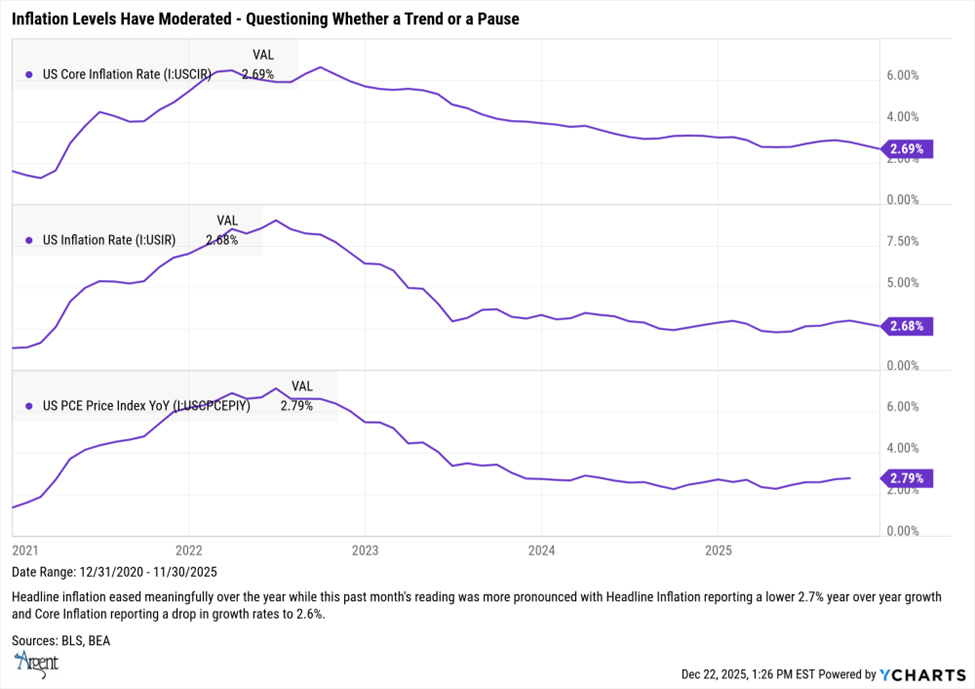
The composition of inflation mattered as much as the direction. Goods inflation cooled materially as supply chains normalized and pricing power faded across many discretionary categories. Services inflation, however, remained more persistent, particularly in shelter, insurance, and other labor-intensive areas. As a result, progress on inflation was steady rather than swift, reinforcing expectations that the final phase of disinflation would take time rather than arrive abruptly. That assessment was further complicated this year by delayed and incomplete data reporting following changes to federal survey processes, placing greater emphasis on trend consistency rather than single-month readings.
The labor market offered one of the clearest examples of economic adjustment rather than deterioration. Employment growth slowed over the course of the year, but weakness remained concentrated in specific segments of the economy. Job losses were most evident in technology, financial services, and temporary staffing—areas that had benefited disproportionately from the post-pandemic expansion and were most sensitive to higher interest rates and tighter financial conditions.

At the same time, hiring remained durable in sectors tied to longer-term structural demand. Health care, government, leisure and hospitality, and infrastructure-related industries continued to add jobs, helping offset softness elsewhere. Wage growth moderated alongside hiring, easing inflation pressure without materially undermining household income. Taken together, these trends pointed to a labor market that was rebalancing rather than breaking.
From the consumer’s perspective, 2025 was defined less by contraction and more by divergence. Higher-income households and asset owners generally fared better, benefiting from equity market gains and relatively stable employment. Lower-income consumers and renters faced more persistent pressure, particularly from elevated housing, insurance, and essential service costs. As excess savings accumulated earlier in the cycle continued to run down, spending behavior became more selective, with households prioritizing value, necessity, and experiences over discretionary excess.
This divergence helps explain why consumer spending held up better than consumer confidence throughout the year. Households continued to spend, but they did so with greater price sensitivity and less tolerance for nonessential purchases. The result was an economy that often felt uneven in real time yet remained more resilient than sentiment measures alone would suggest.
Markets, Leadership, and Where Capital Actually Moved
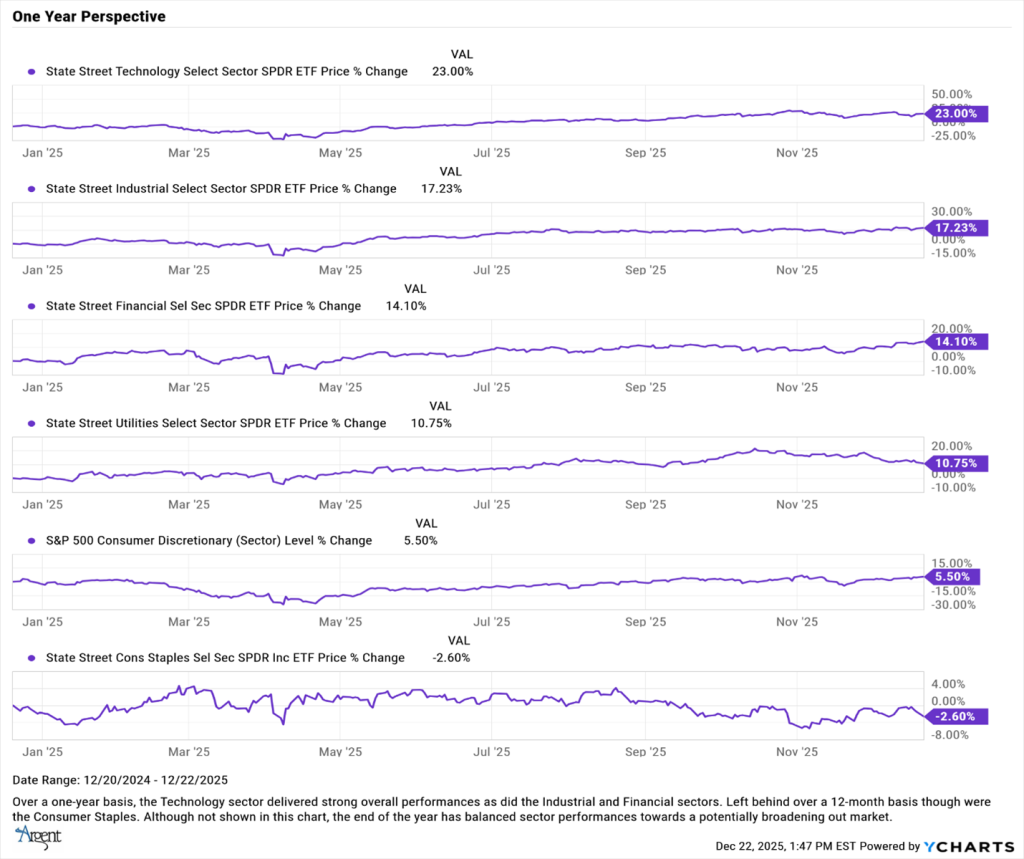
Market performance in 2025 reflected the economic environment that produced it: resilient, uneven, and increasingly selective. Major U.S. equity benchmarks posted solid gains through mid-December, but the composition of those returns shifted meaningfully over the course of the year. Early performance was driven by a narrow set of dominant companies and themes, while broader participation emerged more quietly as expectations adjusted and dispersion increased.
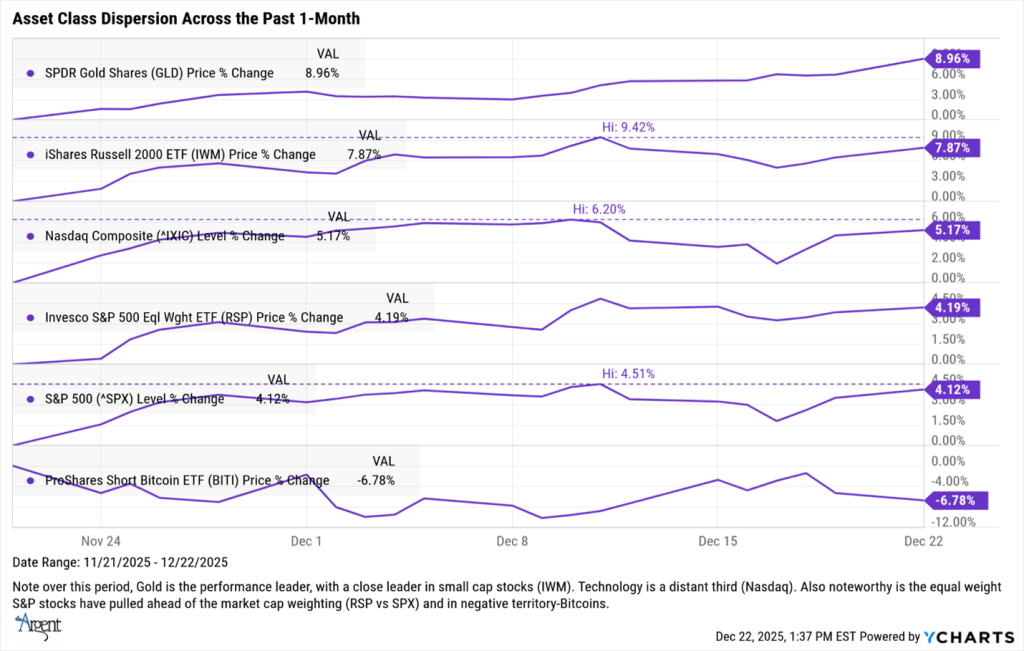
At the start of the year, market leadership was highly concentrated. A small group of mega-cap technology and growth-oriented companies accounted for a disproportionate share of index-level gains, supported by optimism around artificial intelligence, margin expansion, and operating leverage. As the year progressed, that leadership began to show signs of fatigue—not because fundamentals deteriorated materially, but because expectations had moved well ahead of near-term delivery. Valuations left less room for incremental upside without continued earnings surprises.
In parallel, other areas of the market began to improve beneath the surface. Cyclical and value-oriented sectors showed stabilization, particularly where earnings growth, margins, and pricing power were less dependent on ideal macro conditions. Industrials, select financials, health care, and parts of the consumer complex began to contribute more meaningfully to returns, even as headline indices remained dominated by their largest constituents. This transition marked an important shift from momentum-driven leadership toward a market that increasingly rewarded execution and earnings durability.
Capital flows reinforced this narrative of rotation rather than retreat. Throughout 2025, investors remained engaged with financial markets, but they adjusted how and where capital was deployed. According to BlackRock’s year-end ETF flow analysis released in December, global ETF inflows in 2025 were on pace to exceed $1 trillion, the largest annual total on record. That magnitude alone underscored investors’ willingness to deploy capital despite elevated interest rates, geopolitical uncertainty, and persistent macro noise. Notably, a meaningful share of those inflows occurred during periods of heightened volatility, suggesting conviction rather than complacency.
Looking more closely at asset allocation, data compiled by First Trust and the Investment Company Institute showed that equity ETFs absorbed approximately $850–$875 billion in net inflows year-to-date, while fixed-income ETFs attracted roughly $390–$400 billion over the same period. That balance was instructive. Investors were not abandoning growth exposure, nor were they crowding exclusively into cash. Instead, they paired continued equity participation with income and ballast, a pattern more consistent with late-cycle positioning that remains constructive rather than defensive.
Retail investor behavior further supports this interpretation. Data tracked by Nasdaq and highlighted in MarketWatch reporting showed that retail investors committed well over $100 billion in net new capital to U.S. stocks and ETFs during the first half of 2025 alone, exceeding comparable periods last year. Daily retail buying activity remained elevated even as volatility increased and leadership rotated, underscoring continued engagement rather than capitulation. Importantly, those flows were broadly diversified rather than concentrated in a single theme or narrow group of names.
Global fund flows told a similar story. EPFR-tracked data cited by Reuters showed that global equity funds recorded one of their largest weekly inflows in over a month in mid-December, led by U.S. and European equity funds. At the same time, money-market funds experienced notable outflows as capital was redeployed into risk assets. Emerging-market equity funds also posted consecutive weekly inflows late in the year, reflecting renewed investor interest as valuation gaps narrowed and earnings momentum improved outside the United States.
Taken together, these patterns clarified what price action alone can sometimes obscure. Investors did not step away from markets in 2025. They repositioned within them. Capital flowed away from narrow concentration and toward broader diversification across asset classes, geographies, and strategies. That behavior is not characteristic of investors bracing for recession. It is more consistent with investors preparing for a more selective market environment—one where outcomes are driven less by broad exposure and more by where earnings, cash flow, and valuation intersect.
From Transition to Attribution
If 2025 was a year of transition, 2026 is shaping up to be a year of attribution—one in which markets become less forgiving of broad narratives and more attentive to where earnings, revenues, and cash flows are being generated. After a year defined by adjustment, dispersion, and recalibration, the market’s focus appears to be shifting from what might happen to what is being delivered.
One of the clearest signals that the dust may be settling comes from the earnings outlook itself. FactSet’s most recent bottom-up estimates point to mid-double-digit earnings growth for the S&P 500 in 2026. While that headline figure is important, the composition of expected growth is more telling than the aggregate number. Unlike earlier phases of this cycle, when earnings growth was heavily concentrated in a small group of mega-cap technology companies, current estimates suggest broader sector participation.
FactSet sector-level data indicate that industrials, financials, health care, and select consumer-related sectors are expected to contribute meaningfully to earnings growth next year, alongside—but not overwhelmingly dominated by—technology. Revenue growth expectations follow a similar pattern, with dispersion narrowing and a wider range of companies projected to participate in top-line expansion. This broadening matters. Markets tend to be more stable when growth is distributed across multiple sectors and more vulnerable when outcomes depend on a narrow set of assumptions.
At the same time, investor focus is evolving beyond revenue growth alone. Markets appear increasingly attentive to cash-flow conversion, margin durability, and balance-sheet strength. Companies able to translate demand into free cash flow—rather than deferred profitability—are commanding greater attention. This shift is particularly relevant given elevated capital expenditures tied to artificial intelligence, infrastructure, and energy. The market is no longer asking whether investment is occurring; it is asking who ultimately benefits economically from that investment.
Federal Reserve commentary over recent weeks reinforces this setup. Chair Powell and other Fed officials have consistently emphasized that policy is now near neutral and that future adjustments will depend on incoming data rather than a predetermined path. The urgency that defined earlier stages of the tightening cycle has faded, replaced by a more patient, reactive posture. For markets, this carries two important implications. First, monetary policy is unlikely to serve as a significant tailwind in 2026. Second, it is also unlikely to become an immediate headwind unless inflation meaningfully reaccelerates. In that environment, earnings growth—not policy relief—becomes the primary driver of returns.
From a macroeconomic standpoint, consensus GDP forecasts heading into 2026 point to continued expansion at a slower, more sustainable pace. Growth expectations remain modest but positive, an environment historically supportive of earnings resilience even if it does not fuel aggressive multiple expansion. Importantly, economic visibility has improved. After a year of frequent revisions and policy-related uncertainty, incoming data have begun to normalize, allowing markets to focus less on hypothetical scenarios and more on underlying fundamentals.
Fixed income and credit markets are also positioned to play a more central role in portfolio outcomes than they have in years. Today’s yield levels reintroduce the potential for price appreciation should growth continue to moderate, and interest rates drift lower over time. In that context, fixed income offers something it has not consistently provided in recent years: the combination of current income, diversification, and the possibility of capital gains, rather than reliance on any single outcome. Credit spreads remain contained, suggesting confidence in corporate balance sheets even as growth slows.
As the year draws to a close, it is timely to reflect not only on what worked in 2025, but on why it worked—and what the market quietly stopped rewarding along the way. Leadership was no longer granted simply for size, narrative, or momentum. Instead, markets increasingly demanded confirmation through earnings delivery, cash-flow generation, and operational discipline.
In the end, 2025 was not defined by a single shock or turning point. It was defined by adjustment. Markets absorbed higher rates, shifting growth dynamics, and persistent uncertainty without losing their footing—but they did so by becoming more selective and less forgiving. As investors look ahead, the task is not to predict the next headline or policy move. It is to remain focused on the factors that tend to matter most over time: earnings quality, balance-sheet strength, diversification, and discipline. Those principles served investors well as the dust began to settle in 2025, and they are likely to remain just as relevant in the year ahead.
Not Investment Advice or an Offer -This information is intended to assist investors. The information does not constitute investment advice or an offer to invest or to provide management services. It is not our intention to state, indicate, or imply in any manner that current or past results are indicative of future results or expectations. As with all investments, there are associated risks and you could lose money investing.


