


BY: Tom Stringfellow, CFA®, CPA®, CFP®
Chief Investment Strategist
Baked-In
- Upbeat GDP Report: Q2’s second GDP estimate was revised upward from 2.8% to 3.0%, surprising on the upside.
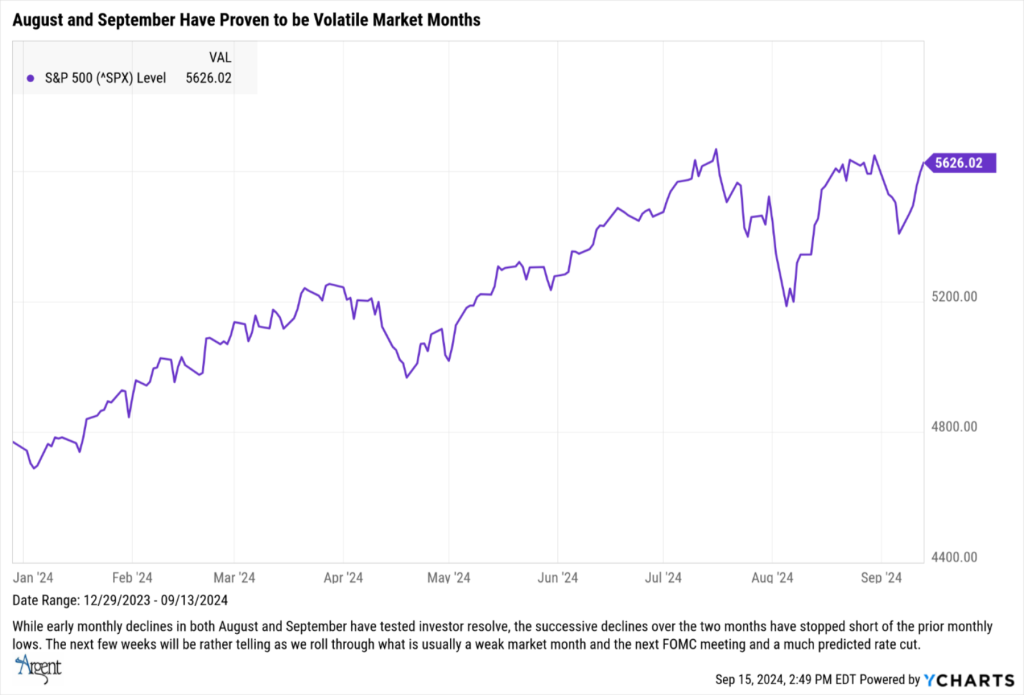
- Equity Market Gains: Despite a rocky start in September with the S&P 500 falling 4% during the first trading week of the month, the markets rallied in anticipation of an upcoming rate cut. As of September 15, the S&P returns reflect an 18% year-to-date gain.
- September Rate Cut Baked-in: Market and economic data signal the Federal Reserve’s first rate cut this month. The key question remains: how significant and how quickly will other cuts follow? Odds as of this writing is a one-half percent initial cut (50 basis points).
- Retail Sales Surprise: According to the Commerce Department, retail sales increased 0.1% last month after an upwardly revised 1.1% surge in July. Sales increased 2.1% on a year-on-year basis in August, with online store sales rebounding 1.4% last month following a 0.4% decline in July. Sales at gasoline stations dropped 1.2%, reflecting lower prices at the pump.
An About-Face in Market Sentiment
In early August, investor pessimism surged amid concerns about weakening economic data and deteriorating labor markets. Calls for an emergency Federal Reserve rate cut intensified, especially during the first trading week in August, resulting in the S&P 500 losing about 8% of its valuation from mid-July highs. However, by the end of August, economic data had become less alarming, sentiment improved, and the Fed refrained from intervening prematurely.
As fears of an imminent recession faded, the S&P recovered most of the ground lost during early August. By last month’s end, the S&P ETF equivalent, SPY, was up over 18% over the prior 8 months. September, however, got off to a similarly rocky start, with the market falling more than 4% through September 6th—its largest weekly loss since March 2023—driven by weaker-than-expected job growth and skepticism over Artificial Intelligence (AI) products and stock demand.
Yet, through mid-September, market sentiment shifted positive once again. With this week’s Federal Reserve meeting in the backdrop, equity market benchmarks are once again priced at near-perfection, with the S&P 500 hovering near last August’s close, again up at the 18% year-to-date level.
Boosted market sentiment was aided by a slate of news easing investor concerns over a rapid economic downturn. Additionally, the Federal Reserve has signaled that a rate cut is imminent. Fed Chair Jerome Powell’s Jackson Hole speech indicated that “the time has come for policy to adjust,” a sentiment echoed by New York Fed President John Williams, who stated, “it is now appropriate to dial down the degree of restrictiveness in the stance of policy by reducing the target range for the federal funds rate.” Fed Governor Christopher Waller added, “The labor market continues to soften but not deteriorate, and this judgment is important to our upcoming decision on monetary policy… I believe the time has come to lower the target range for the federal funds rate at our upcoming meeting.”
How well the markets have priced in this anticipated rate cut will become clear after the FOMC meets Wednesday, September 19th. By this week’s end, one investor question will have been addressed-the timing (and perhaps magnitude) of interest rate cuts. We know from Chair Powell’s most recent Jackson Hole speech, a reduction in rates is all but guaranteed, but market watchers are split over how much and how quickly. Quite a few forecasters believe 25 basis points (0.25%) should be sufficient, but the odds for a 50 basis point cut are ratcheting upwards-despite the better-than-expected retail sales report for August.
The outstanding question though will still remain-whether the Fed’s landing program for easing monetary policy results in a soft (slow but still positive economic growth) or a hard (recessionary) economic landing.
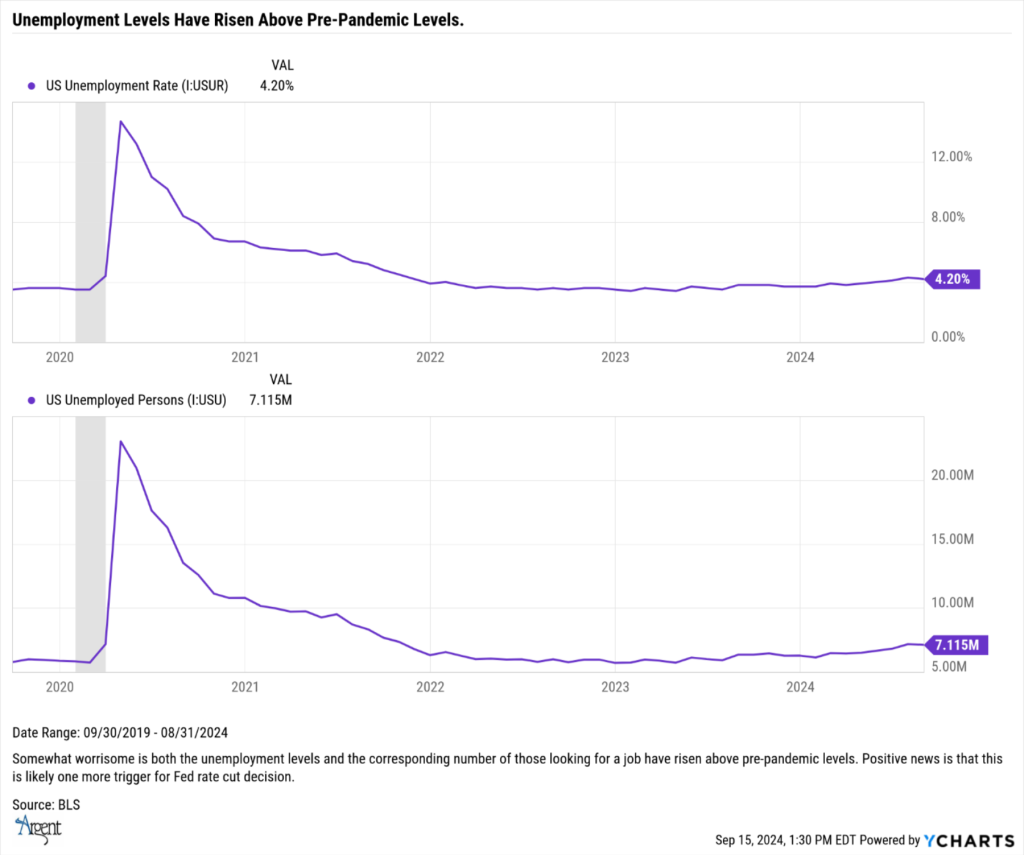
There were a number of factors that have provided some assurance to the Fed voting members that inflation is slowing down as is targeted economic data. Most glaring is the moderating of inflation readings and forecasts. There is also the job market conundrum where unemployment levels and new jobs created are both slowing down, risking future economic growth prospects-which is also the case with still falling ISM manufacturing surveys. Housing markets and affordability are likewise high on the FOMC alert list, which, despite the relatively quick drop in mortgage rates, has yet to signal a sustainable housing industry revival or price stability. Many prospective buyers are being priced out of the market as home prices continue to climb. If rates fall further, we could see renewed activity in the housing sector, but the risks remain, especially if economic conditions deteriorate.
What has run counter to the recession and inflation fears though has been equity market trends. In this instance, investors are looking further out assuming this expected rate cut will not be the last. Different this time though is where the money flows are heading. Think smaller cap, rate sensitive and non-tech.
Another backward-looking report countering the feared economic downturn has been the Gross Domestic Product (GDP) data. According to the recent release, the nation’s economic growth rate for the second quarter was 3%. Interesting though was that since the third quarter of 2022, the percentage increase in government expenditures had exceeded that of the consumer. It helps explain both growing deficits and the impact of economic stimulus. As to forecasts for Q3, according to the Atlanta Fed GDPNow model, expect growth rates to continue at 3%. A signal that perhaps recession worries are once again kicked down the calendar a bit longer.
Inflation Slows to a Three-Year Low: Relief on the Horizon?
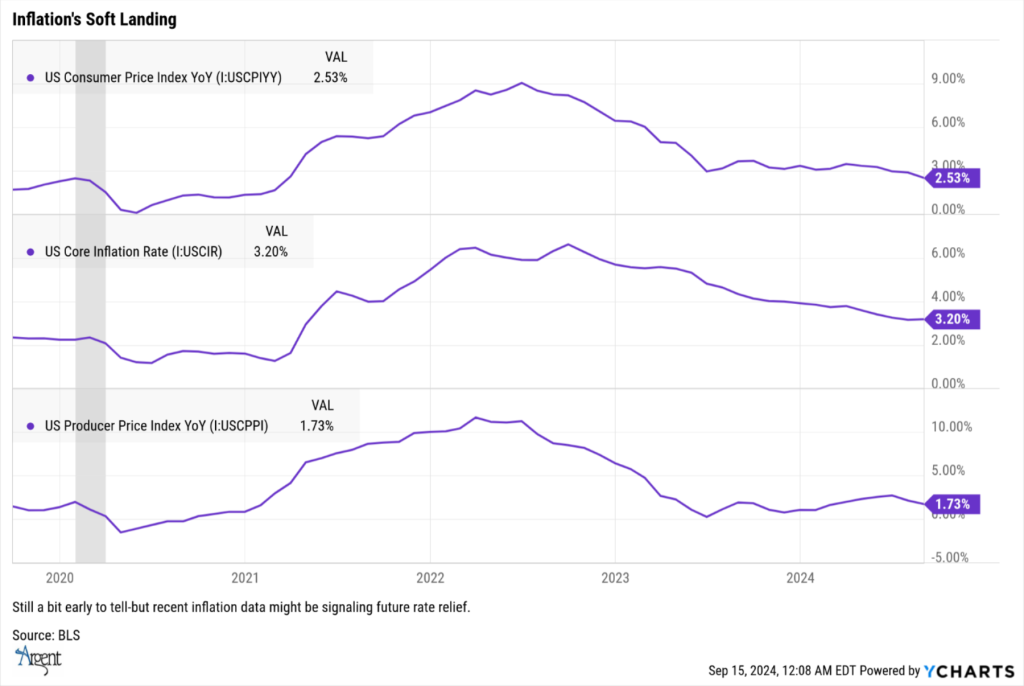
On another positive note, last month’s inflation data highlighted a slowing in the headline Consumer Price Index (CPI) to “only” a 2.5% year-over-year increase from August 2023, the smallest annual increase since February 2021. In July, the headline CPI posted a 2.9% year-over-year increase, which for comparison purposes, marks its slowest pace since March 2021.
Excluding the more volatile components of CPI—such as food and energy costs—the year-over-year core inflation rate rose by 3.2%, the slowest rate of increase since April 2021. The difference between the more volatile headline inflation (2.5%) and core inflation (3.2%) was largely driven by a significant drop in fuel prices, with gasoline prices down approximately 14% from the year ago $4 per gallon.
Shelter costs, however, continue to exert the most pressure on both core and headline inflation, rising over 5% year-over-year as of August 2024. And unfortunately, shelter costs account for over 70% of the 12-month increase in core CPI.
The Producer Price Index (PPI), the cost measure incurred by manufacturers and producers, increased by 1.7% year-over-year—its smallest annual rise this year and well below the March 2022 peak, when producer costs had surged over 11%. Despite the modest uptick, the broader inflationary trend continues to ease, aligning with other data suggesting inflation is cooling.
The good news-as inflation slows it reaffirms the Federal Reserve’s more accommodative monetary policy changes after holding interest rates steady in the 5.25%-5.50% range since July 2023.
Labor Market Weakness Emerging
Despite positive downturn in inflation data, the labor market is now showing signs of strain. The U.S. added only 142,000 jobs in August, falling short of expectations and below the average monthly gain of 202,000 over the past year. Of greater concern is the composition of these gains: 50% came from sectors like government (+24,000), healthcare, and education (+47,000)—typically stable sectors, but less indicative of broader economic strength. The July jobs report was also revised down to just 89,000 new jobs, with 70,000 of those concentrated in the same sectors: government, healthcare, and education.
In terms of “sustainable economic” employment categories, construction showed improvement, with 34,000 new jobs in August—well above the average monthly gain of 19,000. Heavy and civil engineering accounted for 14,000 of these jobs, likely driven by infrastructure projects. On a positive note, average hourly earnings increased by 0.40% in August, translating to an annualized rate of 3.8%, slightly outpacing inflation.
However, there were also some concerning signs, such as a decline of 24,000 jobs in manufacturing, which is not a good indicator for business investment or productivity in that sector.
The key takeaway from the August jobs report is that higher interest rates—and perhaps uncertainty surrounding the upcoming election—are now impacting the labor market. Again, one more crucial metric leading the Federal Reserve to move toward easing interest rates at this next FOMC meeting.
State of the Manufacturing and Services Economy
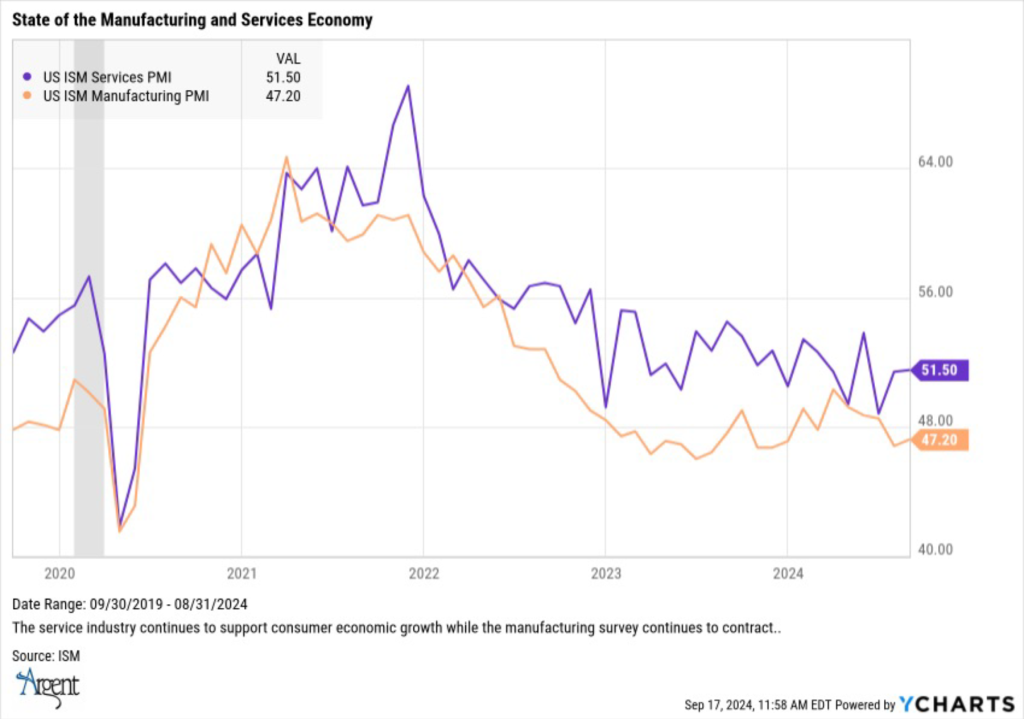
ISM Manufacturing PMI reported yet another disappointing month: just a 47.2 reading in August, marking the 21st monthly contraction in the past 22 months (a reading below 50 is considered economic contraction). The decline was once again driven by ISM New Orders, reporting its 23rd monthly decline over the past 26 months.
Industrial production spiked higher in August with a month-over-month gain of 0.8%-much of the rebound attributed to a 9.8% increase in motor vehicle production. While manufacturing only contributed 10.1% to the overall this year’s Q1GDP growth, according to the St. Louis Fed, it still bears a strong leading correlation to the U.S. business cycle. A reason to keep an eye on the trend as we gauge whether the Fed is able to navigate towards an anticipated soft economic landing.
Regarding the ISM Services PMI, the August reading of 51.5 was the sixth monthly expansion this year and the 48th expansion over the past 51 months. Not surprising that GDP growth has continued to hold steady over the past few years as the service sector accounts for 79% of U.S. output.
According to the St. Louis Fed, service industry contributions have grown from 52% in 1950 to 62% in 1980 to 79% today. The basis for growth-increase in the quantity and pricing of services such as health care, financial services, arts, entertainment, professional, education and recreation.
Market Outlook: Increased Volatility and Market Broadening
The markets have behaved interestingly of late. What worked earlier in the year has not held up these past few months. What is different this time are the expectations of an impending rate cut. As mentioned already, markets are priced to perfection today although there has been a rotation in market focus. In the past three months for instance, the top performing sector was Real Estate (XLRE), up 18.9% while the laggard, Technology (XLK) was down 3.37%.
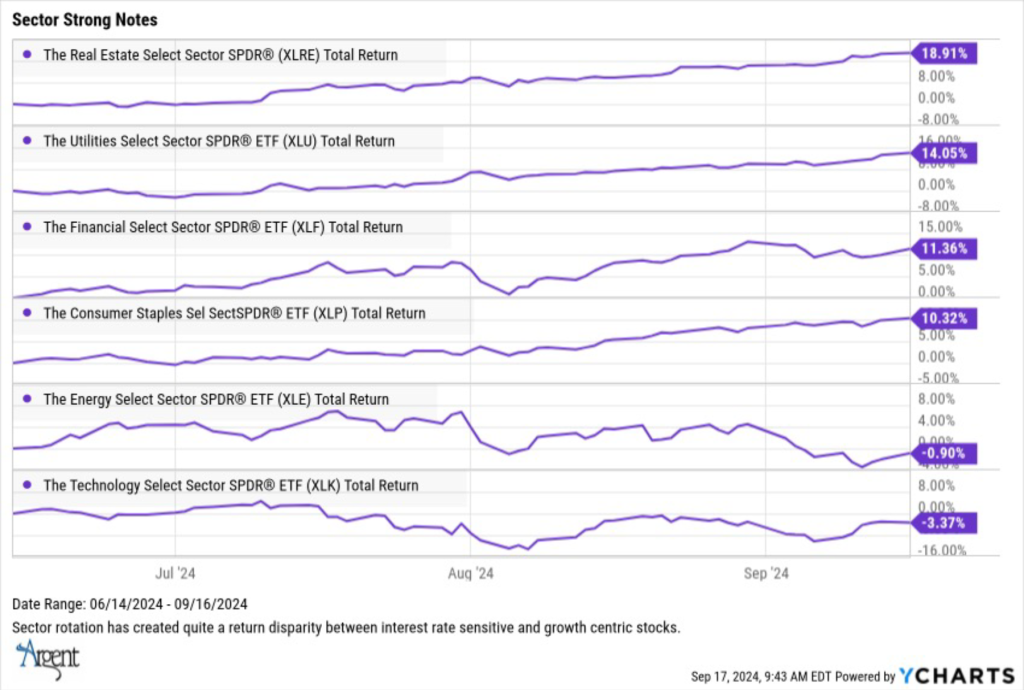
Looking back on the first six months (January 1-June 14, 2024), price level returns were reversed. At that juncture, Technology was up 18.48% while Real Estate was down 3.17%. What a difference three months can make.
The same parallel can be seen in broader market rotations. Top performing equities during the prior three months were small cap stocks (IWM) up 9.5%, while the laggards were the Nasdaq proxy, QQQ which was down by 1.24%. Again, not shown here, but comparing the period from January 1 to June 14, 2024, performances were again reversed with the ETF QQQ up 17% while the small cap index was underwater by nearly 1%.
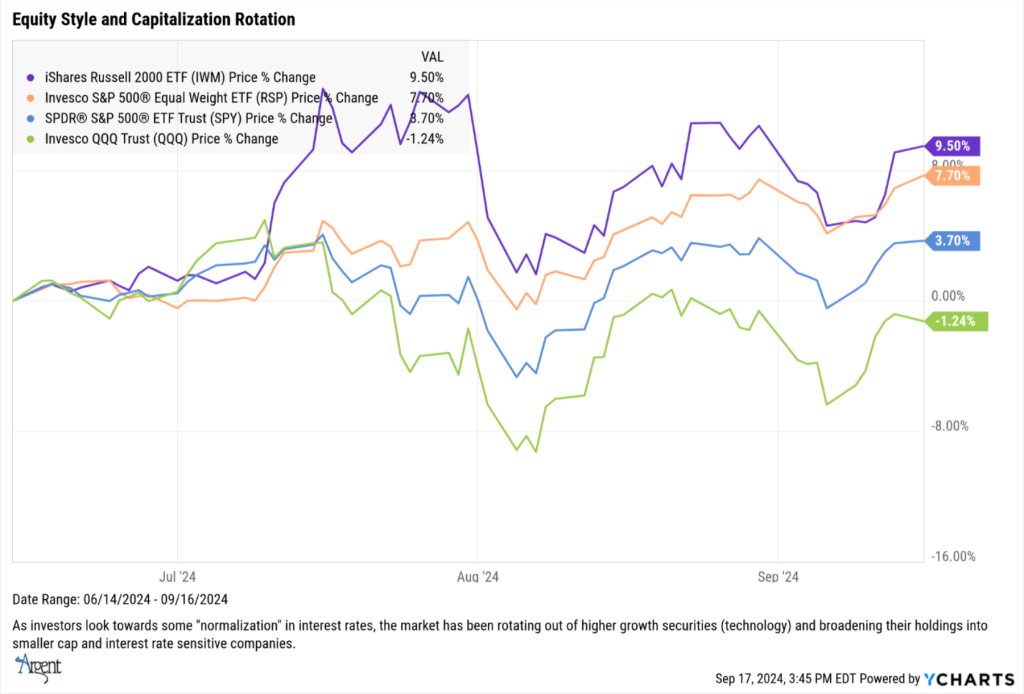
Not much has changed during this period in terms of equity other than investors rotating toward sectors and asset classes perceived to do better in a lower rate environment. These rotations during periods of falling rates traditionally favor smaller companies with higher debt loads (and now cheaper financing) along with the housing industry and broader consumer companies benefiting from a widening of the economy. Undoubtedly Artificial Intelligence-focused companies will also benefit in this environment as well, but revenue growth will matter more now.
Also positive are analysts’ expectations of more earnings growth this quarter and next. As of now, earnings growth for Q3 is projected to be at 4.9% and for Q4, 15.4% levels. Again, the recession kicked a bit further down the calendar. How this does play out in terms of market reactions, a few thoughts to keep in mind:
- The market news has not been bad enough to cause a sustainable drop in the equity markets since 2022. This includes now slowly rising unemployment levels, weak ISM data, political uncertainty (49 days until the presidential election as of this writing), and geopolitical conflicts overseas.
- Most economic data is slowing but still growing. While housing demand has slowed, it is a function of supply constraints, not lack of home-buyer interest (interest rates-yes). GDP, earnings growth (more than 10% growth) and now Industrial production appear to be on a growth track.
- Most important, the Fed will be embracing a regime of rate cuts hopefully providing some comfort to the market makers, investors, and certainly to borrowers leveraged to higher rates. This was not the case in 2022.
- Nothing said here means that there will not be market corrections, but those periods will provide more buying opportunities for the estimated $6.4 trillion sitting in money markets as of mid-August.
- Borrowing a phrase from Sevens Research, “the risks facing the market today are tectonic. They evolve over time until they are sustainable-when that occurs-that is when bear markets generally occur.” I suspect many of those risks are now passing in the rear-view mirror.
Not Investment Advice or an Offer -This information is intended to assist investors. The information does not constitute investment advice or an offer to invest or to provide management services. It is not our intention to state, indicate, or imply in any manner that current or past results are indicative of future results or expectations. As with all investments, there are associated risks and you could lose money investing.

