


BY: Tom Stringfellow, CFA®, CPA®, CFP®
Chief Investment Strategist
Two Years and Counting
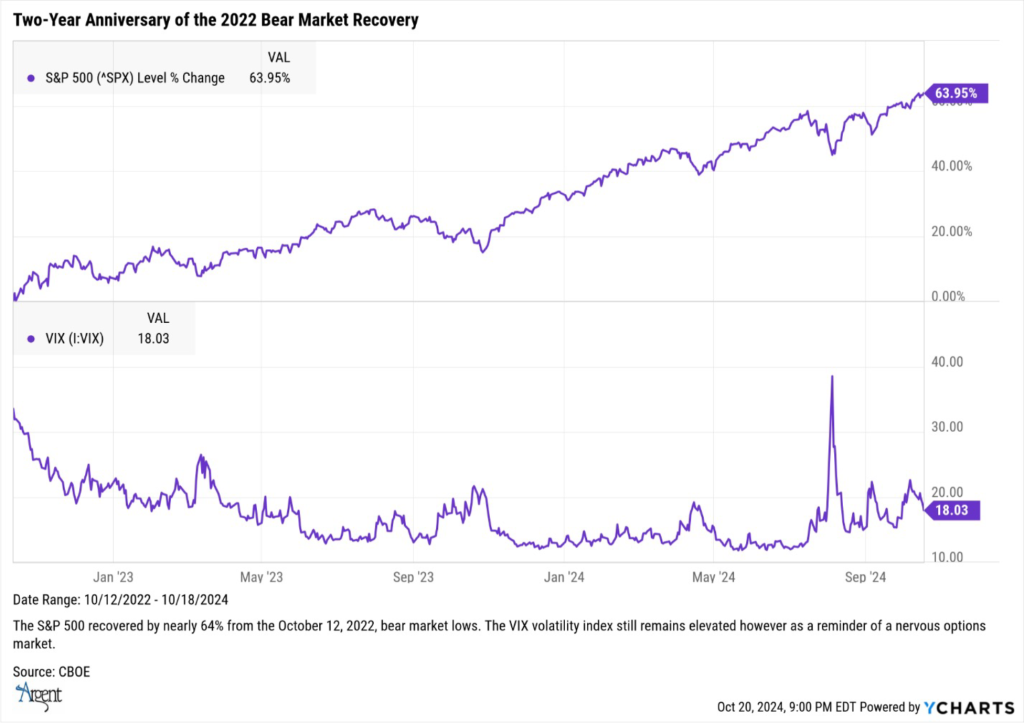
- Two-Year Market Anniversary: The bull market entered its third year following the two-year anniversary of the October 12, 2022, bear market low. As of Friday, October 18, the S&P 500 has surged by 63.9% from its reversal two years ago.
- Services and Manufacturing PMI: After dipping below 50 during the summer, the Services PMI rebounded to the mid-50s, signaling solid growth. However, the Manufacturing PMI remains in contraction, sitting at 47.2, despite showing some recent improvement.
- September Job Growth: Job gains have picked up but remain below summer averages, with unemployment ticking upward. Unemployment claims are still elevated, influenced by the aftermath of two hurricanes, Helene and Milton.
- Retail Sales: Control retail sales—a key indicator of discretionary spending—rose 0.7% in September, compared to a 0.3% increase in August. This uptick in consumer spending reduces the likelihood of a broader economic slowdown.
- Inflation and Household Debt: Inflation has begun to ease after three years of rising costs. However, total household debt has increased by over $2.5 trillion since 2020.
Hard Landing/Soft Landing Continuum
Recent economic data paints a more optimistic picture, reinforcing the narrative that a soft landing—where the economy avoids a severe downturn—is now the most likely outcome. Following a summer lull, multiple economic indicators have shown notable rebounds, fostering optimism about the stability of both economic growth and financial markets. These positive signals suggest the most favorable conditions since early summer. This resurgence in select economic activities aligns with the recent rally in the S&P 500, as equity markets are buoyed by improving fundamentals and a Federal Reserve inclined toward additional rate cuts.
Surprisingly, escalating geopolitical risks—such as the war in the Middle East, the ongoing conflict between Ukraine and Russia, and an unpredictable U.S. election—have yet to derail these positive developments. Despite global macroeconomic concerns, both the U.S. economy and equity markets have defied expectations, seemingly sidestepping an anticipated recession that has loomed for the past 18 months.
Inflation pressures have begun to ease both domestically and abroad, aided by stable commodity prices despite rising global tensions. As of Friday, October 18, the S&P 500 rose nearly 23% on a year-to-date basis. Since bottoming out on October 12, 2022, the index has recovered by nearly 64%. On a sector level, all eleven sectors have posted double-digit returns this year, with Energy (XLE) up 10% and Utilities (XLU) surprising with a 32% gain.
As the year progressed, market breadth has expanded to include income-producing sectors (defensive stocks), such as utilities, alongside more growth-oriented sectors like technology, indicating that investors are diversifying their portfolio exposure. However, despite the S&P 500 holding near new highs, a short-term risk indicator, VIX, remains elevated around the 20 level. This suggests that some investors are continuing to buy short-term puts (hedges) in anticipation of a potential downturn.
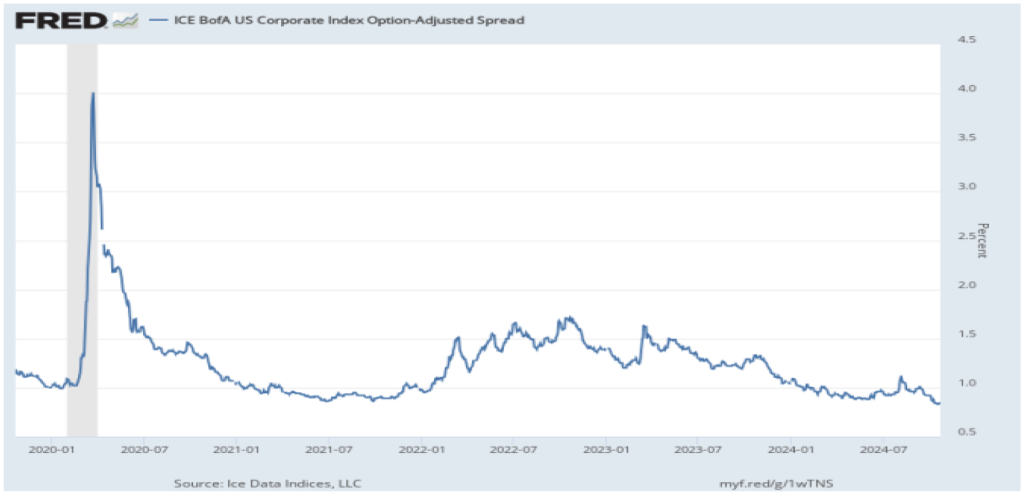
In the credit markets, however, U.S. corporate credit spreads have hit fresh multi-year lows, signaling growing investor confidence. The spread on the ICE BofA U.S. Corporate Index, which reflects the premium investors demand for holding corporate bonds over safer government securities, recently declined to its lowest level since 2005. Meanwhile, strong demand for sub-investment-grade bonds, in particular, suggests optimism about financial conditions, with investors appearing less concerned about potential defaults.
Federal Reserve: Rate Cuts Expected—But Not Guaranteed
The economy’s resilience could create headwinds for future rate cuts. Although current data suggests the Fed may pause after its November cut, two more reductions remain on the table for 2024. However, if growth stays strong, market expectations may shift from a “soft landing” to a “no landing” scenario—where economic growth continues without significant slowing.
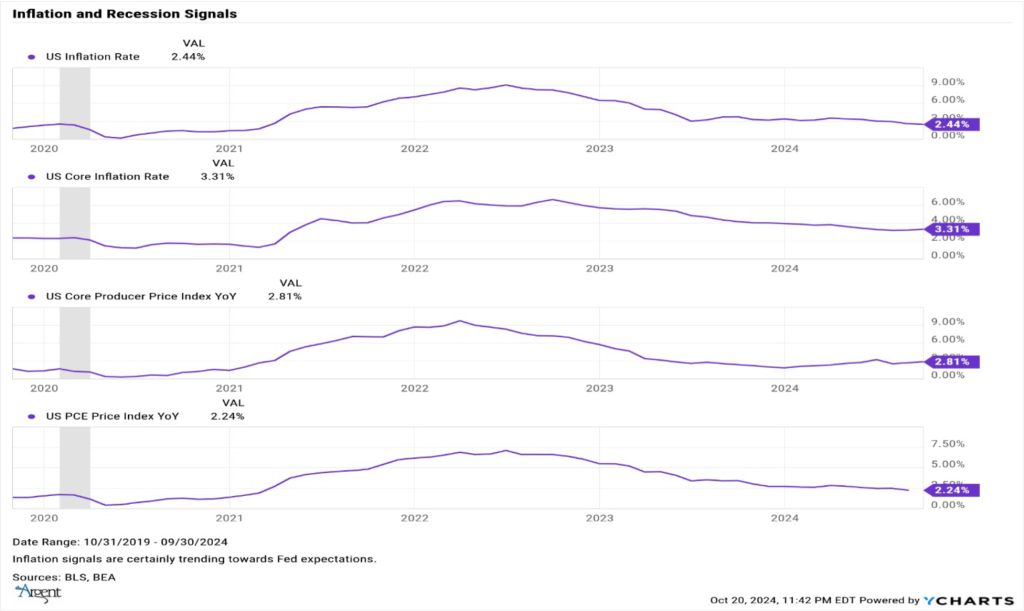
While this shift might temper market enthusiasm slightly, it’s unlikely to disrupt the broader trend as long as growth remains steady. The Fed will likely wait for further confirmation from upcoming ISM PMIs and the October jobs report before making any meaningful policy adjustments. For now, inflation trends remain favorable to Fed policy. As of September, the Consumer Price Index (CPI) rose 2.4% year-over-year—the smallest 12-month increase since February 2021. Similarly, Core Inflation (excluding food and energy) ticked up to 3.3%, slightly above the prior month’s three-year low of 3.2%.
More telling, however, is the Personal Consumption Expenditures (PCE) Price Index, which the Fed closely monitors. As of August 2024, PCE rose 2.2% year-over-year, comfortably within the Fed’s target range, reinforcing the possibility of continued rate cuts. The next Fed policy meeting, scheduled for November 6-7, follows the U.S. election on November 5.
Globally, the European Central Bank (ECB) implemented its second consecutive rate cut, reducing the EU policy rate from 3.5% to 3.25%, as annual inflation in September fell to 1.7% from 2.2% in August. In Canada, headline inflation dropped to 1.6% in September, prompting a 50-basis-point (0.5%) rate cut, bringing policy rates to 3.75%. Domestically, U.S. policy rates now sit in a range of 4.75% to 5.00%.
Consumer Spending Shows New Life
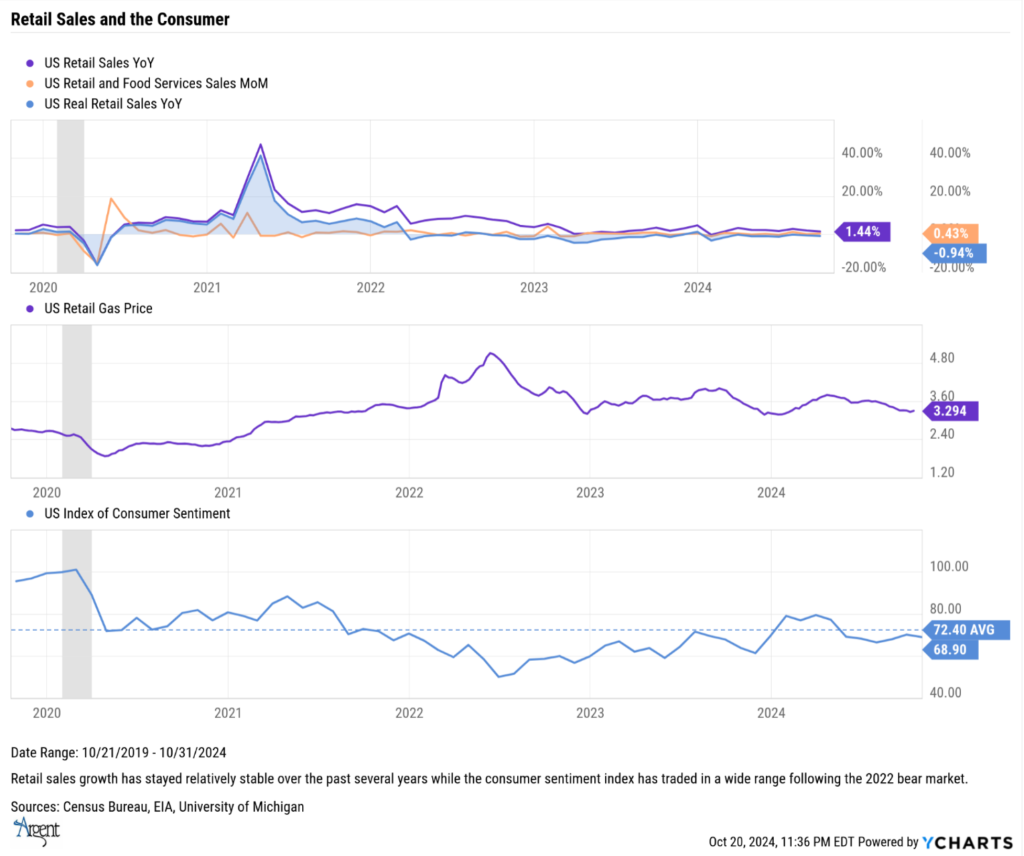
Despite higher credit card interest rates averaging 23.03%, according to WalletHub, consumer spending has remained resilient, with retail sales exceeding expectations last month. Headline September sales rose 0.4% month-over-month, up from August’s 0.1% gain. Excluding autos and gasoline, core retail sales climbed 0.7%—one of the largest gains in the past two years.
Spending and economic growth are being bolstered by solid income gains, ample savings (4.8%), and strong household balance sheets. Although labor market momentum has slowed, layoffs remain historically low, supporting wage growth. Buyers spent more than anticipated, particularly on clothing and personal care products, contributing to the robust retail numbers.
Receipts at food services and drinking places—a key services indicator—jumped 1.0% in September, following a 0.5% increase in August. Economists consider dining out a reliable barometer of household financial health. Clothing store sales rebounded 1.5%, likely driven by back-to-school shopping. Sales at miscellaneous retailers surged 4.0%, while online sales increased 0.4%. Grocery store sales rose 1.0%, possibly reflecting consumer stockpiling in response to Hurricane Helene and a brief dockworkers’ strike.
General merchandise store receipts rose 0.5%, and sales at building material and garden equipment stores gained 0.2%. Consumers also increased spending on sporting goods, hobby supplies, musical instruments, and books. These gains offset declines in other categories, including a 3.3% drop in electronics and appliance store sales and a 1.4% decline in furniture store receipts. Auto dealership sales were flat, while service station sales fell 1.6%, reflecting lower gasoline prices.
The strength in retail sales contrasts with muted consumer sentiment and company reports indicating some hesitance to spend ahead of the U.S. presidential election on November 5. However, the strong sales momentum suggests that, given the 68% weighting of consumer spending in national economic indicators, another robust GDP report for the third quarter of 2024 is likely.
Labor Market: Slowing but Stable
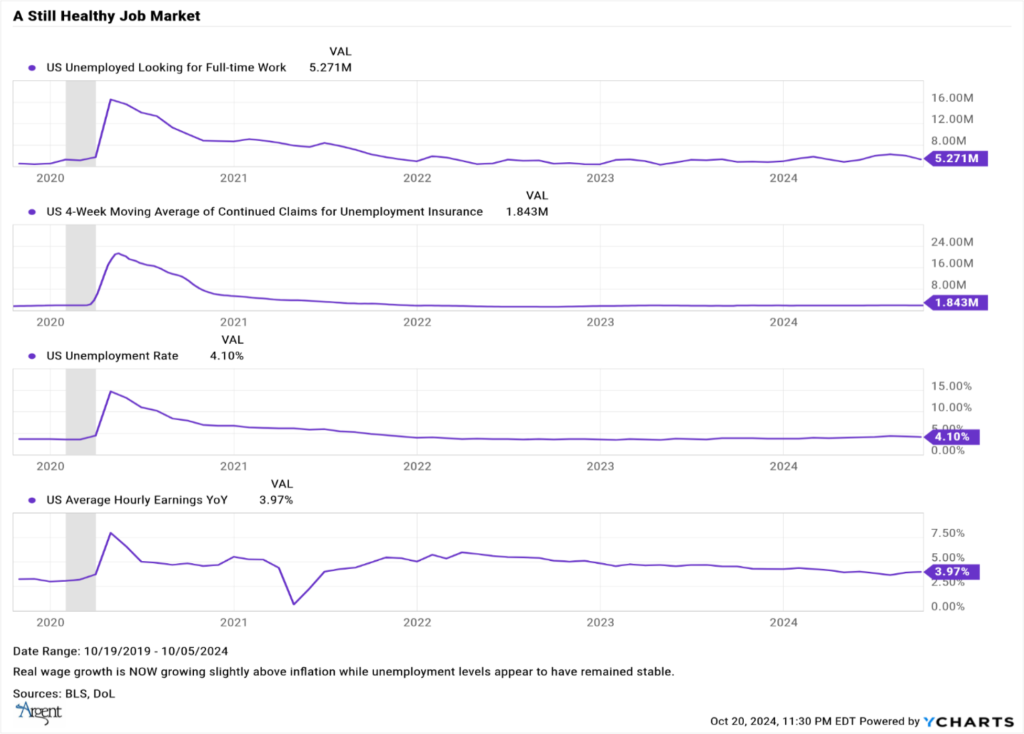
The October 2024 jobs report highlights the strength of the U.S. labor market, surpassing expectations and reinforcing economic momentum. Employers added 254,000 jobs in September, significantly beating forecasts of around 140,000. The unemployment rate edged down to 4.1%, while the labor force participation rate held steady at 62.7%
Robust hiring in the service sector fueled the gains, with the health care (+71,700) and leisure and hospitality (+78,000) industries leading the way. Service industries collectively contributed 202,000 jobs to the total, offsetting challenges in the manufacturing sector, which lost 7,000 jobs. These broad-based job gains signal resilience, reinforcing the likelihood of a “soft landing” where economic growth continues without a sharp downturn.
The report comes just before the Federal Reserve’s November policy meeting, increasing the probability of a series of smaller 25 basis point cuts. Previously, the Fed lowered rates by 50 basis points to maintain economic momentum amid signs of a potential labor market slowdown. However, given the strength of this data, policymakers will most likely opt for more measured adjustments going forward.
Despite the positive job numbers, consumer sentiment remains subdued, reflecting persistent concerns about inflation and uncertainty surrounding the upcoming U.S. presidential election. Nevertheless, with robust job growth and strong consumer spending, analysts expect a solid GDP report for Q3 2024, bolstering optimism for continued economic expansion.
The American Household: Still in good shape-on average
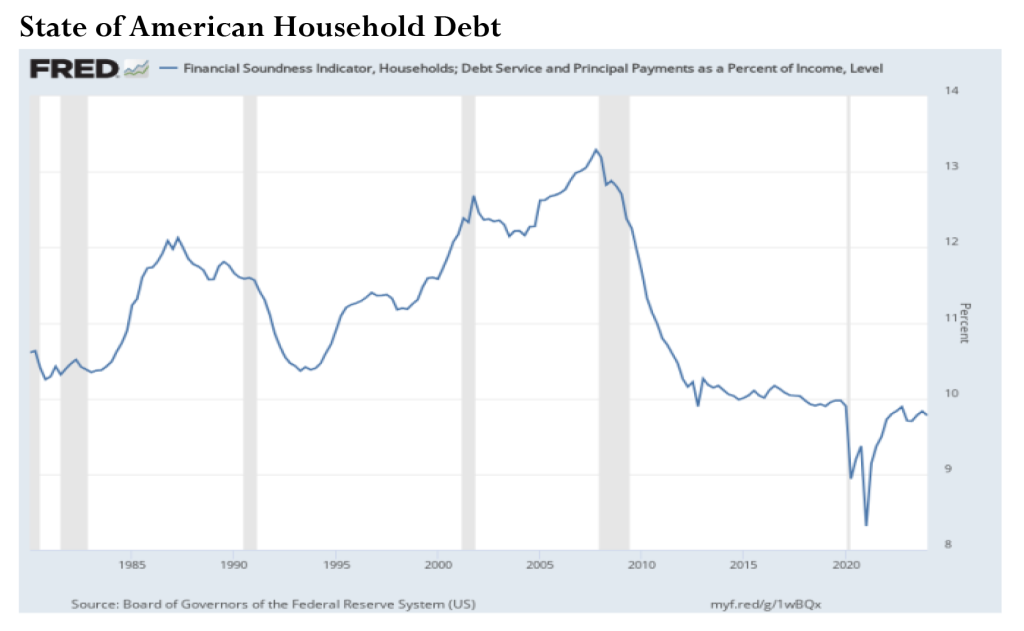
According to The Ascent (Motley Fool Research), American households carried $17.796 trillion in debt as of Q2 2024, averaging $104,215 per household—a record high, according to the New York Fed. Mortgage debt makes up 70% of this total, with an average mortgage balance of $244,498 as of 2023. Credit card debt also climbed, reaching $1.142 trillion by the end of Q2 2024. Although slightly dated, the average balance per cardholder last year stood at $6,501.
Credit card delinquencies are rising, with 9.1% of accounts 30 days or more past due, up significantly from 4.3% in Q2 2021. Despite a moderation in inflation after years of rising prices, delinquency rates have continued to increase. Personal loans and auto loan defaults have also surpassed 2020 levels and are now at highs not seen since the 2008 recession.
Surprisingly, and on a more optimistic note, the Federal Reserve reports that household debt payments as a percentage of disposable income now stand at 9.8%. This is in line with pre-pandemic levels (9.9% in Q4 2019) and significantly lower than the peak of 13.2% in Q4 2007, prior to the financial crisis. While inflation continues to pressure consumer debt servicing, acting as a “silent tax,” these figures provide valuable context. They suggest that despite rising debt levels, household payment capabilities remain stable over the long term.
Markets Justified by Solid Economic Data—For Now
While a soft landing remains the prevailing expectation, it’s important to acknowledge that a hard landing, though not imminent, is still a possibility. However, there are no clear signs suggesting that a severe downturn is on the horizon. Markets now appear to be looking beyond the more challenging periods when recession fears dominated investment sentiment.
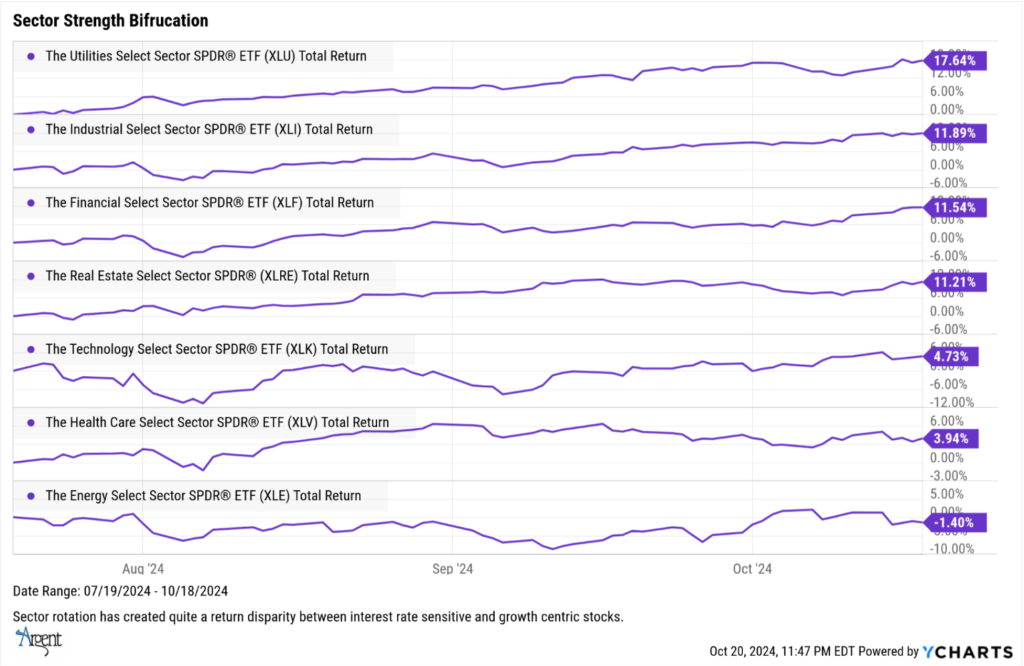
In the first half of the year, market performance lacked broad participation. During the first quarter, the top performing sectors were energy, up 13.51%, communications, up 12.68%, and financials, up 12.44%. Several sectors posted mid-single-digit returns, with real estate being the only one to end the quarter in negative territory. As noted earlier, by October 18, all sectors had turned positive for the year, each delivering double-digit returns (10%+).
Over the past three months, we’ve seen a rotation in market leadership, with utilities, industrials, financials, and real estate taking the lead. In contrast to its strong performance in the first quarter, energy has lagged. However, this could shift if disruptions in Middle Eastern oil supplies trigger production cuts and higher prices, potentially propelling energy back into a leadership position.
With the uncertainty of the coming weeks leading up to election day, it’s wise to stay mindful of potential market volatility. Depending on the election outcome, there could be attractive buying opportunities, making it helpful to have some cash on hand to capitalize on them. However, selling investments solely based on which party might win isn’t a sound strategy, as companies tend to adapt and thrive regardless of the political landscape—at least here in the U.S.
History shows that pre-election efforts to make sweeping portfolio changes often create unnecessary tax events without meaningful benefits. Given the market’s recent run-up, these tax implications may pose a bigger concern than the actual election outcome.
Bottom Line: A Soft Landing (Likely) Still on Track
Economic conditions continue to improve, reinforcing the soft landing narrative. The possibility of a “no landing” scenario is also gaining visibility, with retail sales, consumer spending, and business activity showing resilience. For now, the economy seems positioned to navigate this uncertain period with momentum. A November rate cut still appears likely, but whether the Fed will continue easing in December remains uncertain, as decisions will always be “data dependent.”
As long as growth stays steady and key data remains strong, markets can maintain their current trajectory. However, it’s essential to monitor indicators such as labor market data, corporate earnings, and PMI reports—these will provide early signs of any potential shift in conditions. So far, corporate earnings have been mostly positive, with projections for annualized earnings growth of 14% this quarter and 15.1% next year, much of which is likely already reflected in stock valuations.
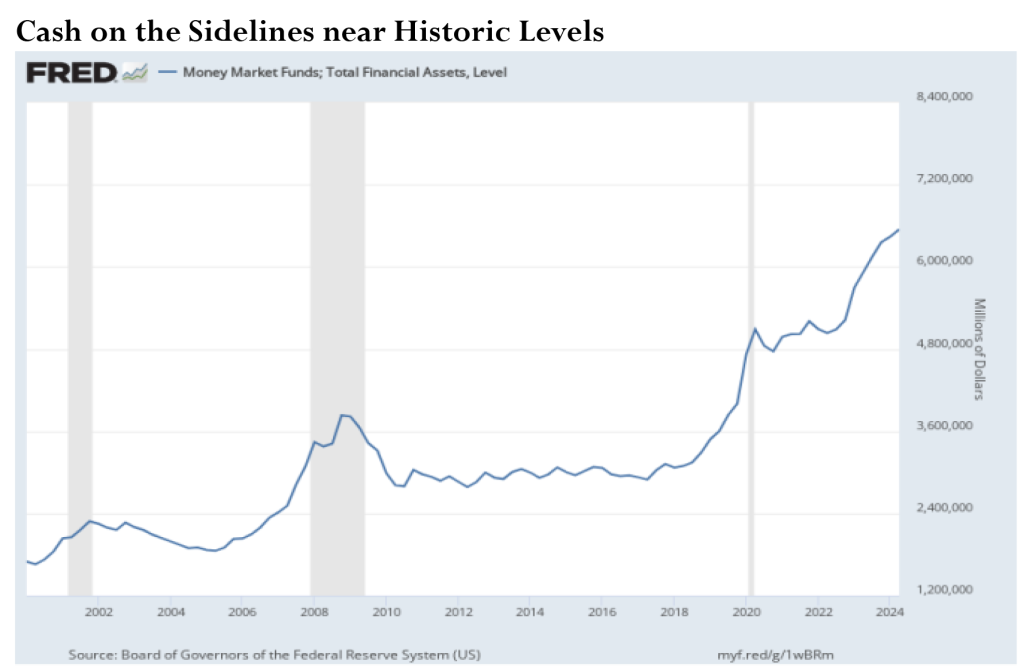
Geopolitical risks and potential Fed policy missteps, however, could alter this outlook. Some reassurance can be found in the significant capital still sitting on the sidelines in money market accounts, providing ample liquidity to support the market, regardless of what lies ahead.
Not Investment Advice or an Offer -This information is intended to assist investors. The information does not constitute investment advice or an offer to invest or to provide management services. It is not our intention to state, indicate, or imply in any manner that current or past results are indicative of future results or expectations. As with all investments, there are associated risks and you could lose money investing.

