
3rd Quarter 2024 Review
• At the FOMC’s September meeting officials lowered the Fed Funds rate by 50 basis points (0.50%) to a range of 4.75% to 5.00% and signaled that they expected another 50 basis points of cuts before year-end 2024
• Additionally, the FOMC currently expects another 100 basis points of cuts (1.00%) in 2025, with an eventual bottom in the 2.75%-3.00% range in 2026
• In the Statement of Economic Projections (SEP) released following the September meeting, the FOMC lowered inflation expectations and its growth forecast, but increased unemployment expectations slightly for year-end
• The core rate of inflation has declined but is still higher than the Federal Reserve’s stated target of near 2%. The Federal Reserve’s preferred measure of inflation, the core PCE price index, was 2.70% year over year in the most recent release
• US Treasury (UST) yields declined in what is known as a “bull steepener” (as short-term yields fell more than longer-term yields) during the quarter due to anticipated rate cuts, cooling inflation, and labor market weakness
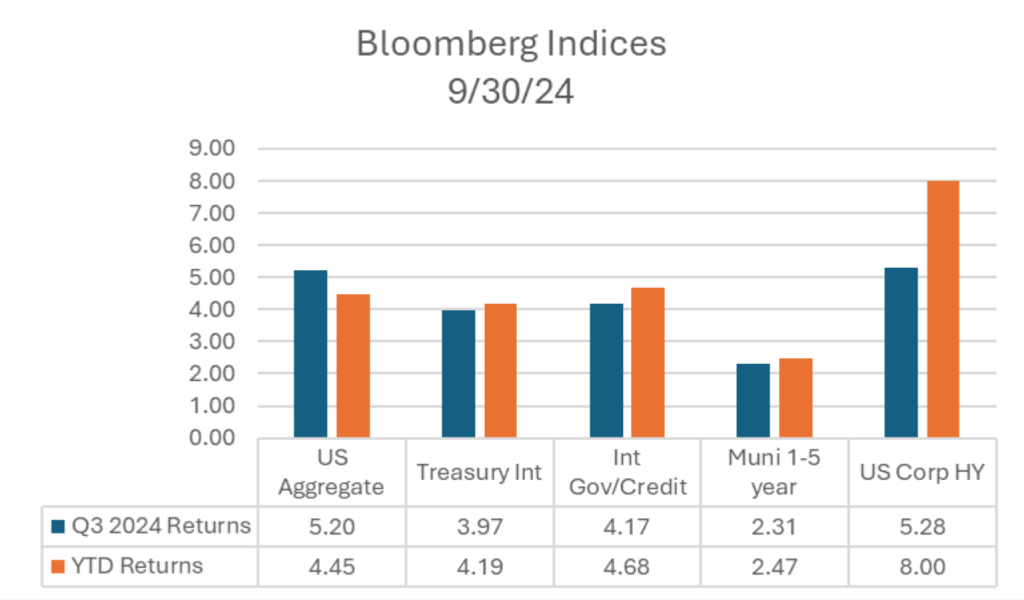
Below are select Bloomberg fixed income index returns for Q3 and Year-to-Date 2024:
Markets
Riskier fixed-income allocations, with sizably larger coupons or cash flows, once again beat total returns for investment grade bonds in both taxable and tax-exempt sectors in Q3. Although more volatile, non-investment grade corporates, tax-exempts, bank loans, emerging market debt, private credit, and asset-backed securities have consistently outperformed traditional “core” strategies for quite some time. Notwithstanding the fact that these sectors are more sensitive to deteriorating economic conditions, it appears many investors continue to embrace riskier allocations in fixed income for more generous cash flows.
We continue to recommend selective exposure to these sectors, with pre-vetted active managers, where appropriate, but remain vigilant.
Below is a graph of the changes in UST yields during Q3 2024:
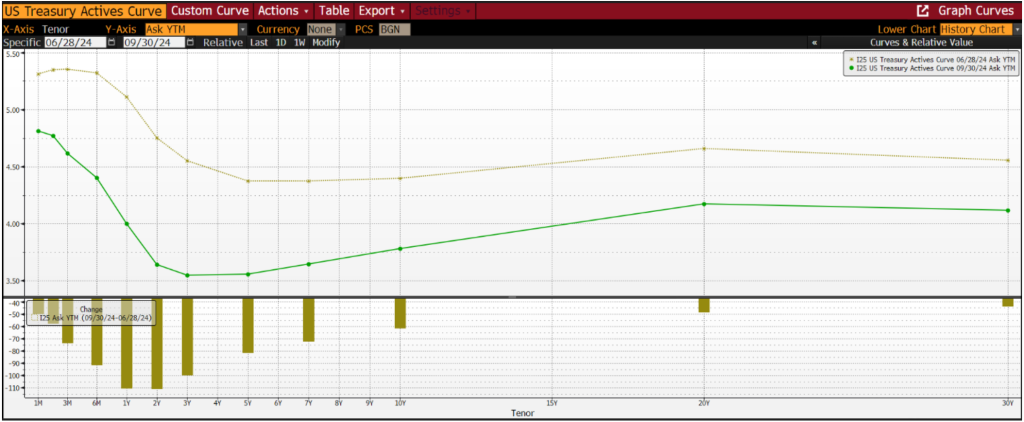
The green line is the UST yield curve as of 9/30/24 and the yellow line is the UST yield curve as of 6/28/24. The lower panel bar chart represents the change in yields by various maturities for this time period.
The 2-year Treasury Note had a third quarter low yield of 3.54% early in September and a high yield of 4.76% in July. The 2-year UST ended Q3 at 3.64%. Similarly, the 10-year Treasury Note had a low yield of 3.62% early in September and a high yield of 4.46% in July. The 10-year UST, widely used as a benchmark rate for many areas of the economy, ended the quarter with a yield of 3.79%.
Long considered a harbinger of economic recession, the 2 to 10-year UST yield curve was inverted (2-year yield higher than 10-year yield) for almost two years. The spread finally “dis-inverted” in early September and was positively sloped at 14 basis points at the end of the quarter.
The Fed
In what was likely the most widely scrutinized Fed meeting this year, the FOMC cut its Fed Funds or “overnight” unsecured deposit rate by 50 bps on September 18th, signaling the beginning of a new phase of monetary policy. The stage had been set for a rate cut of some sort, as FOMC chair Jerome Powell had already declared in August (at the Kansas City Fed’s annual economic conference in Jackson Hole, Wyoming) “the time has come for policy to adjust.” However, there was a very spirited debate during the summer over both the amount of rate cuts required and the timing in which they should occur.
The Federal Reserve System is charged with simultaneously promoting both maximum sustainable employment and stable prices- the “dual mandate.” Because employment has been historically strong following the pandemic, the FOMC has been almost singularly focused on fighting inflation since the first Fed Funds rate hike in March of 2022. While core inflation continues trending in the right direction (currently 2.7%), an unexpectedly weak jobs report for July, released in August, abruptly switched the FOMC’s focus from inflation to employment.
Following what many described as a “preemptive” or “outsized” 50 basis point rate cut by the Fed in September, the overriding questions facing bond investors are (1) Where will overnight rates settle in this easing cycle? and (2) How quickly will they get there? The most recent SEP released following the September FOMC meeting highlights that, on average, Committee members currently project 250 basis points of cuts in total for this policy easing cycle. Just two more 25bp cuts are projected in 2024, then four more in 2025, with another two in 2026. However, the markets currently discount a much more aggressive path, with the “neutral rate” being reached as soon as Q3 2025. A similar disconnect was in place at the end of December 2023 followed by a material walk-back in UST prices as surprisingly strong inflation data surfaced this past January.
What We Think
Based on recent data and a preponderance of third-party research we are currently in the camp of those who anticipate a “soft landing” for the US economy. Central banks in the largest economies globally are all positioned to respond to economic weakness and the US economy may not need rate cuts as deep as currently discounted to fuel a continued expansion. We feel interest rates in this, the most widely anticipated rate cut cycle in recent memory, will settle at a higher level than generally expected, and there is a good chance fixed income markets have discounted too many rate cuts too quickly.
The US Treasury market has already done much of the work for the Fed. The 10-year yield peaked at 5% more than eleven months ago (as of this writing it stands near 3.75%) and fixed income markets have already reversed a sizeable portion of the post pandemic tightening cycle. That said, it is likely that very short-term rates in the US will continue to fall as core inflation trends on a positive path and employment concerns remain in focus.
With global conflicts proliferating and fiscal responsibility bowing to political pressure in most developed economies, conditions can change rapidly. Going forward, we will continue to focus on credit quality and liquidity, as well as opportunities to diversify and enhance cash flow to augment risk-adjusted returns for our fixed income clientele.
Please contact one of the individuals below, or your Argent portfolio manager, with questions or comments regarding this commentary or the fixed income markets in general. We look forward to hearing from you.
For additional information, please contact one of the commentary contributors below:
Sam Boldrick: sboldrick@argenttrust.com
Hutch Bryan: hbryan@argenttrust.com
Matthew Kimbrough: mkimbrough@argenttrust.com
Not Investment Advice or an Offer | This information is intended to assist investors. The information does not constitute investment advice or an offer to invest or to provide management services. It is not our intention to state, indicate, or imply in any manner that current or past results are indicative of future results or expectations. As with all investments, there are associated risks and you could lose money investing.

