

The Cost of Waiting for Higher Yields
What Yield Would Make Waiting Worthwhile
The recent rise in bond yields and the uncertain path for rates going forward provide an opportunity to reflect on what a bond’s yield-to-maturity represents, and how it fits into a broader discussion of returns. This note focuses on how narrowly using YTM as a measure of value/return may lead to a misjudgment of value, particularly when assessing whether higher yields today justify increasing fixed income exposure.
A bond’s yield-to-maturity (YTM) is often the most cited measure of its value. However, its wide acceptance and use in market commentary risk painting an incomplete picture of what return the buyer may expect to receive, and, for an investor delaying an investment, it gives no indication of what YTM would be equivalent for that same security later.
YTM represents an annualized rate of return that an investor may earn if a bond is purchased at its current market price, held until maturity, and all interim cash flows are reinvested at the same yield. It is also the single rate that, when used to discount each expected future cash flow, produces the current market price. While providing an approximation of expected return, it should not be viewed as a guaranteed outcome and is unlikely to be fully realized unless its underlying assumptions hold.
Sources of Return: Coupon + Pull-to-Par + Roll + Market Yield Changes
Returns are more completely understood through the contributions of coupon income and price appreciation or depreciation. This allows for an assessment of what future YTM an investor should be economically indifferent to, as well as what yield level over a fixed horizon would serve as a breakeven between a positive and negative return.
Most fixed-income securities[1] trade in price, rather than yield terms. A bond purchased for a price of 98 (98 percent of par) equates to $980,000 for $1mn face/par[2]. The $20,000 difference will be gained as the bond approaches maturity. The pace of convergence will reflect the par price being discounted over shorter horizons as well as the shape of the yield curve as it approaches maturity.
Coupon Return
Coupon interest is typically the largest source of return to the buyer of a bond. The coupon rate represents the amount of interest income a holder can expect to receive independent of market price fluctuations. Most fixed-income securities (Treasuries and corporates) pay interest on the purchased par/face value to the holder twice per year. For instance, a 5% coupon would make two payments of 2.5% each. Coupon interest accrues daily to the owner but is paid on predetermined payment dates. The owner receives any accrued interest in addition to the quoted market price if selling between coupon dates.
Market Price Changes
Unlike the predictability of coupon interest, bond price changes are primarily driven by their sensitivity to changes in interest rates, as well as their eventual convergence to a par price of 100.
While a bondholder receives par at maturity, its price may trade above or below par as market conditions shift. As it approaches maturity, those price fluctuations will generally become smaller in magnitude. A bond’s price sensitivity to interest rates is primarily gauged by its duration, which captures the time over which its cash flows will be received. Bonds with more time to maturity and lower coupon rates tend to have more duration and therefore exhibit the largest price moves in response to market interest rate changes.
Pull-to-Par
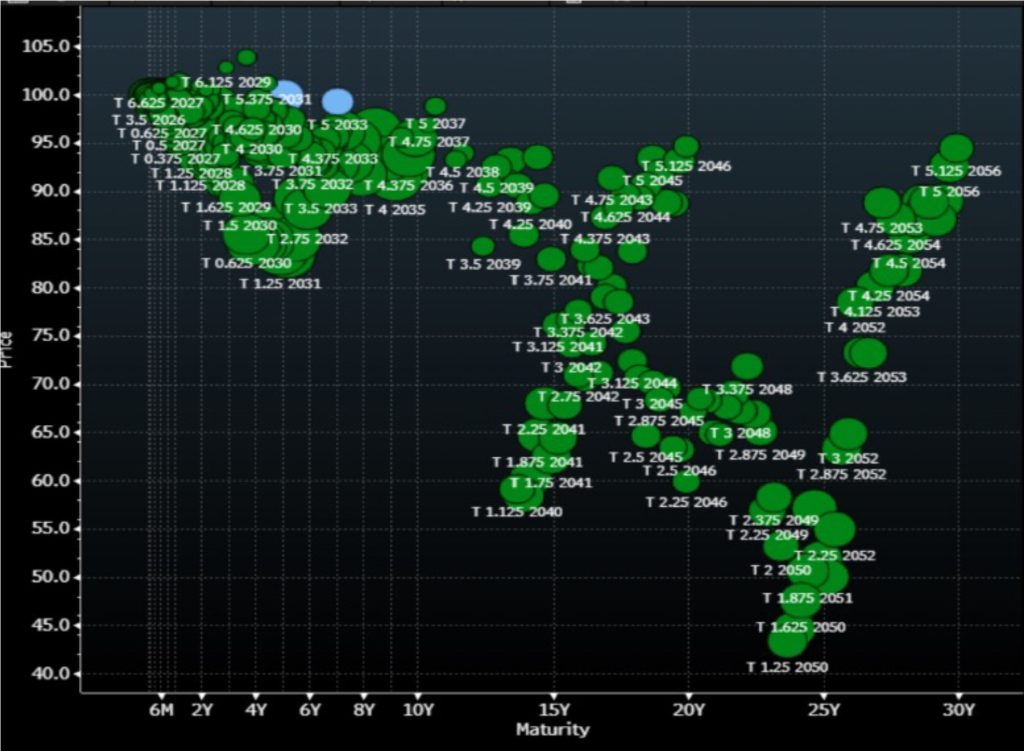
Independent of market fluctuations, bond prices will naturally gravitate towards par as they approach maturity. Chart 1 depicts this effect. The dispersion of prices around maturities mainly reflects coupon differences. For a given maturity, higher coupon bonds tend to trade at higher prices due to a larger portion of their return coming from interest income than price.
The portion of the move towards par independent of market yields is known as a bond’s “pull-to-par”. Pull-to-par is largely a function of the bond issuers’ obligation to repay at par, though it is also driven by the bond’s par value price being discounted over shorter horizons, which mechanically results in the price converging to 100.
Roll
Additionally, the rate at which price converges to par is also driven by the slope of the yield curve or “roll”. As prices and yields move inversely, a larger spread between yields of differing maturities results in a more pronounced roll effect. Lower yields/higher prices at shorter maturities produce positive roll; higher yields/lower prices result in negative roll.
Since pull-to-par and roll are both impacted by the passage of time, it is important to be sure their effects are isolated. This is done by separating the price change from simply aging with unchanged yields (pull-to-par) and the price impact of the current security trading at the shorter maturity yield at the defined horizon (roll).
For instance, the owner of a 5-year bond today will own a 3-year bond in 2 years. Therefore, the slope of the yield curve “roll” and the passage of time independent of yield levels “pull-to-par” will both be at work. Importantly, roll is not fixed, as the slope of the yield curve is not constant; however, maturities on parts of the curve with greater roll will contribute a disproportionate portion of price returns. It is common for fixed-income strategies to overweight allocations to these portions of the curve for this reason, rather than passively allocating across maturities.
Current Prices/Coupons Provide Substantial Cushion Against Yield Increases
An understanding of a bond’s price sensitivity to interest rates, along with coupon income, estimates of pull-to-par and roll, provides investors with a more useful framework for assessing bond value than YTM alone. Moreover, it is valuable when evaluating the opportunity cost of delaying an investment and/or what yield levels would need to be approached to offset this return over a given period.
For example, an investor has the option to buy a 5-year bond today with a 5% coupon and 5.09% YTM or wait 1 year to invest, forgoing the coupon income and price returns. The relevant question therefore becomes what yield would need to be available one year from now to leave the investor with the same return potential.
This can be answered using the concept of forward breakeven price/yield shown in the table below.
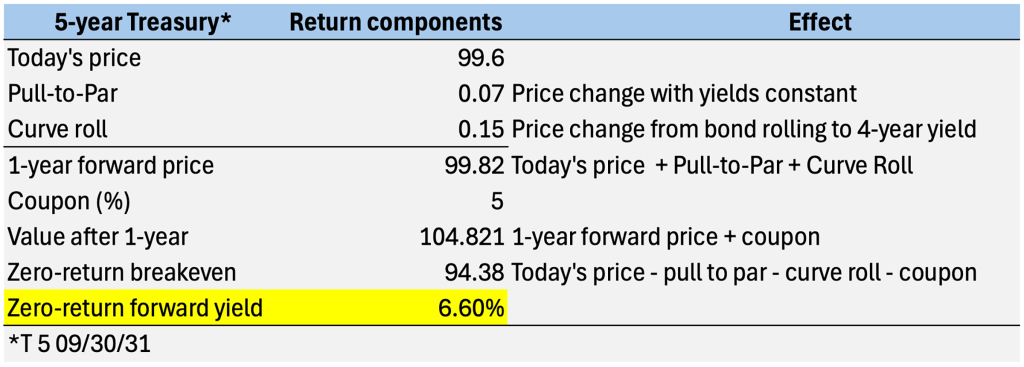
The table above shows that the current 5-year Treasury would need to trade at a price of 94.38, well below current levels, to offset coupon and price returns over the next year. This, of course, rests on the assumption that current 4-year yield levels are realized, so it is by no means a guarantee. In yield terms, this implies the current 5-year bond is trading at a roughly 6.6% yield over the next year, well above market expectations and a level not seen on any sustained basis since the mid-1990s.
The takeaway here is that while it is natural to focus on whether yields can continue their ascent from current levels, there is a cost to waiting for higher future yields. Coupon income, pull-to-par, and roll all contribute to return while an investor remains out of the market. As a result, future yields must be substantially higher to simply offset the forgone return. So, while YTM can be seen as a part of making an assessment of relative value, a more complete assessment requires understanding the underlying sources of return.
[1] Treasury bills and other very short-term instruments trade in yield terms.
[2] Buyer will also pay seller accrued interest since last coupon date.
Not Investment Advice or an Offer -This information is intended to assist investors. The information does not constitute investment advice or an offer to invest or to provide management services. It is not our intention to state, indicate, or imply in any manner that current or past results are indicative of future results or expectations. As with all investments, there are associated risks and you could lose money investing.


