

BY: Matthew Kimbrough
Senior Portfolio Manager
Fed Signals the Start of a Modest Tightening Cycle
The 2026 PIVOT is Here: The Fed Announces Tighter Monetary Policy
As of this morning, Fed Funds futures markets indicated a 93% chance that today’s meeting would result in a 25bp rate hike. The same gauge also suggested that 3-4 total rate hikes are expected over the next 12 months. This is a far cry from market expectations earlier in the year, as back in January, 2-3 cuts were penciled in for the following 18 months. The difference between these two extremes is an astounding 175 basis points.
Over the course of the year, treasury yields have followed suit, rising significantly alongside expectations of tighter monetary policy. At the time of this writing, the 2yr UST yield is up 114bp, the 5yr UST yield is up 103bp, the 10yr is up 76bp, and the 30yr is up 47bp in 2026. Within the past month, yields on both the 10yr and the long bond reached levels that had not been seen since 2007.
Although Warsh appeared reticent to act, as of the July FOMC meeting, recent economic data and market expectations may have forced his hand this time around. Additionally, in his speech at the Jackson Hole Economic Symposium in late August, he set the stage for tighter conditions when he stated that “I would be hard-pressed to describe broad financial conditions as restrictive.”
The eyes of FOMC members remain squarely set on their 2% inflation target, and recent PCE and CPI inflation data have confirmed that not enough progress is being made on this front. A portion of inflation’s recent stickiness is attributable to energy supply shocks and the rise in oil prices due to the conflict with Iran. The inflationary effects of this conflict can also be seen in other nations, as guidance from both the ECB and the Bank of England has recently turned hawkish (with 4-5 hikes expected from each institution over the following year).
The announcement of a rate hike today represents a reversal of the trajectory that was established in September of 2024, officially pivoting from less restrictive to more restrictive (tighter) monetary policy.
The Decision
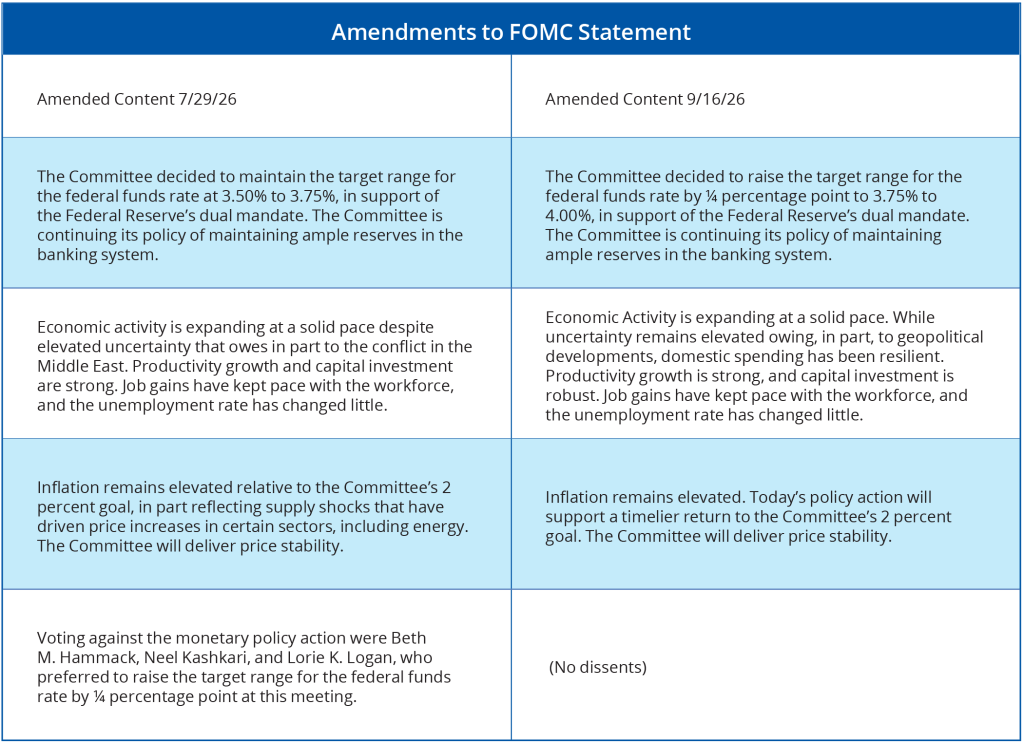
A new pivot for the Fed—at the conclusion of today’s FOMC meeting, the Fed Funds rate was raised 25 basis points, to a new range of 3.75%–4.00%.
Today’s decision was unanimous; there were no dissents.
The Statement
This meeting’s statement contained few amendments, which are highlighted in the chart below.
New Economic Projections
Fed Chair Warsh has called for a formal review of the SEP by the Fed Communications Task Force. A year-end deadline was set for the 5 new Task Forces to publicize their findings. The Fed Chair’s own projections are no longer listed within the SEP.
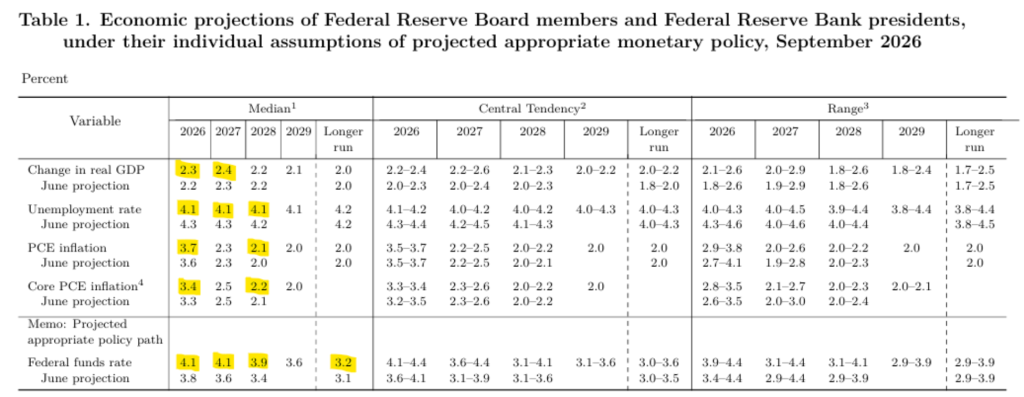
The most significant aspects of this quarter’s Statement of Economic Projections (SEP) document are highlighted below.
1| The median Dot Plot projection now shows one additional 25bp rate hike in 2026, with 16 of 18 participants projecting at least one rate hike and 4 participants projecting two hikes. Interestingly, the long-run Fed Funds rate also ticked up from 3.1% to 3.2%.
2| Core PCE inflation expectations for year-end 2026 moved slightly higher, from 3.3% to 3.4%.
3| Real GDP is expected to be 2.3% for 2026, 0.1% higher than projected in June. 2027 GDP projections also increased by 0.1%.
4|Year-end unemployment expectations declined 0.2% to 4.1%, holding there through 2027.
Warsh’s Prepared Remarks & Press Conference
His prepared remarks reiterated that the FOMC’s primary focus is on the inflation side of its dual mandate. He stated that they must be confident that inflation is moving towards the target clearly and at sufficient speed. He also stated that the unanimous vote today shows commitment towards that goal.
The press conference progressed quicker than prior press conferences due to a new format. If a reporter asked more than one question, Warsh would cherry-pick just one question to answer from each person.
Warsh indicated that even if rate hikes are not tools to directly address supply shocks, they may be able to ensure pockets of inflation do not broaden out.
Warsh characterized today’s rate hike as “removing a dose of accommodation” but failed to specify whether this resulted in a new range that equated to restrictive territory.
One reporter noted that while the statement mentioned a “timelier” return to the 2% inflation target, the SEP might be considered incongruent with this, as the projection for a return to 2% was pushed out from 2028 to 2029.
Today’s SEP projections showed a 0.1% increase in the longer-run Federal Funds rate, an acknowledgment that the economy may be in a higher neutral-rate regime. It was also interesting that Warsh dismissed the operational relevance of the neutral rate during the press conference, calling it an “academic matter” with no effect on current policy decisions.
Warsh pushed back on all questions involving President Trump, stating that “the independence of the Federal Reserve means that we stay in our lane.”
He did, however, acknowledge meeting with other central bank counterparts at recent conferences, stating that they are facing price pressures too and they are acting in conjunction with their own remits. He admitted that to some extent spillover effects do exist where the actions of one central bank can affect others across the globe.
When asked about the rise in Treasury yields since the last FOMC meeting, he referenced three reasons—economic strength, the competition for capital from hyperscalers, and geopolitics.
The Market Reaction
At the start of the day, Treasuries rallied (yields were down around 5bp across the curve). However, partly due to Warsh’s hawkish tone during the press conference, this rally dissipated, and the curve flattened, led by a rise in short-term yields; the 2yr UST at one point reaching 4.72%, its highest yield since mid-2024.
Not Investment Advice or an Offer | This information is intended to assist investors. The information does not constitute investment advice or an offer to invest or to provide management services. It is not our intention to state, indicate, or imply in any manner that current or past results are indicative of future results or expectations. As with all investments, there are associated risks and you could lose money investing.


