


BY: Tom Stringfellow, CFA®, CPA®, CFP®
Chief Investment Strategist
Earnings Strength but Higher Hurdles
- Market participation has improved meaningfully in recent weeks, with small caps and equal-weight indices beginning to outperform.
- While leadership remains selective, the market is transitioning from narrow concentration toward broader, but still uneven, participation.
- Earnings remain the primary support, with strong growth, rising forward estimates, and historically high profit margins.
- Macro conditions remain a constraint, with higher oil prices and interest rates limiting the margin for error.
- The market environment is constructive but requires selectivity, as dispersion across sectors and individual stocks remains elevated.
Markets Moving Ahead of Headlines
At the open of this last trading day in April 2026 (Thursday, April 30, 2026), markets continue to demonstrate a pattern that has repeated throughout history. Equity prices have moved higher despite ongoing geopolitical uncertainty, elevated oil prices, and shifting expectations around monetary policy. The extension of the ceasefire between the U.S. and Iran has provided some stability, but uncertainty remains, and markets appear comfortable moving forward without full resolution.
The S&P 500’s recovery from its early-year drawdown reflects a repricing of expectations rather than a resolution of risks. Earlier in the year, markets discounted worst-case scenarios, including escalation in geopolitical tensions, higher inflation pressures, and a more restrictive Federal Reserve. As those risks stabilized, even modestly, capital repositioning drove a meaningful rebound.
This behavior is consistent with historical precedent. Markets typically bottom well before geopolitical conflicts are resolved, not because outcomes are known, but because expectations become sufficiently priced. Once the range of outcomes narrows, markets shift focus back to fundamentals.
At present, those fundamentals, particularly earnings, are improving. That is the key factor supporting the current environment and explains why markets have been able to advance even as headline risks remain elevated.
Liberation Day One Year Later: Adjustment Rather Than Resolution
One year after “Liberation Day”—the April 2025 policy announcement that formalized a new phase of U.S. trade strategy through expanded tariffs and a renewed push toward domestic manufacturing and supply-chain independence—the economy looks less like a system that escaped risk and more like one that adjusted to it. The policy was intended to reduce reliance on foreign production, strengthen national industrial capacity, and create more resilient supply chains. In practice, it also introduced a new set of frictions, including higher input costs, shifting trade flows, and renewed inflation sensitivity.
The original concerns around tariffs, supply-chain disruption, higher input costs, and inflation pressure did not disappear. Instead, they were absorbed across different parts of the economy.
Growth has slowed, but it remains positive. Consumers are still spending, though the quality of that spending has changed. Corporations continue to report strong results, but the market is rewarding those with visible earnings growth far more than those relying on broad economic momentum.
That is the core shift from a year ago. The economy is still expanding, but it is doing so through a narrower set of supports. AI-related capital spending, select industrial activity, and stronger-than-expected earnings have helped offset pressure from higher oil, higher rates, and weaker sentiment.
This does not suggest an economy on the verge of collapse, but it does suggest a more conditional environment. The system is holding, but it requires earnings, policy, and inflation expectations to remain reasonably stable.
Domestic Markets: Index Strength with Uneven Participation
Domestic equity markets remain firm, but the internal story has changed meaningfully since the earlier part of the year. The market is no longer being driven only by large-cap growth. Through April 29, market close, the Russell 2000 ETF (IWM) was up 10.73% year-to-date, compared with 6.34% for the Nasdaq Composite, 5.06% for the S&P 500 Equal Weight ETF (RSP), 4.64% for SPY, and 2.11% for the Dow ETF (DIA).
This shift toward a broader market spectrum is important. It suggests that investors are becoming more willing to allocate capital beyond mega-cap technology and into more economically sensitive areas. Small-cap strength reflects improving confidence in economic stability and earnings resilience.
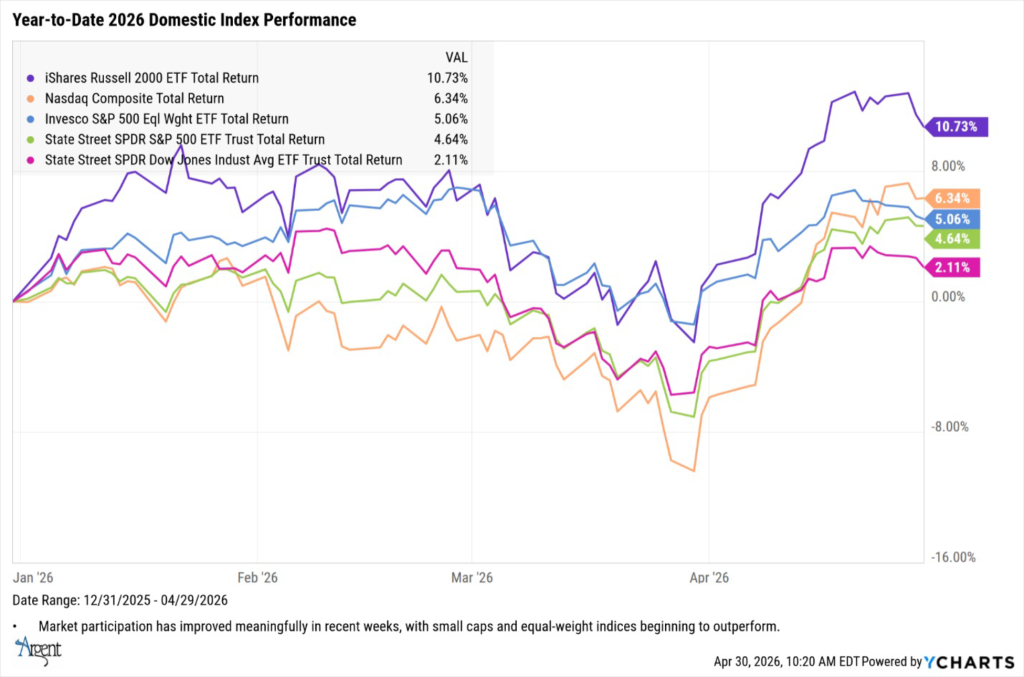
That said, the broadening remains incomplete. While participation has improved, it has not yet reached the level typically associated with early-cycle expansions. The market is transitioning from narrow leadership toward broader participation, but it is not fully synchronized. Performance is still being driven by companies with earnings visibility, pricing power, and exposure to durable investment themes.
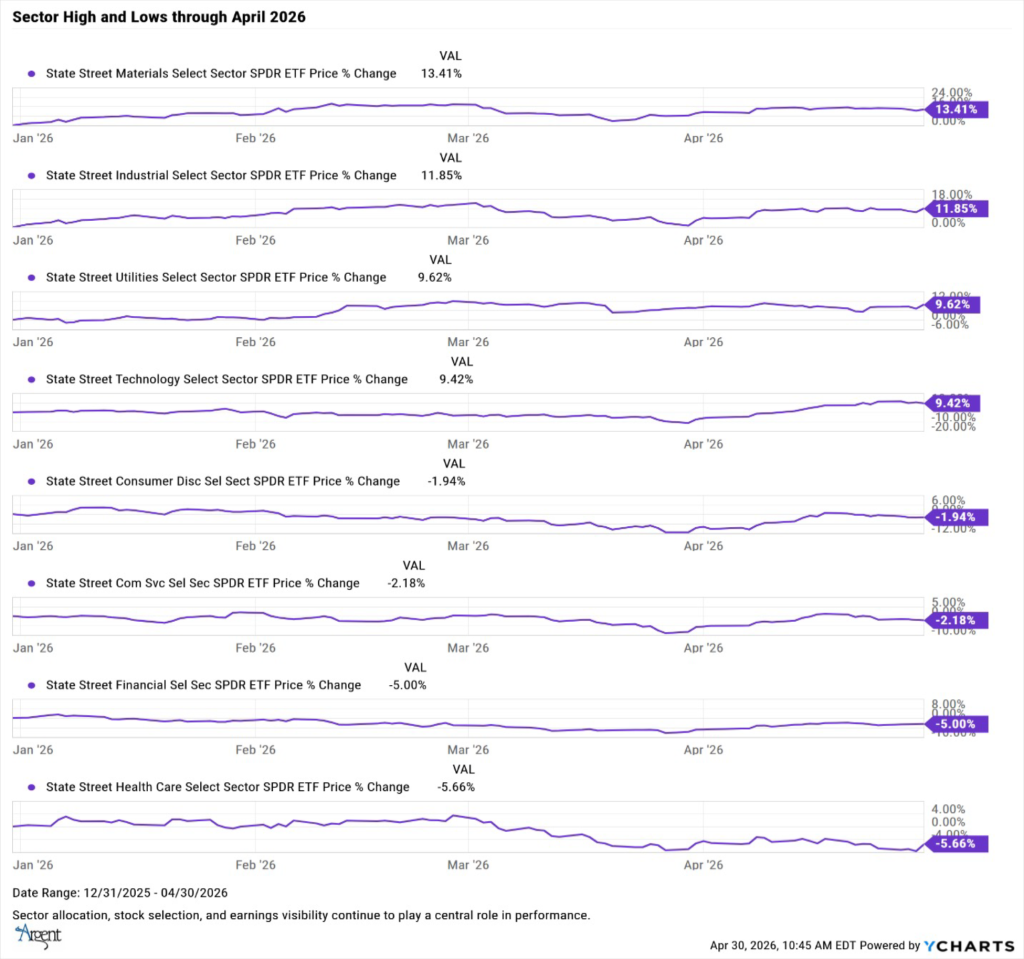
This is a more constructive environment than earlier in the year, but it remains selective. Broad exposure alone may not capture the full opportunity set. Sector allocation, stock selection, and earnings visibility continue to play a central role in performance.
Corporate Earnings and Profit Margins: The Strongest Argument for Equities
Corporate earnings continue to provide the strongest support for equity markets. As of late April, approximately one-quarter of S&P 500 companies have reported first-quarter results, with the majority exceeding expectations on both earnings and revenue.
Aggregate earnings growth has been strong, supported by demand in technology, industrials, and select cyclical sectors. Revenue growth has also been healthy, indicating that earnings gains are not solely the result of cost-cutting.
Forward expectations have improved as well. Consensus estimates now project earnings growth in the high teens for 2026, with several quarters expected to exceed 20% growth. These upward revisions are a key factor supporting current valuations.
Profit margin data is one of the more important parts of the current story. Despite higher oil prices, wage pressure, and rising input costs, the S&P 500 blended net profit margin for Q1 2026 is running at 13.4%. If that holds, it will mark the highest net profit margin since
FactSet began tracking the metric in 2009, exceeding the prior record of 13.2% from the previous quarter.
That is not what one would normally expect in an environment with rising energy costs. At the sector level, five sectors are reporting year-over-year margin expansion, led by Information Technology, where margins have increased to 29.1% from 25.4%. Six sectors are reporting year-over-year margin declines, led by Communication Services.
Energy is also interesting. Even with higher oil prices, Energy margins are below their five-year average, at 6.6% versus 9.6%. That suggests higher prices are not flowing cleanly into margins across the sector.
FactSet also shows analysts expect margins to move even higher through the rest of the year, with Q2 through Q4 estimates at 14.1%, 14.6%, and 14.6%. That is a key reason the market remains supported.
Consumer Spending and Inflation: Holding Up, But Increasingly Stretched
Consumer spending continues to hold, but the details are less clean than the headline suggests. March retail sales rose 1.7% month-over-month and roughly 4% year-over-year. That is a strong headline, but gasoline was a major driver. Gas station sales rose sharply during the month and accounted for a disproportionate share of the increase, reflecting higher energy prices rather than a broad-based acceleration in demand.
The broader income and spending data reinforces that point. Personal spending increased 0.9% in March, outpacing personal income growth of 0.6%. While both figures were solid and generally in line with expectations, the gap between spending and income resulted in a personal savings rate of 3.6%, which remains below levels seen during the prior economic expansion. That dynamic suggests consumers are maintaining spending, but with less financial cushion.
After adjusting for inflation, real spending was meaningfully lower than the headline retail figure, reinforcing the idea that nominal strength is being supported in part by higher prices rather than purely higher volumes. The control group, which excludes gasoline, autos, and building materials, rose 0.7%, suggesting underlying demand remains intact but not accelerating.
Inflation remains an important part of the story. The PCE deflator rose 0.7% in March and 3.5% year-over-year, while core PCE increased 0.3% on the month and 3.2% annually. Both measures remain above the Federal Reserve’s target and reflect continued pressure from energy prices and broader cost dynamics.
At the same time, labor market conditions remain stable. Initial jobless claims declined to 189,000, while continuing claims fell to 1.78 million, indicating that layoffs remain contained and employment conditions continue to support household income. However, the composition of income may be shifting, with some workers supplementing earnings through part-time or gig employment.
The category data shows where pressure is building. Online sales continue to grow at a high single-digit pace year-over-year, while restaurant spending has been flat to modestly higher. That divergence suggests consumers are still spending but becoming more selective and more price-sensitive.
This is not a collapsing consumer. It is a consumer reallocating. Higher energy costs and rising prices in essential categories are crowding out portions of discretionary spending. That distinction matters because it supports growth today, but it leaves less flexibility if inflation remains elevated or labor income begins to soften.
Economic Activity: Growth Holding, But Becoming More Uneven
Economic activity remains in expansion, but the composition of that growth is shifting. The ISM Services PMI registered 54.0 in March, down from 56.1 but still above its 12-month average. Business activity slowed to 53.9, while new orders rose to 60.6, the highest level in over a year. Demand remains intact, but momentum is moderating.
The more important development is beneath the surface. The services employment index fell to 45.2, its first contraction in four months, while the prices index jumped to 70.7, the highest level since late 2022. Supplier deliveries also slowed, reflecting ongoing supply frictions. The combination points to continued growth, rising costs, and weakening hiring momentum.
Manufacturing shows a similar pattern. The ISM Manufacturing PMI rose to 52.7, marking a third straight month of expansion, with production, new orders, and backlogs all indicating real demand. However, prices paid surged to 78.3, and employment remained below 50, suggesting output is increasing without corresponding labor growth.
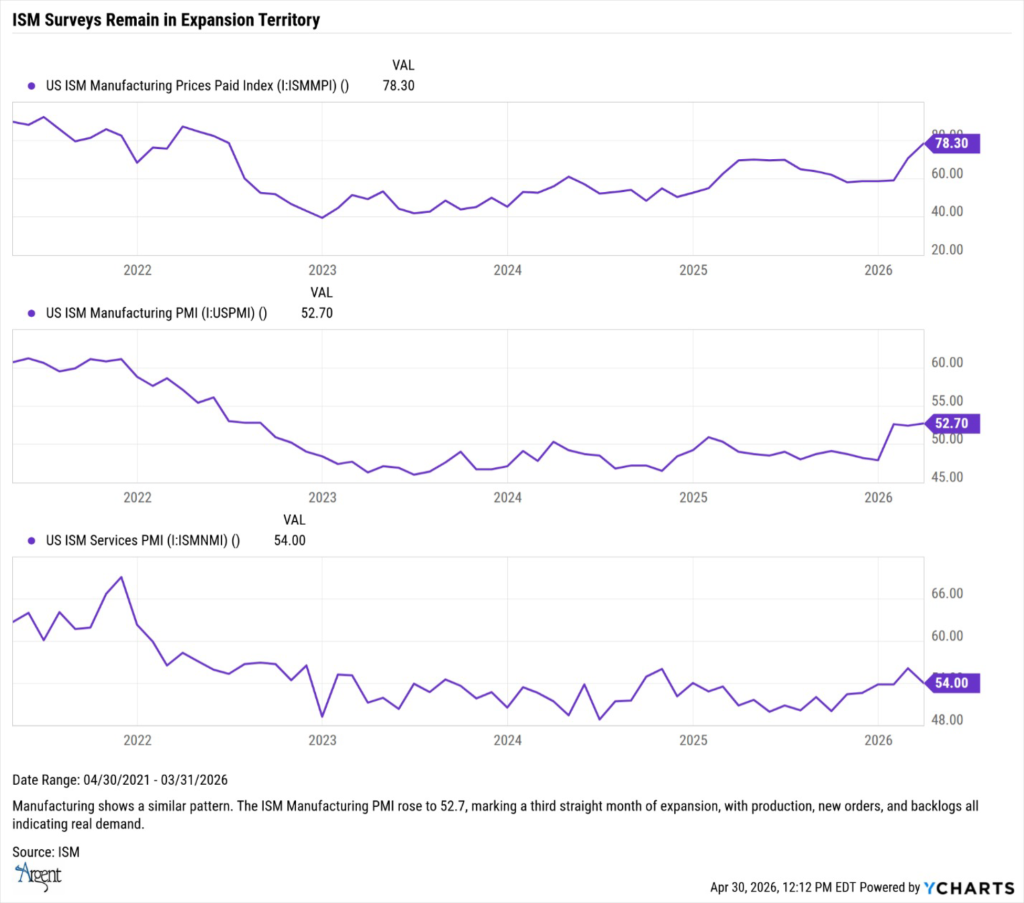
The GDP report reinforces this trend. First-quarter growth came in at 2.0%, supported by investment, exports, and consumer spending. Strength was concentrated in equipment and intellectual property, particularly technology-related investment, while residential and nonresidential structures declined. Consumer spending was driven more by services than goods. Across services, manufacturing, and GDP, the message is consistent. The economy is still growing, but growth is becoming more dependent on investment and services, while inflation pressures and uneven labor trends limit the margin for error.
Federal Reserve and Rates: Policy Pause, Leadership Transition, and a Narrower Path Forward
The Federal Reserve’s position has shifted meaningfully, both in policy stance and leadership outlook. At its most recent meeting, the FOMC voted 8–4 to leave the fed funds rate unchanged at 3.50%–3.75%, a widely expected decision but one that reinforces the current “pause” regime. Earlier in the year, markets were pricing multiple rate cuts in 2026. Those expectations have largely been removed, as inflation pressures—particularly from energy—have re-emerged and labor market conditions remain resilient.
At the same time, the policy backdrop is becoming more complex with the anticipated transition in Fed leadership. Jerome Powell chaired what is expected to be his final meeting as Fed Chair, with Kevin Warsh moving through the confirmation process and likely to assume the role in May. Powell has indicated he may remain on the FOMC in a limited capacity, though the timing and scope remain uncertain.
Powell’s tenure will likely be viewed through two lenses: the aggressive policy response that supported the economy during the early stages of the pandemic, and the delayed response to post-pandemic inflation, which has been widely debated. More recently, tensions between the Federal Reserve and the administration have brought renewed focus to central bank independence, a dynamic that could influence both policy communication and market perception going forward.
From an investment standpoint, the key takeaway is less about personalities and more about policy constraints. The combination of elevated inflation, driven in part by higher oil prices, and a still-stable labor market leaves the Fed with limited flexibility. Treasury yields reflect this shift, with the 10-year remaining in the mid-4% range even as equities have recovered.
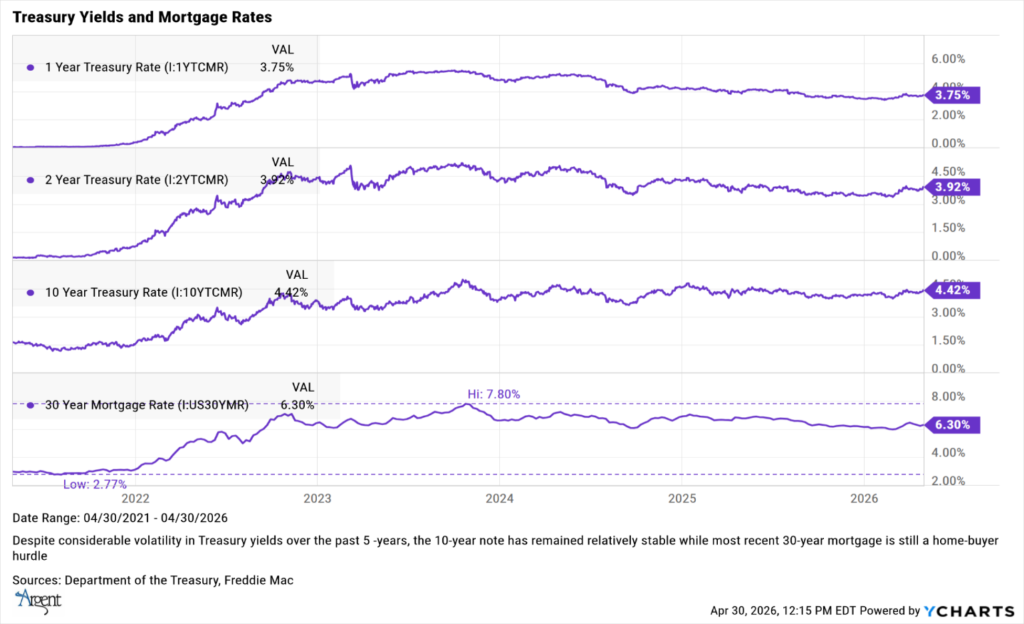
The Fed is no longer a tailwind for markets. It is a constraint. Equity performance from here is less likely to be driven by multiple expansion supported by easing policy and more dependent on earnings growth, margin stability, and the ability of the economy to absorb higher rates without slowing materially.
Portfolio Implications: Stay Invested, But Be More Demanding
Investor sentiment has improved, but it is not uniformly euphoric. American Association of Individual Investors’ bullish sentiment has moved higher, bearish sentiment has declined, and broader measures such as CNN’s Fear & Greed Index have shifted into more constructive territory. Importantly, these measures have not reached levels that would typically signal outright excess. The more relevant issue is the speed of the shift. Investors moved quickly from caution to renewed optimism as the market recovered, which is understandable given the earnings backdrop, but it also leaves the market more sensitive to disappointment.
Bespoke’s review of headlines during the March 30 to April 17 rally made an important point: markets were moving higher even as the news flow remained negative. That remains true today. The market has absorbed higher yields, weaker consumer sentiment, geopolitical uncertainty, and now a meaningful surge in oil prices, because companies have continued to deliver earnings growth and margin resilience.
Oil has become the most important swing factor in that equation. Brent crude has moved back toward levels not seen since 2022, briefly pushing into the high-$110 to near-$120 range, driven by the ongoing conflict with Iran and disruptions tied to the Strait of Hormuz. This is not just a commodity story—it directly affects inflation expectations, consumer spending, corporate margins, and ultimately Federal Reserve policy. If sustained, current oil levels increase the probability that inflation stabilizes at a higher range than previously expected.
The risk is that investors begin confusing market resilience with risk disappearance. Those are not the same. Sentiment is better, earnings are better, and price trends have improved, but the macro backdrop is becoming more sensitive to energy-driven inflation and policy constraints. That argues for participation, but not complacency.
If earnings estimates continue to rise, margins remain near record levels, and oil prices stabilize rather than continue higher, equities can move higher from here. In that environment, today’s valuations may remain defensible, particularly for companies with visible growth, strong cash flow, and pricing power. The market does not require perfect conditions, but it does require earnings durability.
The risk side is more clearly defined than it was earlier in the year. If oil remains elevated, inflation could drift back toward the mid-3% to 4% range, limiting the Federal Reserve’s flexibility and keeping interest rates higher for longer. At the same time, market breadth, while improved, is not fully synchronized, leaving performance still somewhat dependent on leadership. Valuations leave less room for disappointment, and the consumer—while still spending—is doing so with less flexibility given lower savings rates and higher essential costs.
This is not a market to step away from, but it is one that requires discipline. The broad reward remains participation in earnings-led growth. The risk is assuming that index-level strength reflects a uniformly healthy underlying market.
From a portfolio standpoint, the implication is to remain invested, but to be more selective about what is owned. Companies with durable earnings growth, pricing power, strong balance sheets, and exposure to structural investment themes remain attractive. This includes parts of technology, semiconductors, AI infrastructure, power generation, industrial automation, and select capital markets-driven financials.
At the same time, areas that are more sensitive to input cost inflation, discretionary demand, or higher financing costs require more caution. Elevated oil prices and higher rates tend to compress margins and demand in these segments more quickly.
The opportunity set remains intact, but it is narrower and more dependent on execution. This is a market where selectivity—not broad exposure—is likely to drive outcomes.
Not Investment Advice or an Offer -This information is intended to assist investors. The information does not constitute investment advice or an offer to invest or to provide management services. It is not our intention to state, indicate, or imply in any manner that current or past results are indicative of future results or expectations. As with all investments, there are associated risks and you could lose money investing.


