
1st Quarter 2026 Fixed Income Review
- From September 2024 to December 2025, the Federal Open Market Committee (FOMC) reduced its fed funds policy rate by 175 basis points from a peak of 5.25%-5.50% to its current range of 3.50%-3.75%.
- The current monetary policy easing cycle remains on pause, but at the March FOMC meeting Fed officials indicated that, on average, they anticipated one additional 25 basis point rate cut by year-end and one in 2027. The jury is still out…
- In late January, President Trump named Kevin Warsh as his nominee to head the FOMC. Warsh’s term should commence in mid-May, but his appointment is still pending congressional confirmation. Additionally, although it would be atypical for him to do so, current Fed Chair Jerome Powell has the option of remaining on the FOMC as a Governor until early 2028. So far, he has not indicated whether he intends to exercise this option.
- Q1 saw an increase in commodity-related inflationary concerns due to the conflict with Iran. The price of oil spiked as high as $113. Treasury market volatility rose to levels not reached since the announcement of tariffs in April 2025. Corporate spreads widened concurrently but have since narrowed somewhat.
- Private credit funds have faced a wave of negative publicity, leading to redemption requests during Q1 that have, in many cases, exceeded quarterly caps. Though we continue to characterize private credit markets as facing a liquidity event rather than a credit event, the situation is being closely monitored.
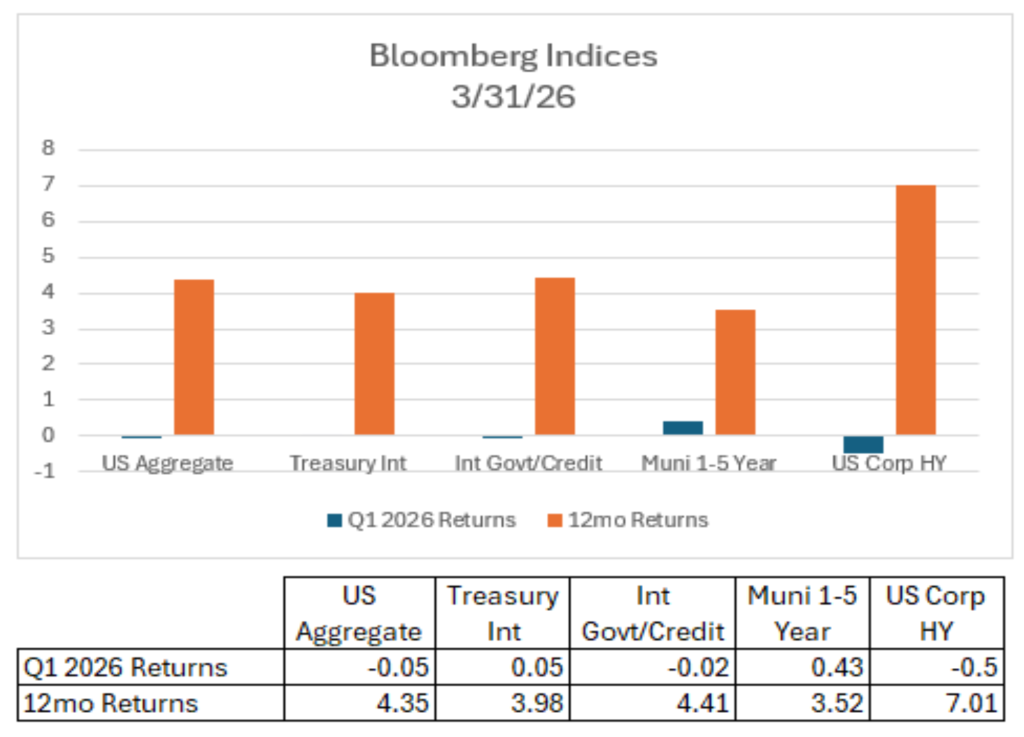
Below are select Bloomberg fixed income index returns for Q3 2025 and Year-to-Date:
An Atypical Reaction in Fixed Income
As shown in the table above, fixed income markets exhibited relatively flat performance during the first quarter of 2026. Positive returns during the month of January were eroded by the war in Iran and the effects of renewed inflationary concerns later in the quarter.
Typically, a period of increased geopolitical volatility (especially a military conflict directly involving the United States) would result in a “flight to quality” reaction in global markets. This often entails the selling of risky assets and buying of risk-averse ones (or at least slightly safer ones), such as U.S. Treasuries. This time, however, the flight-to-quality reaction function did not occur at all. Instead, Treasury yields rose significantly due to concerns about the spike in oil prices. Yields on 2-year U.S. Treasury notes rose approximately 70 basis points during the month of March. Spreads on intermediate corporate bonds also increased from a low of 62 bp to a high of 85 bp during the quarter.
Supply Shocks and Cost-Push Inflation
Around 20 million barrels of oil travel through the Strait of Hormuz daily, with most of the output heading to ports in the Asia-Pacific region. However, since the Iran conflict began, safe passage for oil-bearing vessels has been exceedingly difficult. Many vessels have been struck by projectiles, causing fires and other damage. As a result, the Strait remains largely blocked. The ongoing cumulative deficit in the supply of oil (vs. daily aggregate demand) pushed the price of oil from a range of $60–$65 in January and February to over $100 in late March.
Although this commodity-related supply shock has just begun to filter through into incoming economic data, expectations are for it to register some sort of material impact—at least in the short run. The longer the conflict lingers, the more likely this effect will include a negative impact on growth in the United States, in addition to upward pressure on headline inflation.
Any increase in inflation reduces the likelihood that the FOMC will be able to reduce the Fed Funds rate, but a sustained increase in inflation expectations is even more troubling for the Fed if it becomes more anchored in the minds of consumers. Hopefully, the conflict ends soon, the Strait of Hormuz reopens, and commodity-related inflationary concerns remain short-lived.
A Quick Note on Private Credit Markets
Fresh on the heels of the high-profile bankruptcies of Tri-Color and First Brands in late 2025, new concerns have arisen for private credit investors. AI software development tools, such as Anthropic’s Claude, are threatening to commoditize the software development process, and software and “software-as-a-service” companies have traditionally seen a significant allocation in private credit direct lending portfolios. With these business models facing a new threat and lower barriers to entry, some investors are clamoring for the exits. Although several large direct lending funds saw redemption requests exceeding their quarterly 5%–7% caps in Q1, we continue to characterize private credit markets as currently facing a liquidity event rather than a credit event.
What We Think
The first quarter of 2026 was once again dominated by geopolitics, fears of disruption accompanying advances in artificial intelligence, the ongoing debate regarding the independence of the Federal Reserve, and the widespread perception of latent weaknesses in the private credit markets.
Concern over the stickiness of inflation has led to (at least) a temporary reassessment of the path of future rate cuts in the U.S. Although the backup in U.S. Treasury yields has not produced any true “dislocations” in the public markets, credit spreads for high-quality offerings are more attractive, and we are selectively putting money to work as opportunities present themselves. Likewise, we are currently monitoring more peripheral fixed-income sectors—such as high yield, mortgages, and emerging market debt—for signs of stress, although the broad domestic equity markets have recovered almost completely to levels seen in late February.
We thank you for your continued confidence and hope you will feel free to contact either a member of our fixed-income team or your portfolio manager with any questions regarding our outlook or the markets in general.
Not Investment Advice or an Offer | This information is intended to assist investors. The information does not constitute investment advice or an offer to invest or to provide management services. It is not our intention to state, indicate, or imply in any manner that current or past results are indicative of future results or expectations. As with all investments, there are associated risks, and you could lose money investing.
Sam Boldrick, Matthew Kimbrough, and Robert Petitto contributed to this commentary. No artificial intelligence or ChatGPT was used in the collection of information or production of this content. For additional information, please contact one of the following:
Sam Boldrick: sboldrick@argenttrust.com
Matthew Kimbrough: mkimbrough@argenttrust.com
Robert Petitto: rpetitto@argenttrust.com

