

Summary
- Global equity markets were positive during the month—with international markets continuing to lead the gains.
- U.S. Treasury rates fell during the month, with the 10-year rate finishing the month below 4%.
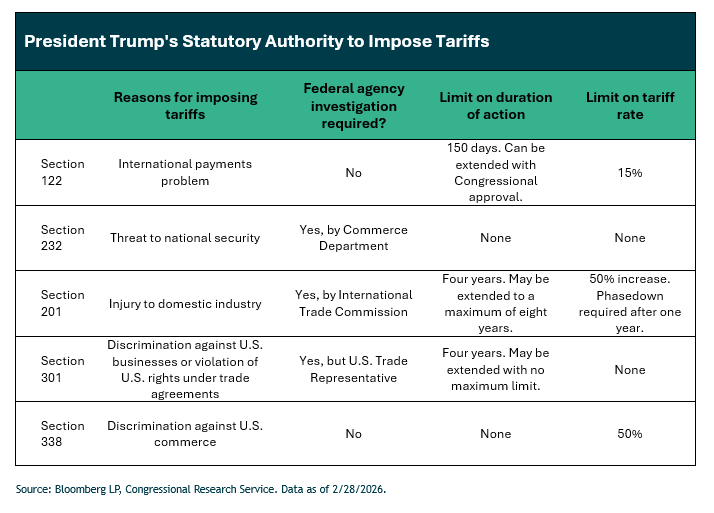
- The Supreme Court struck down President Trump’s use of tariffs under the International Emergency Economic Powers Act (IEEPA). The President immediately used Section 122 of the Trade Act of 1974 to place a 10% baseline tariff.
- The month ended with U.S. and Israeli strikes on Iran. This operation represents a major escalation from the previous campaign last summer that targeted nuclear sites. Iranian Supreme Leader Ayatollah Ali Khamenei and many other senior leaders were killed in the strikes.
Market Performance
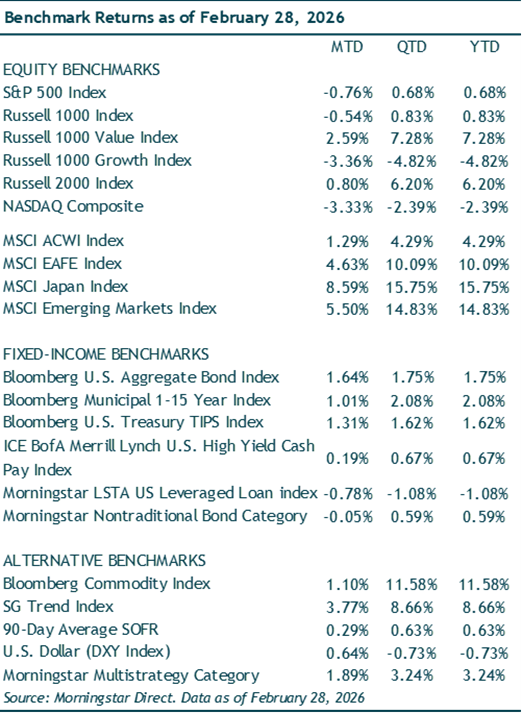
The S&P 500 fell 0.8% during February. This trailed the return of major international equity markets. Developed international markets (MSCI EAFE) gained 4.6% while emerging markets (MSCI EM) returned 5.5%. The rotation out of mega-cap U.S. growth stocks and into other areas of the market continued during the month. Russell 1000 Growth fell 3.4% last month while the value counterpart gained 2.6%. U.S. small-cap stocks (Russell 2000 Index) also outperformed the S&P 500 with a modest return of 0.8% for the month.
Foreign equity outperformance continued despite the dollar strengthening during the month. Japan and South Korea were the main drivers behind the strong numbers. MSCI Japan and MSCI South Korea gained 8.9% and 22.0% in February, respectively. Korean equities are up 56.3% so far this year. Their strong returns can mainly be attributed to the memory chip shortage from AI demand—Samsung and SK Hynix make up a little over half of the index after their extraordinary price increases.
It was a positive month for fixed-income markets. Treasury rates fell across the intermediate and longer-end of the curve, helping U.S. core bonds return 1.6% in February. This was the Bloomberg U.S. Aggregate Bond Index’s best monthly return in a year. Long-term Treasuries (Bloomberg Long-Term U.S. Treasury Index) fared even better with a gain of 4.2% last month, also its best return in a year.
Supreme Court IEEPA Tariff Ruling
Markets reacted calmly to the ruling, and attention has since shifted to the strikes on Iran. With the Middle East conflict dominating headlines, tariff uncertainty has moved to the background.
While the Supreme Court ruled that the International Emergency Economic Powers Act (IEEPA) cannot be used to implement tariffs, the President retains other statutory authority to do so (see table below). The current baseline tariff rate of 10%, imposed under Section 122 of the Trade Act of 1974, can remain in place for only 150 days before requiring a congressional extension. This means that by late July, Congress will need to vote on an extension—or President Trump will need to pursue alternative statutory authority. Either way, we think it is unlikely that tariffs revert to where they stood at the start of last year.
Israel and U.S. Strike Iran—Now What?
The U.S. and Israel have initiated a military offensive against Iran with the objective of eliminating Iran’s nuclear and missile programs and forcing regime change. This operation represents a large-scale escalation from the U.S. air campaign of June 2025, in which B-2 stealth bombers struck three nuclear facilities suspected of enriching uranium for weapons use. The current attacks are far broader in scope, targeting key Iranian leadership compounds and naval assets. Iranian Supreme Leader Ayatollah Ali Khamenei was killed when his compound in Tehran was destroyed in the opening strikes. Numerous other senior leaders were also targeted and killed.
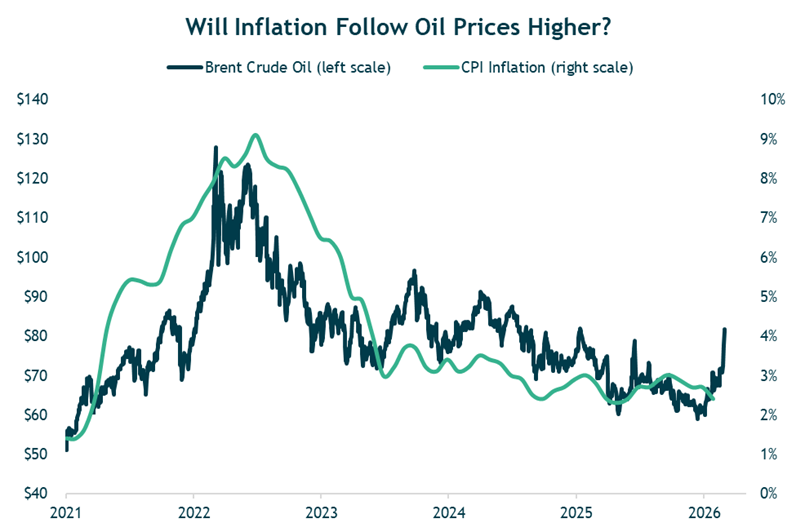
The U.S. intervention raises immediate questions about the nature and scale of Iran’s response. Thus far, the regime has launched hundreds of missiles and drones at Israel and U.S. military bases across the Middle East. The most significant near-term impacts have been the disruption of global air travel through the Gulf—one of the world’s busiest transit corridors—and a sharp spike in oil prices following the effective closure of the Strait of Hormuz, through which roughly 20% of the global oil supply passes daily. President Trump has pledged military escorts and insurance guarantees for tankers navigating the Strait in an effort to keep energy flowing.
In our view, the longer-term economic impact will hinge on the duration of the conflict. A prolonged closure of the Strait of Hormuz risks embedding elevated energy costs into global supply chains—reigniting inflationary pressures that central banks have only recently managed to contain. That is where the deeper systemic risk lies.
Investment Implications
Global equities have proven resilient in the wake of these events. While volatility has risen, prices remain close to their 2026 highs. Brent crude spiked from $70 to over $100 per barrel, though this remains below the $120 per barrel seen when Russia invaded Ukraine in 2022. U.S. equity markets are largely unchanged, and international markets have fallen between 1% and 2.5%. As is typical in periods of stress, the U.S. dollar has strengthened against major currencies. The one asset not behaving as expected is U.S. Treasuries, where yields have risen slightly on inflation concerns tied to higher oil prices rather than falling in a traditional flight to safety.
Comparisons to the 1973 Yom Kippur War and the OPEC oil embargo that followed are understandable, but the parallels have limits. While higher energy prices are unambiguously negative for growth, the impact will not be uniform across economies. Capital Economics notes that 80–90% of crude oil and LNG exports transiting the Strait of Hormuz are destined for Asia, with China by far the largest buyer of Iranian oil, accounting for roughly 90% of Iran’s exports. That said, coal still represents a significant share of China’s overall energy mix, which partially offsets its exposure. The U.S., now largely energy independent, is unlikely to face supply shortages; the primary impact domestically would be felt at the pump rather than through broader supply disruption. It is also worth noting that the global economy is far less oil-intensive than it was fifty years ago.
What is certain amid the uncertainty is that the probability of a tail risk scenario has increased. With equities trading at elevated valuations and credit spreads near historically tight levels, near-term volatility would not surprise us. That said, we do not believe these events are likely to derail the broader market advance, which has been underpinned by strong and broadening corporate earnings growth. History shows that geopolitical shocks rarely tip markets into sustained bear markets, and investors are often best served by looking through them. We would view any material price weakness as an opportunity.
Certain material in this work is proprietary to and copyrighted by Litman Gregory Analytics and is used by Argent Financial Group with permission. Reproduction or distribution of this material is prohibited, and all rights are reserved.


