


BY: Tom Stringfellow, CFA®, CPA®, CFP®
Chief Investment Strategist
Changing of the Guard
Key Takeaways
- The policy backdrop is shifting, not destabilizing. Changes at the Federal Reserve reflect an emphasis on credibility and discipline rather than a break from growth-supportive policy.
- The economy remains on solid footing. Manufacturing activity has rebounded, business investment is resilient, and the labor market continues to show stability rather than stress.
- Inflation risks are moderating but persistent. Market-based expectations have firmed, limiting the scope for aggressive easing and reinforcing the need for selectivity.
- Market leadership is broadening. Small caps and cyclically oriented sectors are participating as rates stabilize and domestic growth holds up.
As we move through the opening months of 2026, markets are not grappling with a collapse in economic fundamentals, but rather the framework through which policy, risk, and credibility are understood is beginning to change. Growth remains intact, labor markets are holding together, and financial conditions are not overtly restrictive. Yet investors are being asked to recalibrate expectations formed over more than a decade of highly predictable central bank behavior.
The impending transition at the Federal Reserve sits at the center of this recalibration. The nomination of a new Fed chair has not introduced an abrupt hawkish turn or a clear policy shock. Instead, it has injected uncertainty around how policy will be communicated, how credibility will be restored or reinforced, and how aggressively the Fed will rely on unconventional tools should the next downturn arrive. Markets are adjusting not to a new destination, but to a less certain path.
This distinction is important. For much of the post-financial-crisis period, investors operated with a high degree of confidence that policy support would be swift, expansive, and asymmetric—quick to ease, slow to tighten. That assumption shaped risk-taking, valuations, and portfolio construction across asset classes. A gradual shift toward a framework that emphasizes discipline, credibility, and institutional normalization—even without immediate tightening—changes the calculus for investors accustomed to reflexive accommodation.
At the same time, the economic backdrop does not justify alarm. Recent data point to an economy that is slowing unevenly, not stalling. Manufacturing is showing early signs of re-engagement, business investment remains resilient, and labor conditions continue to reflect stability rather than stress. Inflation has moderated from its peaks, but it has not faded cleanly back to target, leaving policymakers with less flexibility than markets may be assuming.
Federal Reserve Transition & Policy Credibility
The market’s reaction to the nomination of Kevin Warsh as the next Federal Reserve chair was instructive, not alarming. Stocks did not sell off because investors suddenly feared tighter policy or an imminent rate shock. Instead, markets briefly stumbled because the nomination challenged a long-standing assumption: that the Fed’s policy playbook would remain unchanged regardless of who occupied the chair.
Warsh was not the market’s first choice, but neither was he an outlier. His public comments over the years point to a policymaker who is dovish on rates yet more skeptical of the Federal Reserve’s expanding reliance on unconventional tools, particularly quantitative easing. That combination unsettled investors who have grown accustomed to viewing QE as a permanent backstop for asset prices rather than an emergency measure.
Compounding that unease were Warsh’s comments calling for a form of “regime change” at the Fed. While that phrase can sound dramatic, it is better understood as a critique of credibility and communication rather than a call for abrupt tightening. His argument—that the same leadership presided over both post-pandemic stimulus and the subsequent inflation surge—is not radical. But markets care less about diagnosis than about implementation, and the lack of specificity around what “regime change” means explains the initial discomfort.
Importantly, none of this undermines the prevailing expectation that policy rates will move lower over time. Warsh’s own views suggest he believes rates should be lower than current levels. If growth moderates and inflation continues to ease, rate cuts remain a realistic outcome later this year. In that sense, the nomination does not jeopardize the broader bull market.
What does change is the confidence with which markets can assume unlimited policy accommodation. Investors may need to become more discerning about when and how support arrives, rather than assuming it will always be immediate and expansive. That is a meaningful shift in tone, even if the direction of policy remains broadly supportive.
The takeaway is straightforward. Markets do not “hate” the Warsh nomination. They are simply recalibrating to the idea that the next phase of monetary policy may place greater emphasis on credibility and discipline than on reflexive easing. That transition may introduce short-term volatility, but it does not invalidate the underlying growth backdrop or the longer-term case for risk assets.
The result is a market environment defined less by extremes and more by tension: between growth and restraint, between disinflation and persistence, between policy continuity and policy evolution. These are not conditions that typically precede crisis, but they are conditions that demand greater selectivity, discipline, and attention to cross-asset signals.
This edition of Market Perspectives focuses on that transition. Not on predicting a regime break, but on understanding how shifting policy assumptions, evolving economic momentum, and changing market leadership are beginning to reshape the investment landscape as 2026 unfolds.
Manufacturing Re-Engages As Growth Broadens
For much of the past year, manufacturing has been the weak link in the U.S. growth picture. While services carried the economy forward, factories struggled with inventory overhangs, uneven global demand, and the cumulative impact of tighter financial conditions. That dynamic began to shift meaningfully in January.
The ISM Manufacturing PMI rebounded to 52.6, moving back into expansion territory for the first time in twelve months. More important than the headline, however, were the internals. New orders surged, production accelerated, and order backlogs expanded at their fastest pace since 2022. This was not a narrow or technical rebound; it reflected a broad-based improvement in demand and throughput.
Manufacturing matters in this context not because it dominates economic output, but because it is sensitive to changes in confidence, credit conditions, and end demand. When manufacturing turns higher after a prolonged contraction, it often signals that the broader economy is stabilizing rather than decelerating further. That distinction is critical for markets trying to determine whether slowing growth is morphing into something more concerning.
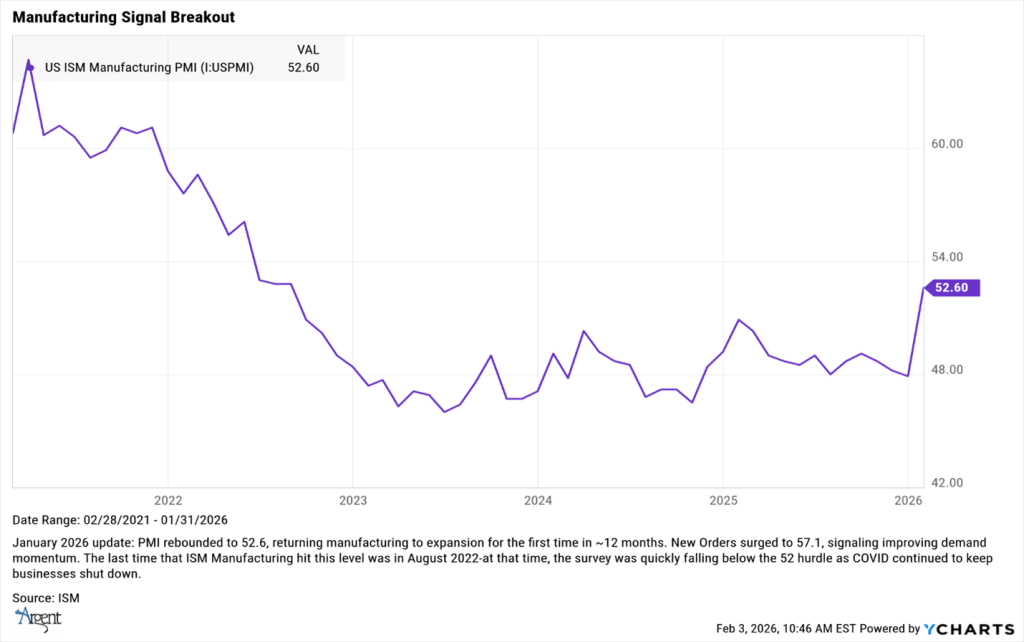
The timing of the rebound is also notable. It coincides with easing financial conditions at the margin, improved visibility around supply chains, and renewed capital spending in select industries tied to infrastructure, energy, and technology. In other words, manufacturing is not rebounding in isolation; it is responding to real demand signals rather than inventory restocking alone.
This improvement complements continued strength in the services sector, which remains comfortably in expansion territory. Together, these trends support a view of uneven but broadening growth, rather than an economy losing momentum across the board. That broader participation helps explain why equity leadership has begun to rotate beyond a narrow group of large-cap names.
Importantly, this does not imply a return to a manufacturing-led boom or a straight-line acceleration from here. Volatility in global demand, trade policy uncertainty, and geopolitical risks remain. But the evidence suggests that manufacturing is no longer acting as a drag on growth—and that shift carries meaningful implications for cyclically sensitive sectors and domestically oriented companies.
Business Investment: Cautious, Not Defensive
Recent durable goods data showed a meaningful rebound, but the more telling signal came from non-defense capital goods orders excluding aircraft—widely regarded as the best real-time proxy for core business investment. That measure continued to advance, reinforcing a message that has been consistent for several quarters: companies are still spending, still investing, and still planning for growth, even if they are doing so selectively.
This matters because business investment is often one of the first areas to roll over when confidence deteriorates. When executives begin to fear a downturn, capital expenditures are delayed or canceled outright. We are not seeing that behavior today. Instead, firms are prioritizing projects tied to productivity, efficiency, infrastructure, and technology, while avoiding more speculative or discretionary expansions.
That posture fits the broader economic tone. Growth is not accelerating sharply, but it is holding together well enough to justify continued investment. Financing conditions, while tighter than in the zero-rate era, remain workable. And demand visibility, particularly in areas tied to domestic infrastructure, energy systems, and data-driven capacity—has improved.
Importantly, this pattern undercuts the notion that policy uncertainty alone is enough to derail the expansion. Businesses are clearly aware of shifting Fed leadership, evolving trade policy, and geopolitical risk. Yet the data suggest those factors are being managed, not feared. Capital is still being deployed where returns are visible and strategic.
For markets, this reinforces a critical point. Economic slowdowns driven by collapsing investment tend to be abrupt and disorderly. Slowdowns characterized by selective, disciplined investment tend to be more durable and more forgiving for risk assets. While vigilance is warranted, current investment trends align far more closely with the latter scenario.
Labor Market: Stable, But Worth Watching
The labor market remains one of the most important pillars supporting both economic confidence and equity valuations, and for now, that pillar is holding. Recent data continue to point toward a labor market that is neither overheating nor unraveling.
Weekly jobless claims tell the story well. Initial claims remain historically low, hovering just above the 200,000 level, while continuing claims have moved lower, reaching their lowest levels in more than a year. That combination reinforces the idea of a “no-hire, no-fire” labor market: employers are not aggressively adding workers, but they are also not meaningfully cutting back.
From a policy perspective, this is close to ideal. A labor market that stays firm without reaccelerating wage pressure gives the Federal Reserve flexibility. It supports continued growth while keeping rate cuts on the table later in the year, rather than forcing policymakers into a defensive posture.
Wage growth and consumption data reinforce the same message. Household balance sheets remain healthy, spending has moderated but not collapsed, and income growth is cooling in a way that helps ease inflation pressure without undermining demand. This balance is a key reason why recession fears have failed to gain traction despite tighter policy over the past two years.
Housing sentiment offers a similar signal. Higher mortgage rates have weighed on activity, but builder confidence has stabilized, and buyer interest has not evaporated. Housing remains constrained more by affordability than by a collapse in demand, which limits the downside risk of employment tied to construction and related industries.
The bottom line is straightforward. The labor market is no longer accelerating, but it is not deteriorating in a way that signals imminent trouble. For investors, that distinction matters. A labor market that bends without breaking tends to support earnings stability, reinforce consumer spending, and extend the runway for risk assets — even if returns become more selective.
Inflation Expectations: Quietly Firming Beneath the Surface
While much of the public debate around inflation has cooled alongside the headline data, market-based measures suggest the story is not fully resolved. Beneath the surface, investors are beginning to price in greater inflation persistence than was widely assumed just a few months ago — a subtle shift, but an important one.
One of the most useful gauges in this regard is the five-year breakeven inflation rate, which reflects the market’s collective expectation for inflation over the next five years. Unlike survey-based measures, breakevens incorporate real-time pricing by bond investors, making them a valuable window into how inflation risk is being assessed in practice rather than theory.
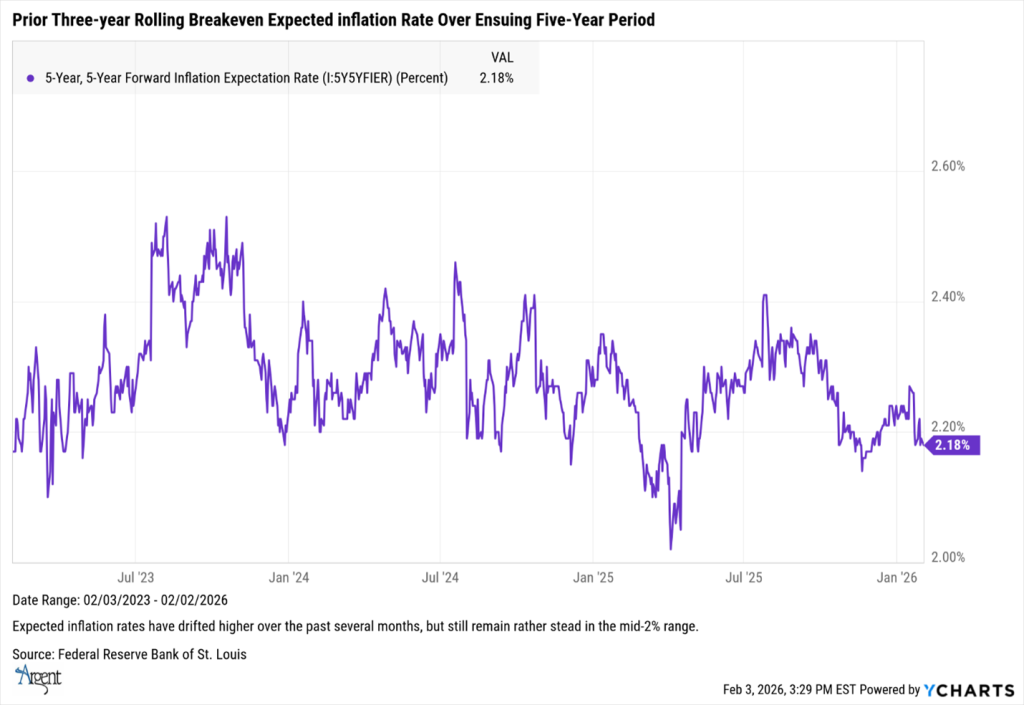
Recently, those breakeven rates have drifted higher. The change has not been dramatic, but it has been consistent. That trend aligns with a broader reassessment of the economic environment: growth has proven more resilient than expected, labor markets remain firm, and several policy-related forces — including fiscal spending, trade policy, and geopolitics — retain an inherently inflationary bias.
Importantly, this does not imply that rate hikes are imminent or even likely in the near term. However, it does introduce an out-of-consensus risk that markets cannot ignore: the possibility that policy remains restrictive for longer. In an environment where equities are trading near all-time highs, even a modest repricing of that assumption can matter.
For investors, the takeaway is not to anticipate a renewed inflation shock, but to recognize that the last leg of the disinflation journey may be slower and less linear than hoped. Inflation expectations do not need to surge to influence markets; they simply need to stop falling.
That nuance is critical. If inflation expectations remain firm while growth holds together, the Fed’s room to maneuver narrows. And when policy optionality narrows, markets tend to reward balance, pricing power, and discipline over speculation.
Commodities: Repricing, Not a Breakdown
Commodity markets delivered one of the clearest examples this year of how quickly sentiment can shift when positioning, policy expectations, and macro signals collide. The sharp moves we have seen recently—particularly in precious metals—were dramatic, but they should be understood as repricing events, not evidence that the underlying thesis has collapsed.
Gold and silver entered the year with significant momentum, supported by a weak dollar, lingering inflation concerns, and uncertainty around central bank independence. Those forces pushed prices to extreme levels, leaving the market vulnerable to profit-taking. When policy clarity began to improve — particularly with the Fed leadership transition signaling less tolerance for inflation and stronger institutional credibility — that vulnerability was exposed.
The resulting selloff was swift, amplified by crowded positioning and thin liquidity. But volatility of that magnitude often marks a reset, not an ending. The fundamental drivers that supported higher precious metal prices — currency trends, geopolitical risk, and longer-term inflation optionality — have not disappeared. What has changed is the market’s willingness to price those risks in a straight line.
Energy markets tell a different, but complementary, story. Oil prices have firmed amid renewed geopolitical tension and a reassessment of global supply and demand dynamics. Earlier consensus expectations for a sizeable surplus in 2026 are being challenged as demand proves more resilient and supply risks re-enter the equation. At the same time, a softer dollar has provided a mechanical tailwind for dollar-denominated commodities.
Technically, oil remains in a longer-term consolidation phase, but conviction around sharply lower prices has eased. That shift matters. When commodities stop reinforcing disinflation narratives, they begin to function as inflation insurance rather than inflation signals — a subtle but meaningful change for portfolio construction.
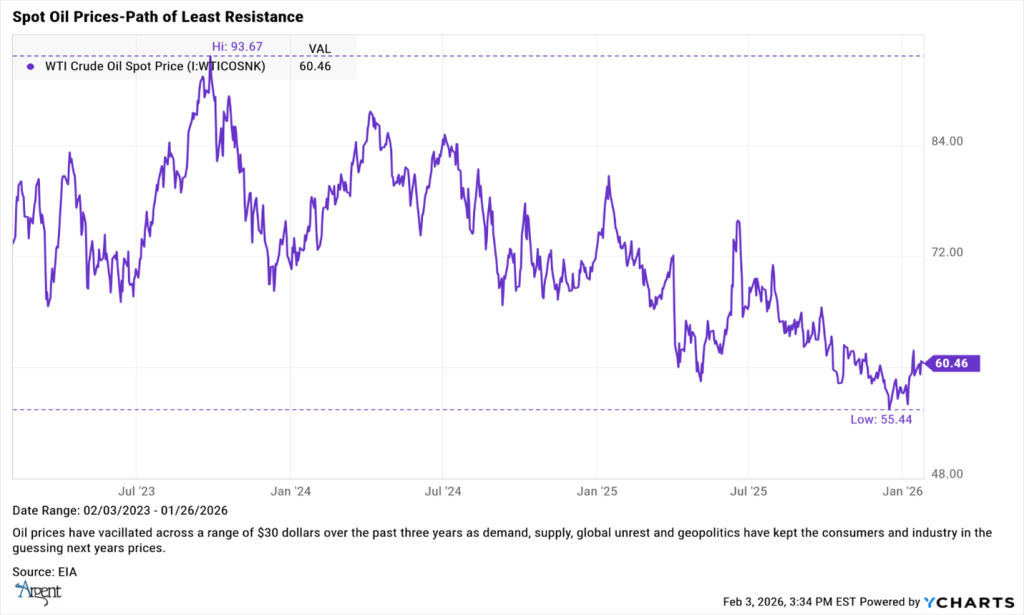
The broader takeaway is that commodities are no longer sending a single, clean message. Instead, they are reflecting a world in which growth is holding up, policy is becoming less predictable, and inflation risks have not been fully extinguished. That combination naturally leads to volatility.
Currencies and Market Plumbing
Currency markets rarely demand attention when they are calm, but they tend to matter when investors start to ignore them. Recent moves in foreign exchange have been notable not because they signal economic distress, but because they point to shifts beneath the surface that can influence risk-taking across markets.
The U.S. dollar has weakened meaningfully, touching multi-year lows before stabilizing. Part of that move reflects expectations that U.S. interest rates will eventually trend lower. Part reflects improved growth prospects overseas. And part reflects a reassessment of policy credibility and fiscal discipline in the U.S. None of those forces, on their own, is destabilizing. Together, they create a backdrop that is less supportive of a relentlessly strong dollar.
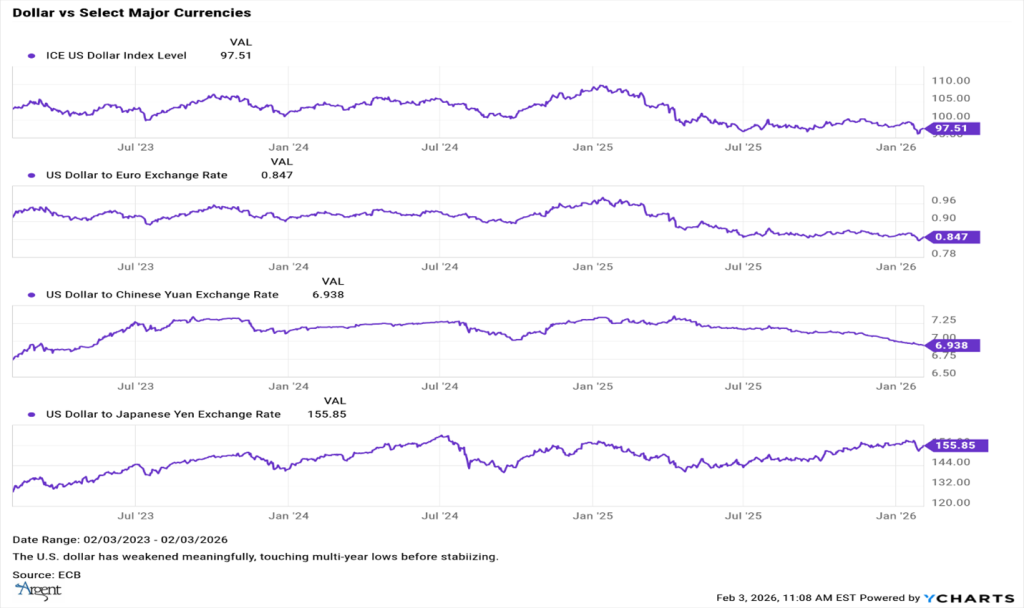
The euro’s strength has been a major driver of that dollar weakness. It is now trading near levels not seen in several years, reinforcing the idea that capital is becoming more willing to look beyond the U.S. for incremental returns. That matters for U.S.-based investors because currency moves often function as accelerants—amplifying trends that are already underway rather than creating new ones.
The Japanese yen deserves special attention. While its move has been less dramatic, a strengthening yen can have outsized implications because of its role in global carry trades. When the yen strengthens, leveraged strategies that rely on borrowing cheaply in Japan to fund risk assets elsewhere can unwind quickly. History has shown that these unwinds tend to surface during otherwise orderly market environments, catching investors off guard.
This is where currencies intersect with broader market plumbing. Equity markets can appear healthy, credit spreads can remain tight, and volatility can stay suppressed—right up until currency-driven leverage begins to unwind. The fact that we are seeing renewed strength in the yen alongside a softer dollar does not signal an imminent problem, but it does warrant attention.
Rates as the Anchor, Not the Threat
For all the noise surrounding policy shifts, currencies, and geopolitics, the bond market has been notably calm. That calm is not accidental, and it matters more than many of the headlines dominating daily market commentary.
Treasury yields have remained remarkably orderly, particularly at the long end of the curve. The 10-year yield has oscillated within a narrow range, holding in territory that is neither restrictive enough to choke off growth nor loose enough to reignite inflation fears. That stability has functioned as an anchor for risk assets, helping markets absorb volatility elsewhere.
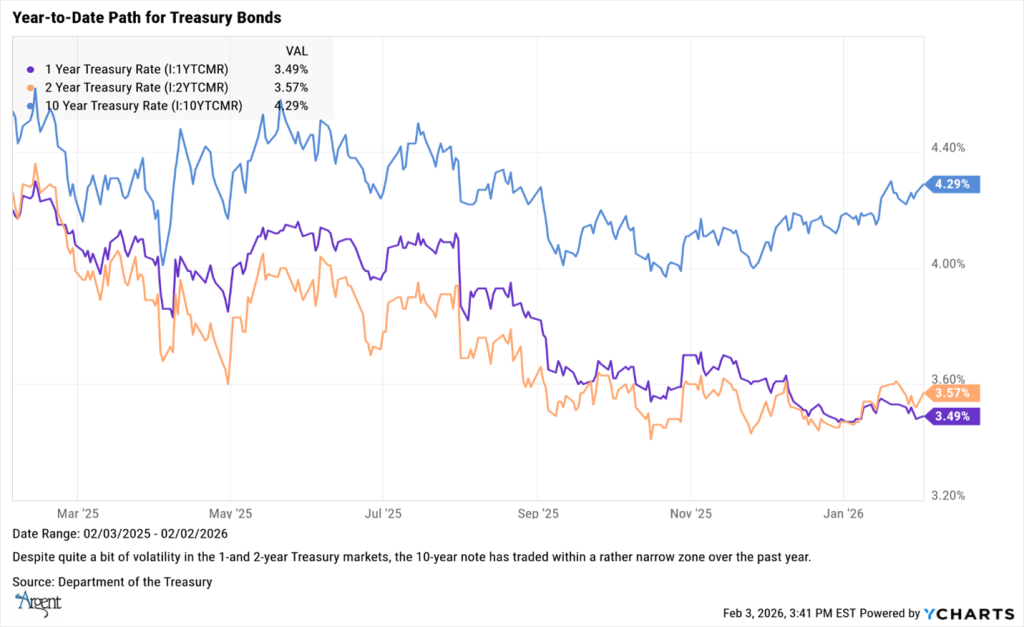
This is a crucial point. Equity markets can tolerate a wide range of outcomes—slower growth, shifting leadership, even moderate policy uncertainty — if rates behave in a predictable manner. What they struggle with is rate volatility, not rate levels. So far, that volatility has been absent.
The bond market’s behavior reflects a balanced assessment of the economy. Growth is solid but not overheating. And the Federal Reserve, despite a change in leadership ahead, is not signaling abrupt moves in either direction. In that environment, bond investors appear content to wait rather than speculate.
Where the risk lies is not in current yields, but in thresholds. A sustained move materially higher—particularly if driven by inflation expectations rather than growth — would force a repricing across equities, credit, and currencies simultaneously. Conversely, a sharp drop in yields driven by weakening growth would carry its own implications.
Neither scenario is playing out today. Instead, the bond market is quietly reinforcing the idea that the economy is navigating a transition, not approaching a cliff. As long as rates remain stable, they serve as a shock absorber, not a shock source.
For investors, this reinforces the importance of watching rates not as a forecast tool, but as a confirmation signal. Right now, that signal is one of restraint—a backdrop that supports risk-taking.
Market Participation Broadens
One of the more constructive developments in recent months has been the gradual broadening of market participation. After a long stretch where returns were dominated by a narrow group of large-cap leaders, performance has begun to spread more evenly across sectors, styles, and market capitalizations.
Small-cap stocks have been a notable beneficiary of this shift. After lagging badly through much of the tightening cycle, they have started to regain traction as interest-rate pressure stabilizes and domestic growth holds up. Relative performance versus large caps has improved, signaling that investors are becoming more comfortable moving down the market-cap spectrum rather than crowding into perceived safety.
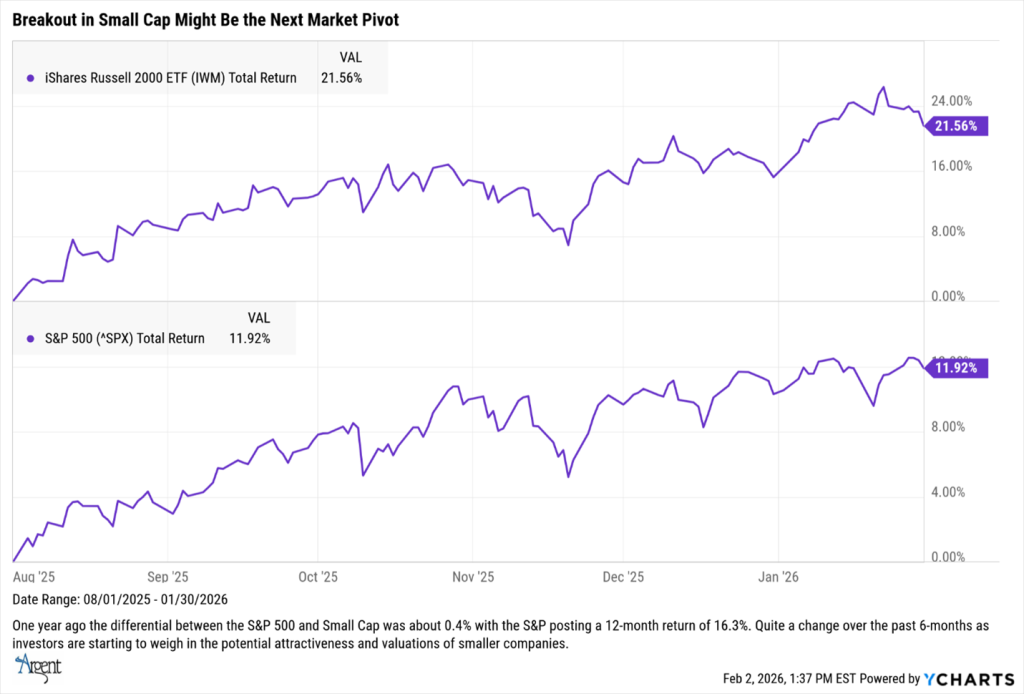
This matters because small caps tend to be more sensitive to changes in financial conditions, labor trends, and domestic demand. Their renewed strength suggests confidence that growth is durable enough to support earnings outside of the largest, most globally diversified companies. It also reflects the reality that valuations in parts of the small-cap universe have become increasingly compelling as rates have stopped getting worse.
Sector leadership tells a similar story. Cyclically oriented areas tied to manufacturing, energy infrastructure, and domestic investment have gained momentum, while leadership within technology has become more selective. This is not a wholesale rotation away from growth, but rather a refinement—rewarding companies with clear earnings visibility and balance-sheet strength over speculative narratives.
Importantly, broader participation tends to improve market resilience. When gains are not concentrated in a handful of names or themes, markets are better able to absorb shocks without cascading drawdowns. The takeaway is not that leadership has permanently shifted, but that it has expanded. That expansion aligns with an economy that is slowing unevenly, not contracting, and with a policy environment that is transitioning rather than tightening.
Outlook and Positioning: Discipline Over Prediction
As we look ahead, the investment landscape is best described not by extremes, but by trade-offs. Growth remains intact, inflation is no longer accelerating but not fully subdued, and policy support is evolving rather than disappearing. In that environment, success is less about calling the next macro inflection point and more about staying aligned with where capital is flowing.
Capital has continued to favor areas offering earnings visibility, balance-sheet strength, and pricing power, rather than broad thematic exposure. Growth and value have both found footing, but leadership within each has narrowed toward companies with demonstrable cash flow and disciplined capital allocation. This helps explain why markets have advanced even as policy certainty has diminished.
Overseas markets are playing a growing role in that rotation. A weaker dollar has improved the relative attractiveness of non-U.S. assets, particularly in parts of emerging markets where demographics, consumption growth, and industrial investment remain supportive. Several Asian economies, including Korea and select Southeast Asian markets, are benefiting from supply-chain realignment, manufacturing investment, and technology demand tied to data infrastructure and electrification. These trends are structural rather than cyclical, and they are increasingly difficult for global investors to ignore.

Back in the U.S., the rally in small-cap stocks reflects a reassessment of risk rather than a surge in optimism. As rates stabilized and recession fears faded, investors began to recognize that much of the downside risk had already been priced into domestically oriented companies. The leadership within small caps has been telling, favoring industries tied to manufacturing, energy infrastructure, and services rather than speculative growth.
Tariffs and trade policy bear watching, but their impact to date has been more about redistribution than disruption. Certain industries face margin pressure, while others benefit from domestic investment and reshoring. The net effect on growth has been muted so far, but the sector-level implications are real and increasingly visible in earnings dispersion.
The bottom line is this: markets are transitioning from a period defined by liquidity and predictability to one defined by selectivity and verification. That shift does not argue for caution in the abstract, but for intention in positioning. Investors who focus on balance, earnings durability, and exposure to real economic activity are better aligned with the environment taking shape in early 2026.
Not Investment Advice or an Offer -This information is intended to assist investors. The information does not constitute investment advice or an offer to invest or to provide management services. It is not our intention to state, indicate, or imply in any manner that current or past results are indicative of future results or expectations. As with all investments, there are associated risks and you could lose money investing.

