

BY: Matthew Kimbrough
Portfolio Manager
The Decision
At the conclusion of today’s FOMC meeting, the Fed Funds rate was reduced by 25 basis points, lowering the current range to 3.50% – 3.75%. This decision was in keeping with September’s Statement of Economic Projections, which forecasted two additional rate cuts in 2025. This is the sixth rate cut in the current easing cycle.
Today’s decision was once again NOT unanimous. There were three dissenting votes. Stephen Miran would have preferred to lower the target range for the Fed Funds rate by 50 basis points. Additionally, Jeff Smith and Austan Goolsbee dissented in favor of no rate cut at this time.
Contentious Dissention – A Year of Discord at the FOMC
Lately, it seems that FOMC meetings have become more contentious. Dissenting opinions (committee members not in favor of the Fed’s overall decision to raise, lower, or maintain the Fed Funds rate) are typically quite rare, but have become more commonplace in 2025. In July, two Fed Governors, Bowman and Waller, were in favor of a 25bp cut when the decision was to hold Fed Funds steady. This was the first time that more than one FOMC member disagreed with the overall Fed decision since 2019. Then, in September, President Trump’s new FOMC appointee Stephen Moran would have preferred cutting the Fed Funds rate by 50bp instead of 25. At the October FOMC meeting, there were once again multiple dissenting opinions, but this time one on either side of the decision (one member in favor of no cut and Miran in favor of 50bp). Given the result of the previous three meetings, the odds of the December FOMC meeting being unanimous were quite low.
Fed Chair Powell made the comment at one of his recent press conferences that having differing viewpoints within the FOMC fosters exactly the type of healthy debate that is necessary for sound policymaking decisions; however, it has historically been more typical that the Chairman of the FOMC fosters a relative consensus when decisions are made about U.S. monetary policy activity.
Will 2025 be remembered as the Fed’s year of non-unanimity? With economists and FOMC members on both sides of the hawkish/dovish divide, it seems more likely that 2025 could be either the year that the Fed cut too quickly in response to sticky inflation, or the year they responded too slowly to labor market concerns. Of course, hindsight is 20/20, and only time will tell. I’m sure Powell and other FOMC members would prefer that 2025 be remembered as merely the year that we charged ahead with monetary policy normalization despite both a wave of tariff announcements and a lengthy government shutdown.
The Statement
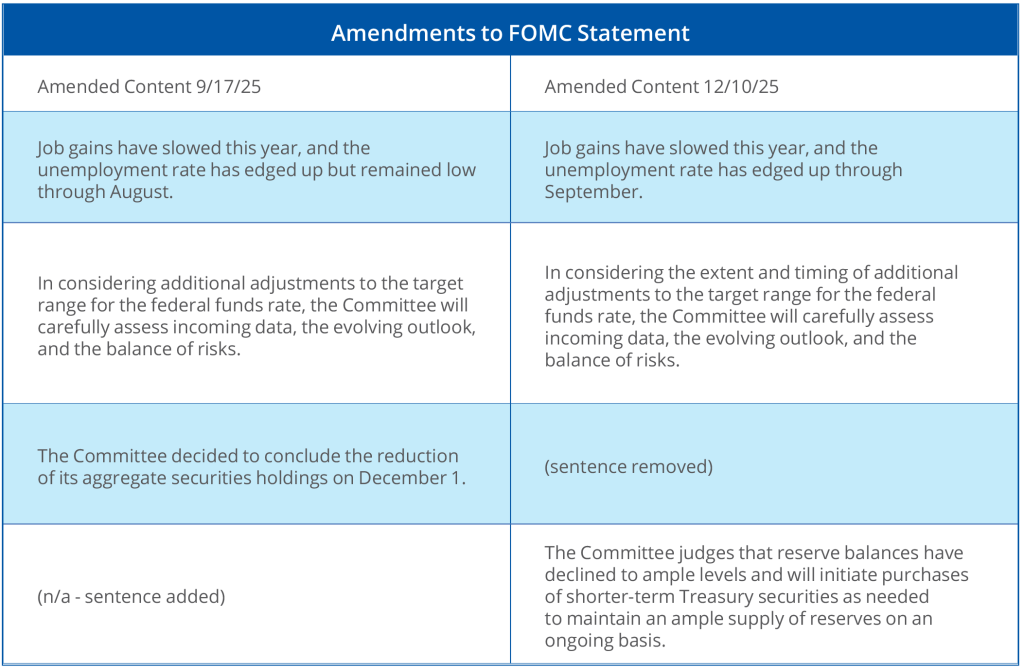
This meeting’s statement contained several amendments, which are highlighted in the chart below.
New Economic Projections
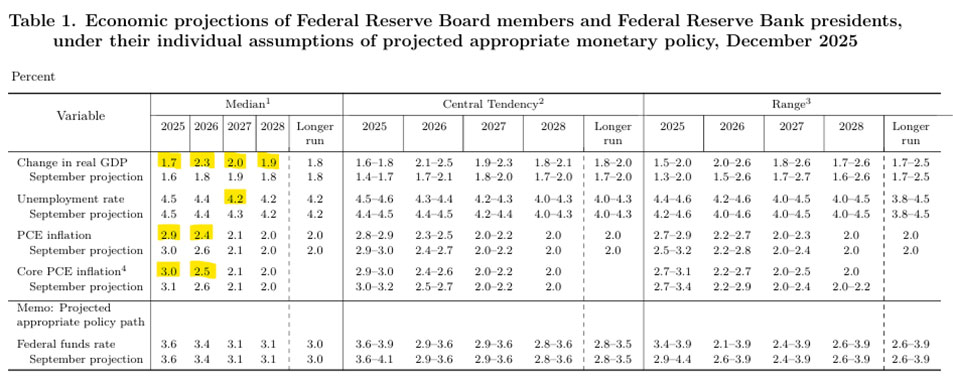
The most significant changes to (or facets of) this quarter’s Statement of Economic Projections (SEP) document have been highlighted below:
- Although the median Dot Plot projection shows one more 25bp cut in 2026 and one in 2027, the range of dots is quite wide.
- Unemployment projections held steady at 4.5% in 2025.
- Core PCE inflation expectations for year-end 2025 fell from 3.1% to 3.0%. Expectations of Core PCE inflation were also lowered 0.1% in 2026.
- Real GDP is expected to be 1.7% for 2025, 0.1% higher than projected in June. 2026 GDP is projected to be 2.3%, 0.5% higher than in September.
Quotes from Fed Chair Jerome Powell
In his prepared statement prior to today’s press conference, Powell described the new Treasury reserve purchase scheme: “…the committee decided to initiate purchases of shorter-term Treasury securities, mainly Treasury bills, for the sole purpose of maintaining an ample supply of reserves over time. Such increases in our securities holdings ensure that the federal funds rate remains within its target range, and are necessary because the growth in the economy leads to rising demand over time for our liabilities, including currency and reserves.” These reserve management purchases will amount to $40 billion in the first month, and are thereafter expected to decline to around $20 billion/month.
The very first question during the press conference was on whether new language in today’s Statement about the “extent and timing of further adjustments” indicated that the Fed was on hold. Powell’s response to this was surprisingly – Yes, the Fed Funds level is within a broad range of estimates of its neutral value and that the Fed is well-positioned to wait and see how economic conditions develop from here.
He also cautioned against a “systematic overcount” of payroll data, and warned that an additional adjustment to payroll data was forthcoming that could be in the neighborhood of 60,000 jobs/month. This also means that the average job growth over the last several months of +40,000/month could actually be amended to a -20,000/month figure.
Powell stated that services inflation is coming down slowly, while goods inflation has been affected by tariffs. These tariff-related goods price increases are expected to peak in Q1 2026, and if they prove to be one-time adjustments, goods inflation should start to decline in the second half of 2026.
One of the final questions was about Powell’s intended legacy as Fed Chair, to which he responded: “I want to turn this job over to whoever replaces me with the economy in really good shape. I want inflation to be under control, and I want the labor market to be strong.”
The Market Reaction
Treasury yields were down 2–3bp prior to the announcement of the Fed’s decision today. During the press conference yields fell another 4–5bp on the front end of the curve. Equity markets rose around 1%.
Not Investment Advice or an Offer | This information is intended to assist investors. The information does not constitute investment advice or an offer to invest or to provide management services. It is not our intention to state, indicate, or imply in any manner that current or past results are indicative of future results or expectations. As with all investments, there are associated risks and you could lose money investing.

