


BY: Tom Stringfellow, CFA®, CPA®, CFP®
Chief Investment Strategist
Both Market Headwinds and Tailwinds Ahead
- Last week marked the five-year anniversary of the S&P 500’s peak before the onset of the COVID-19-induced market turmoil.
- Five years following the COVID-meltdown, all major domestic markets have recovered, with the S&P 500 up over 170% on a price level basis.
- Market concerns over the next several months include potential rise in inflation pressures and the impact of widespread tariffs.
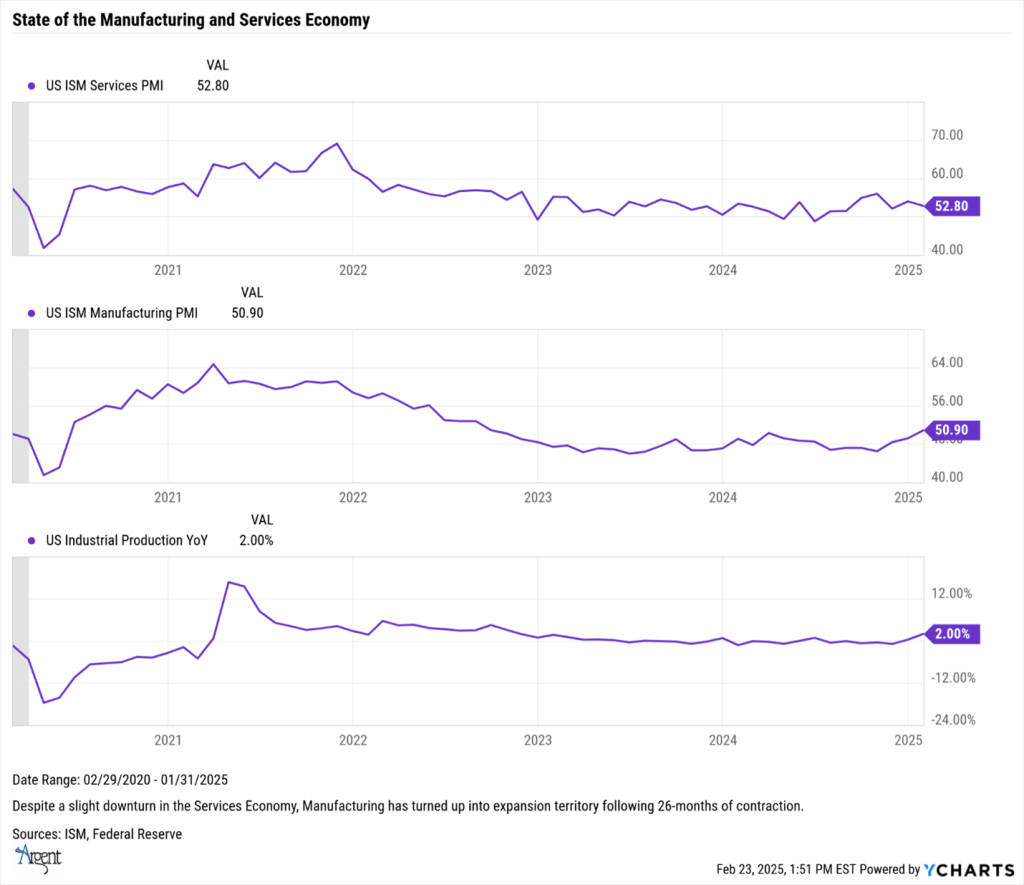
- January’s ISM Manufacturing Index moved into expansion territory for the first time in over two years as the index registered 50.9%.
- The Federal Reserve appears to have taken a “wait-and-see” approach to future rate cuts-much to the angst of investors and market watchers.
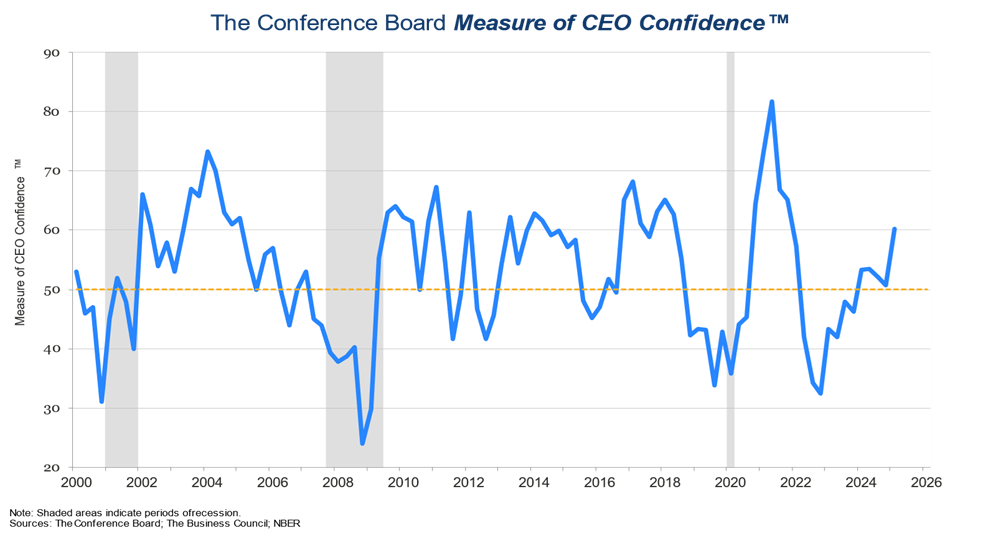
- While retail sales data posted the largest drop in one year, the Conference Board Measure of CEO Confidence increased to the highest level in three years.
Setting the Stage: Headline Risk
Last Friday, February 21, the market closed on a challenging note, capping off a difficult week. The Dow Jones Industrial Average fell 2.6%, marking its worst weekly performance since October. The S&P 500 and Nasdaq Composite also declined, losing 1.5% and 2.5%, respectively.
Earlier in the week, the S&P 500 reached a new all-time high before losing momentum by Friday. Last week also marked the five-year anniversary of the S&P 500’s peak before the onset of the COVID-19-induced market turmoil—a period characterized by spiking unemployment, falling markets, business and economic shutdowns, geopolitical turmoil, highly accommodative central bank policies, and significant loss of life.
By February 20, 2020, the market had begun its downward slide, and over the course of 23 trading days, the S&P 500 lost nearly 34% of its market value. Five years later, all major domestic market indexes have recovered, with the S&P 500 up over 170% on a price level basis, the Nasdaq up nearly 184%, and the Dow Jones Industrial Average up over 133%.
As of last Friday, February 21, despite a market recession in 2022, ongoing conflicts in the Middle East, Ukraine, and Russia, and various other domestic and geopolitical issues, the markets remain within 4% of their record highs. The Federal Reserve played a significant role in this recovery by lowering interest rates to near zero in early 2020 to provide liquidity to the markets and the economy—actions that have contributed to the economic and market conditions we face today. Interest rates were subsequently increased to a high of 5.25%–5.50% by July 2023 and have since been reduced to the current range of 4.25%–4.50%.
This rate trajectory has contributed to the inflationary pressures the Fed is currently addressing. Meanwhile, investors continue to anticipate further rate cuts. Several factors are bolstering the markets. Real GDP grew at an annualized 2.3%—according to the advance estimate—with the next update due on February 27. Subject to revision, the full-year GDP growth estimate is 2.8%. Regarding the current quarter, the latest data from Atlanta’s GDPNow model projects a Q1 growth rate of 2.3%.
Looking ahead, key reports on corporate earnings and the economy are on the horizon. On Friday, the January reading of the Personal Consumption Expenditures (PCE) Index—the Federal Reserve’s preferred inflation measure—will be released.
In the meantime, fears of accelerating inflation, shifting Fed policy, and global uncertainty are setting the stage for 2025. As we monitor the unfolding economic data, it’s also important to consider the impact of ongoing restructuring and cost-cutting efforts within the government, as well as the implementation and effects of proposed tariffs. These include:
- Tariffs implemented on China
- Announced tariffs on steel and aluminum
- Delayed, but not canceled, tariffs on Canada and Mexico
- Potential reciprocal tariffs from our trading partners
These factors collectively contribute to the complex economic landscape as we progress through 2025.
January Inflation Data: A Concern for the Fed and Investors
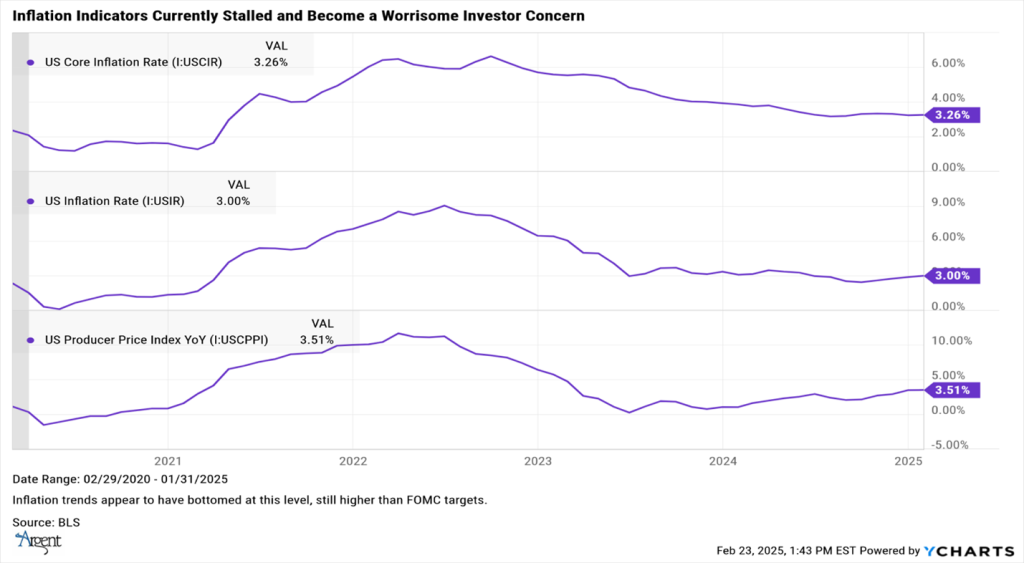
January’s inflation data, released earlier this month, was certainly not what the Federal Reserve or investors wanted to see. The Consumer Price Index (CPI) increased 0.5% on a seasonally adjusted basis in January, following a 0.4% rise in December. Over the past 12 months, the all-items index increased by 3.0%—the highest inflation growth rate since June of last year.
Key Increases:
- Shelter, which rose 0.4%, accounting for nearly 30% of all monthly items.
- Energy, which increased 1.1%, pushing gasoline prices up 1.8%.
- Food prices, which were up 0.4%, led by egg prices surging 15%.
A significant concern was that inflationary pressures were broad-based, with rising costs in used cars, auto insurance, and food items.
Core CPI Performance:
The standout was Core CPI, which exceeded estimates by rising 0.3% for the fourth consecutive month. Over the past 12 months:
- The Core CPI index rose 3.3%.
- The shelter index recorded a 4.4% increase—the smallest 12-month rise since January 2022.
- Other notable 12-month increases included:
- Motor vehicle insurance: +11.8%
- Medical care: +2.6%
- Education: +3.8%
- Recreation: +1.6%
Producer Price Index (PPI):
The Producer Price Index (PPI) also surpassed estimates, with U.S. wholesale prices increasing 0.4% in January and 3.5% over the past 12 months. More than one-third of the January rise in the index for final demand services was driven by traveler accommodation services, which advanced 5.7%. Additional increases were seen in:
- Truck transportation of freight
- Food and alcohol retailing
- Apparel, jewelry, footwear, and accessories
- Diesel fuel prices, which surged 10.4%
Implications for Interest Rates & Policy:
With annual inflation for CPI, Core CPI, and PPI potentially settling in the 3–3.5% range, expectations for interest rate cuts have been pushed back to the second half of the year. Additionally, tariffs could act as a wildcard, adding further price pressures across various sectors and introducing more complexity to Federal Reserve policy decisions. This represents yet another potential market headwind-more confirmation ahead with the February release of the Personal Consumption Expenditures Price Index (PCE).
The Fed Gambit
Given that economic growth data continues to show resilience, as does the most recent inflation data, there is little incentive for the Federal Reserve to lower interest rates any earlier than perhaps this fall. The Fed’s Beige Book, CEO confidence levels, and Small Business Optimism Indexes have all seen notable increases this month, further reinforcing the Fed’s “wait-and-see” approach. This stance was underscored by the FOMC minutes, which highlighted the committee’s resolve to push rate cut considerations further out this year.
Fed Chair Jerome Powell recently reiterated his belief that the Fed remains on the path to achieving 2% inflation. In congressional testimony, Powell stated, “With our policy stance now significantly less restrictive than it had been and the economy remaining strong, we do not need to be in a hurry to adjust our policy stance.”
These comments were echoed in separate speeches last week by Fed Governors Christopher Waller and Michelle Bowman, both of whom suggested that monetary policy could remain unchanged for a bit longer, though with differing perspectives. Governor Waller noted, “I believe a pause in rate cuts is appropriate. Assuming the labor market continues to be in rough balance, I can wait and see if the higher inflation readings in January moderate, as they have in the past couple of years. If so, I’ll have to determine whether this reflects residual seasonality that will fade later in the year or if a different issue is sustaining inflation. Either way, the data do not currently support a reduction in the policy rate. However, if 2025 follows a similar trajectory as 2024, rate cuts would be appropriate at some point this year.”
Governor Bowman also pushed back against the prospect of a near-term rate cut but acknowledged that progress on disinflation may take longer than hoped. She stated, “I continue to see greater risks to price stability, especially while the labor market remains strong.” Bowman also highlighted potential factors that could influence rate policy, adding, “The release of pent-up demand following the election could lead to stronger economic activity, which may also contribute to inflationary pressures. Now that we have entered a new phase in moving the federal funds rate toward a more neutral policy stance, several considerations lead me to prefer a cautious and gradual approach to policy adjustments. This approach provides us with time to assess our progress in achieving our inflation and employment goals.”
Markets are still anticipating the next rate cut, and any further delays, changes, or reversals could negatively impact investor sentiment. Additional risks include rising consumer prices due to enacted tariffs or disruptions within the Fed stemming from new administration policy changes—both of which could present inflation-impact market headwinds.
Commerce: A Surprising Upturn
January’s ISM Manufacturing Index moved into expansion territory for the first time in over two years. The Index registered 50.9%, indicating that manufacturing activity expanded in January after 26 consecutive months of contraction. Demand clearly improved, with the New Orders Index moving further into expansion territory, the New Export Orders Index returning to expansion, the Backlog of Orders Index dropping slightly and remaining in contraction, and the Customers’ Inventories Index staying in the “too low” category-a net positive manufacturing signal.
The Services PMI registered 52.8%, dropping from the prior month’s 54.1 index reading, indicating expansion for the 53rd time in 56 months since the recovery from the coronavirus pandemic-induced recession began in June 2020. Although January’s reading was lower than the previous month’s, poor weather conditions were cited as affecting business levels and production. Additionally, while many respondents mentioned preparations or concerns related to potential U.S. government tariff actions, there was little indication of current business impacts yet.
Also positive were reports from the Philly Fed and the New York Empire Manufacturing Index. Both regions reported solid improvements in manufacturing activity, with the New York survey rising to an index level of 5.7, surpassing estimates of 0.5. More importantly, New Orders surged from -8.6 to +11.6, while Prices Received increased from 9.3 to 19.6, indicating inflationary trends. The Philly Fed report showed a similar pattern, with Prices Paid rising from 31.9 to 40.5, further signaling both growth and inflationary pressure.
The uptick in manufacturing, coupled with continued support from the service sector, is positive for economic growth and, ultimately, for the markets. However, the risk lies in the potential for either a delay in interest rate easing or escalating inflation pressures that could lead to a policy reversal and tighter monetary decisions.
Corporate CEO perspectives appear to be improving as well. The first quarter’s Conference Board Measure of CEO Confidence increased by 9 points to 60, the highest level in three years. For the first time since early 2022, the Measure was well above 50 in Q1 2025, indicating that CEOs have shifted from the cautious optimism that prevailed in 2024 to a more confident optimism.
All components of the Measure improved, with CEOs significantly more optimistic about both current and future economic conditions—overall and within their own industries.
Additionally, CEOs reported a decline in concerns regarding various business risks, with fewer ranking cyber threats, regulatory uncertainty, financial and economic risks, and supply chain disruptions as high-impact concerns.
Until last week, markets were primarily focused on rising CPI, manufacturing data, and even CEO sentiment. However, attention has now shifted to the Fed’s preferred inflation gauge—the Personal Consumption Expenditures (PCE) Price Index—set to be released on February 28.
While improving business sentiment is a positive signal for the broader economic outlook, it could become a market headwind if rising inflation data outweighs the benefits of strong economic growth, corporate earnings, and investor confidence.
Labor Markets: Awaiting the Impact of DOGE Layoffs
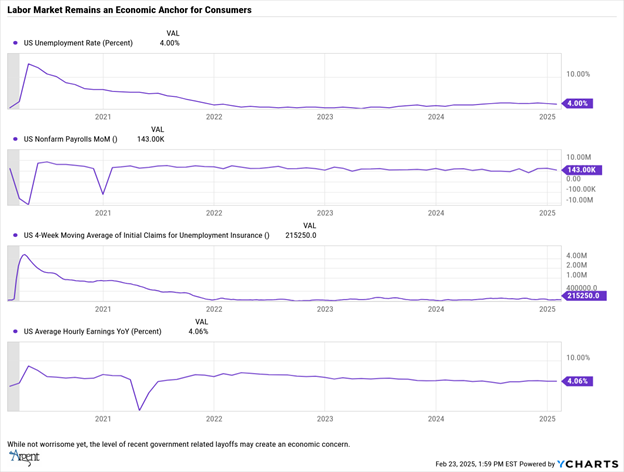
The job market remains steady despite headline layoff announcements across both industry and government. However, this could easily change in the coming months, as employment data is still adjusting to recent weather-related issues (fires, floods, and storms) across the country.
The most recent January report indicated that nonfarm payrolls rose by 143,000 jobs. Over the past three months, payrolls have increased by an average of 237,000 new additions. The unemployment rate ticked down slightly to 4.0%, while average hourly earnings grew by 0.5%.
Although there was little change in several categories—such as construction, professional services, manufacturing, and transportation—growth was seen in healthcare (up 44,000, compared to a 57,000/month average last year), retail (up 34,000, in line with last year), social assistance (up 22,000, versus a 20,000/month average last year), and government (up 32,000, also in line with last year).
Most surprising is the steady job growth in government, despite recent DOGE-related headlines about mass layoffs in government agencies. Recent job data likely has not yet accounted for these layoffs, but fears of job cuts alone are not likely to push the economy into a recession. However, in concentrated areas of federal employment cuts, the impact could be more pronounced due to both job losses and the ripple effect on peripheral businesses.
If a more significant economic impact emerges, the Federal Reserve has stated multiple times that it would be willing to ease policy to protect employment. While this would help stave off an economic downturn, any unemployment spike might still prove to be another market headwind. If, however, the employment levels remain stable, this provides a needed tailwind for improving consumption, corporate earnings and equity markets.
Housing Start Slump
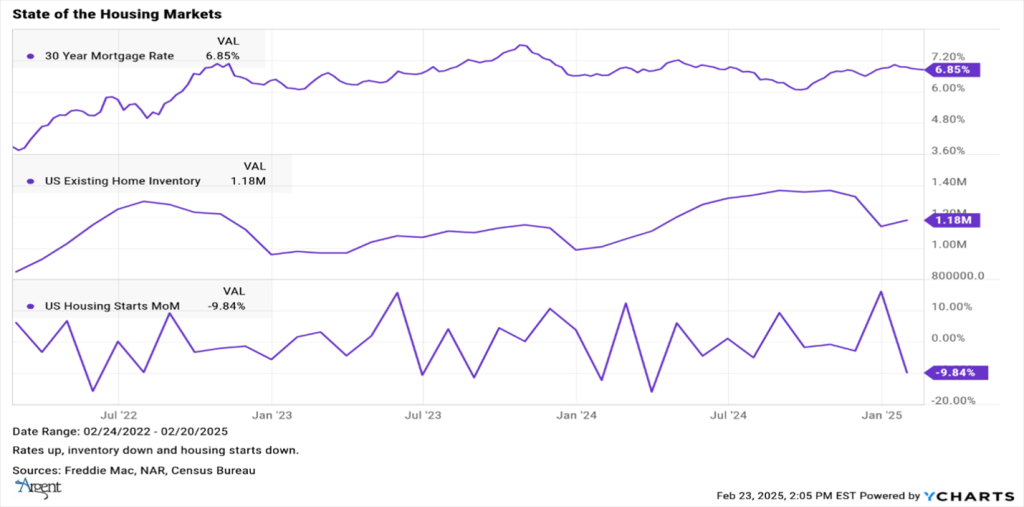
Given the decline in housing starts over the past couple of years, it’s unsurprising that homebuilder sentiment has also decreased. The National Association of Home Builders (NAHB)/Wells Fargo Housing Market Index fell to 42 in February 2025, down from 47 in January and below the historical average of 52, yet still above recent lows.
In January, housing starts declined by 9.8% month-over-month to a seasonally adjusted annual rate (SAAR) of 1.366 million units from a three-year high of 1.67 million homes- following a 16.1% increase in December. This downturn is partly attributed to severe winter weather conditions.
A concerning observation from Bespoke Investment Group highlights that recessions have historically followed such a rollover in housing starts, though the exact timing remains uncertain.
Building permits in January showed a marginal increase of 0.1% from December, reaching a SAAR of 1.483 million. However, single-family permits remained unchanged at 996,000, and with inventories of completed homes rising, construction activity is likely to slow further. The multifamily sector presented mixed signals: permits for smaller projects (2-4 units) rose by 13.2%, while those for larger developments (5+ units) declined by 1.4%. Overall, the data suggests a cooling construction pipeline that may take several months to stabilize.
The slowdown was broad-based across housing types: single-family starts fell by 8.4%, and multi-unit projects dropped by 13.5%. While a rebound is possible in February as weather-delayed projects resume, underlying market conditions indicate continued weakness ahead. One contributing factor is the national average 30-year mortgage rate, which stood at 7.04% in January 2025.
In summary, the combination of declining housing starts, stagnant permit activity, and high mortgage rates points to ongoing challenges in the housing market. These factors may continue to dampen homebuilder sentiment and slow construction activity in the near term, posing a market and economic headwind, if history prevails.
Consumer Sentiment Tested
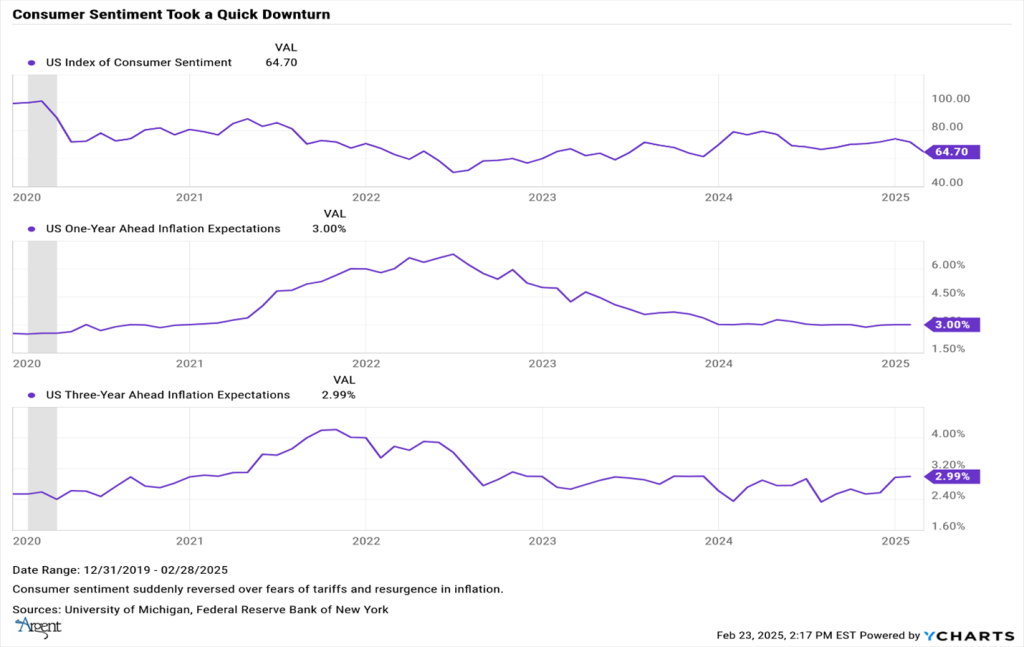
Consumer sentiment declined nearly 10% from January, marking the second consecutive monthly drop across all demographic groups, including age, income, and wealth, according to the January Consumer Expectations survey from the Federal Reserve Bank of New York. All five components of the sentiment index weakened this month, led by a steep 19% decline in buying conditions for durable goods, largely due to concerns over potential tariff-induced price increases.
Expectations for personal finances and the short-term economic outlook both fell nearly 10% in February, while the long-term economic outlook dropped about 6%, reaching its lowest level since November 2023. Sentiment declined among Democrats and Independents but remained unchanged for Republicans, reflecting ongoing partisan differences in perceptions of new economic policies.
News surrounding tariffs—whether trade-related rhetoric or formal policy announcements from the White House—is also weighing on consumer sentiment. According to the survey, about 40% of consumers spontaneously mentioned tariffs, up from 27% last month and less than 2% before the election. Following the January 31 announcement that tariffs on China, Canada, and Mexico would be implemented, year-ahead inflation expectations surged. However, it remains too early to determine whether a significant wave of tariffs is forthcoming or if the headlines merely signal a negotiating tactic by the new administration.
Another concerning factor is the latest retail sales data. January’s 0.9% decline marked the largest drop in a year. Cold weather was certainly a contributing factor, as were the West Coast wildfires. Online shopping fell by 1.9%, car sales dropped 2.8%, and most discretionary spending categories saw declines—except for bars, restaurants, and big-box retailers like Walmart. While this was a weak retail report, it is important to consider the extenuating weather-related circumstances. More data on economic conditions, market trends, and corporate earnings will be necessary before determining whether this signals a broader economic headwind. For now, it is too early to draw definitive conclusions from January’s data.
The Financial Markets-Climbing Another Wall of Worry
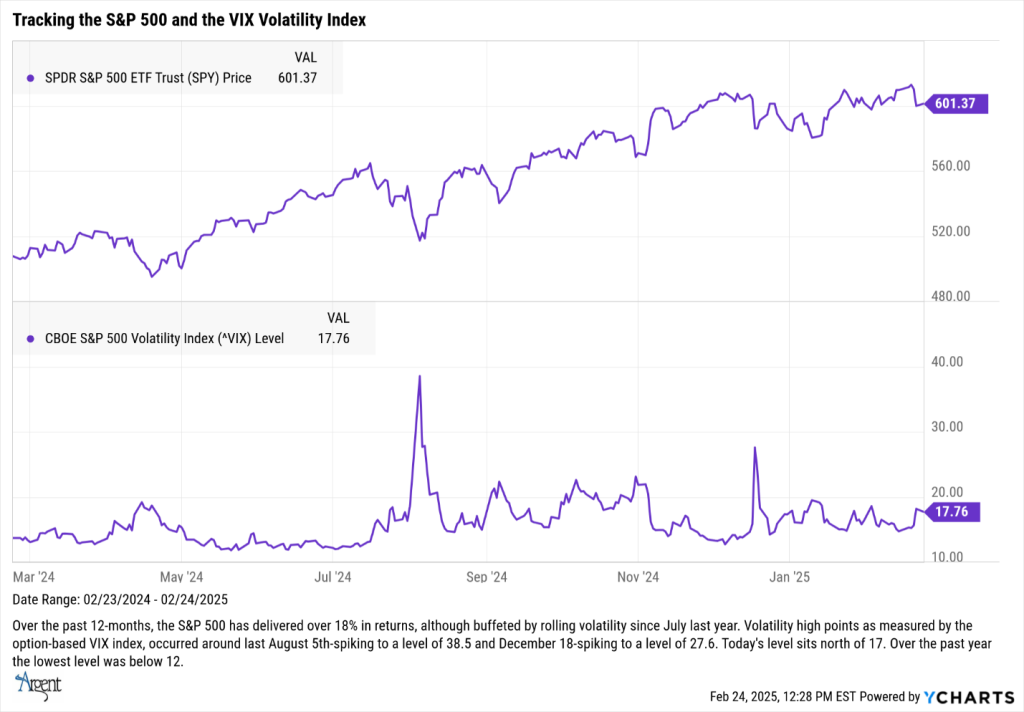
When the S&P 500 last closed at an all-time high on Wednesday, the VIX was in the low 15s. In early afternoon trading on Friday, it was only a little more than a point higher. Whether it’s a sign of complacency or not, the VIX doesn’t appear overly concerned (yet). Since the CBOE Volatility Index (VIX) is a real-time market index representing market expectations over the coming 30 days, any sustained increase in VIX becomes worrisome, as was the case in 2022 through mid-2023.
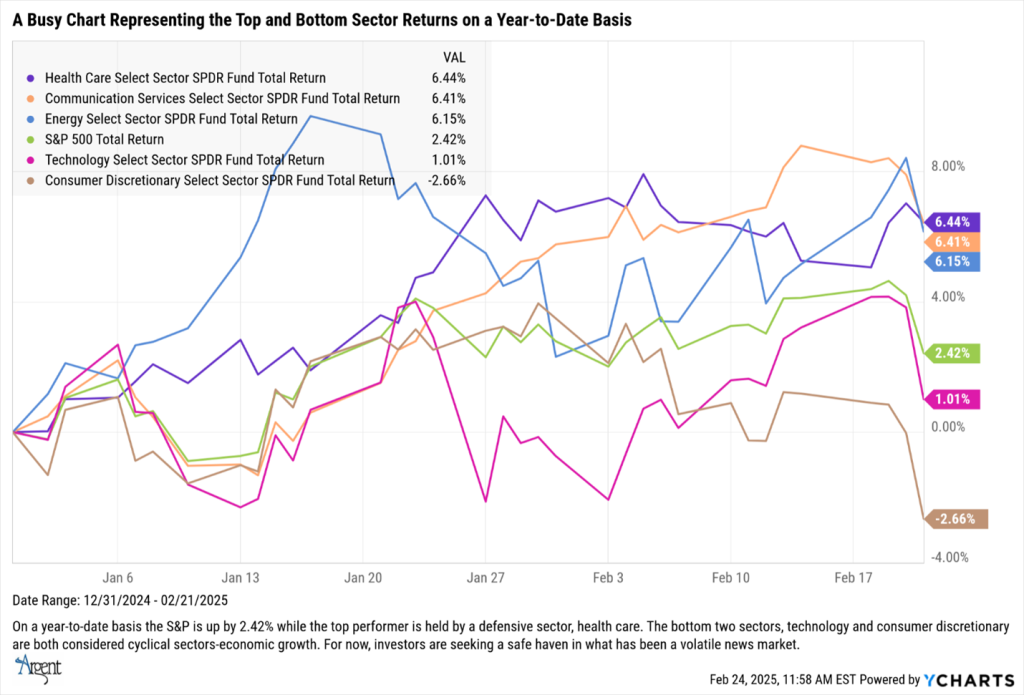
As of last Friday, February 21, 2025, most sectors have shown positive performance year-to-date, with the exception of the consumer discretionary sector, which has declined by 2.66%. This sector, along with technology, is considered cyclical and represents the more “growth-oriented” companies in the market. Notably, the consumer discretionary sector’s returns have lagged behind the S&P 500’s year-to-date gain of 2.42%. In contrast, during the previous year, this sector outperformed the broader market, posting a 25.47% increase compared to the S&P 500’s 23.31% gain. The healthcare sector, viewed as more defensive, has risen by 6.44% year-to-date, a significant improvement from its 0.87% increase over the prior year.
It’s also noteworthy that the breadth—or percentage—of stocks above their 100-day and 200-day moving averages is currently below 60%. Specifically, as of February 21, 2025, approximately 47.91% of S&P 500 stocks were trading above their 100-day moving average, and about 58.64% were above their 200-day moving average. With a few exceptions, the previous year saw a higher percentage of stocks exceeding these moving averages. While this data doesn’t indicate an imminent market breakdown, it’s a metric worth monitoring.
Continuing the market and economic observations and concerns:
- Housing Market Challenges: The U.S. housing market continues to face high mortgage rates, elevated home prices, and limited inventory. While mortgage rates have decreased from their peak in October 2023, when the average 30-year fixed-rate mortgage reached 7.79%, they remain elevated, starting February 2025 at 6.89%. Despite the Federal Reserve’s interest rate cuts beginning in September 2024, these measures have not significantly alleviated housing affordability issues. Relief in housing starts, mortgage rates, and inventory levels would be beneficial.
- Inflation and Consumer Sentiment: Data on inflation and consumer sentiment remains mixed. Investors are concerned about the possibility of the Federal Reserve reversing its policy towards higher interest rates. Recent reports indicate persistent inflationary pressures, with the U.S. services sector contracting and consumer sentiment declining. The Federal Reserve is closely monitoring these developments before making further policy adjustments.
- Labor Market Stability: The job market continues to remain stable, although recent data has not fully accounted for weather-related issues and the impact of government restructuring. While initial unemployment claims have increased slightly, the labor market is expected to absorb those recently displaced, depending on the speed of transitions.
- Tariff Concerns: Tariffs remain a concern due to their potential impact on inflation and supply chain disruptions. Recent tariff threats may serve as negotiation tactics, but they also pose risks of rising prices and restricted trade flows. The Federal Reserve has expressed caution regarding interest rate cuts amid inflation concerns linked to policy uncertainties, particularly tariffs.
- Corporate Earnings Growth: Companies continue to report positive earnings growth, supporting market valuations. As of February 14, 2025, with approximately 77% of S&P 500 companies having reported Q4 2024 earnings, the blended year-over-year earnings growth rate stands at 16.9%, the highest since Q4 2021. Projections indicate year-over-year earnings growth rates of 8.1% for Q1 2025 and 9.9% for Q2 2025, with an anticipated full-year 2025 growth rate of 12.7%.
- Treasury Yields and Inflation: If the fixed-income markets were concerned about the latest inflation reports, an increase in Treasury yields would be expected. However, this has not been the case year-to-date. The 10-year Treasury rate is about 37 basis points below its mid-January high—4.79% on January 13, 2025, compared to 4.42% on February 21, 2025.
In summary, while the economy shows resilience in corporate earnings and labor market stability, challenges persist in the housing market, inflation dynamics, and potential tariff impacts. As the Fed often says, where the market goes from here will be data-dependent, some of which will be this week.
Not Investment Advice or an Offer -This information is intended to assist investors. The information does not constitute investment advice or an offer to invest or to provide management services. It is not our intention to state, indicate, or imply in any manner that current or past results are indicative of future results or expectations. As with all investments, there are associated risks and you could lose money investing.

