


BY: Tom Stringfellow, CFA®, CPA®, CFP®
Chief Investment Strategist
Through the Looking Glass
Hurdles and Opportunities
- The current bull market has lasted for two consecutive years, with nearly any stock associated with “Artificial Intelligence (AI)” benefiting from the momentum rally.
- Despite concerns about economic health last year, summer economic data rebounded—perhaps more quickly than anticipated rate cuts.
- Earnings estimates for the past quarter project 11.4% year-over-year growth, with full-year 2024 growth expected to exceed 9%.
- Under the incoming Trump administration, the Republican Party will control both the House and Senate, an environment historically associated with continued positive market returns.
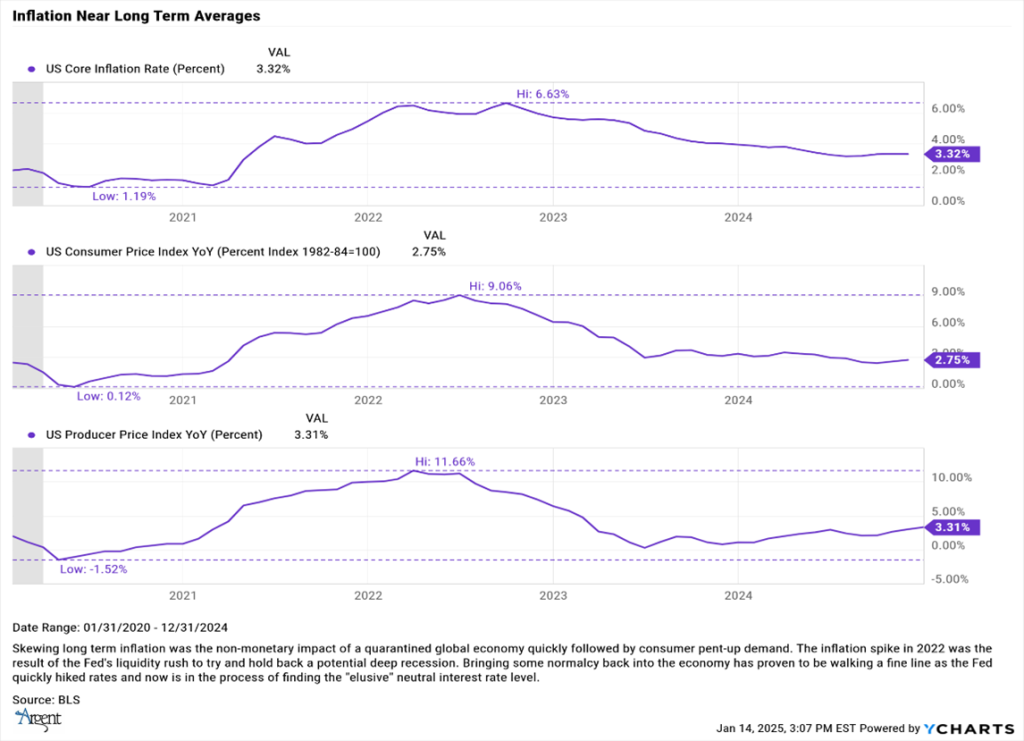
- Inflation remains a concern. Although inflation indicators have retreated from 2022 highs, housing prices have yet to decline. A new risk in 2025 is the potential impact of tariffs disrupting global markets or reigniting inflationary pressures.
Setting the Stage
While the S&P 500 and Nasdaq indices delivered exceptional returns in 2024, not all markets experienced the same level of performance. As shown in the chart below, the small-cap market (IWM) and the S&P 500 Equal Weight ETF (RSP) lagged slightly behind the leaders, though they still delivered solid gains of 15.06% and 14.05%, respectively. A similar ‘muted’ trend was observed in the S&P 500 Equal Weight Index, which lacked the momentum seen in large-cap, tech-focused companies. Despite underperforming the S&P 500 and Nasdaq, the returns of 15.06% and 14.05% were still highly attractive. However, these returns were overshadowed by the highly volatile bitcoin, with its extraordinary surge of nearly 120% last year.
Also, noteworthy last year was the strength in the S&P 500’s market trajectory. According to Bespoke Investment Group, the Index ended 2024 with 57 record high-closings, which was the 5th most in any year since 1953.

The market’s strong performance in 2024 was driven by an improving corporate outlook supported by robust earnings. A joint survey conducted by Fortune and Deloitte, released in December, revealed that 84% of American corporate CEOs were optimistic—or very optimistic—about their company’s prospects for 2025. This optimism was underpinned by expectations of deregulation, fiscal stimulus, and increased market activity. It also aligns with Ernst & Young’s (E&Y) projections for 2025, which anticipate a 10% growth in mergers and acquisitions (M&A) activity and a 16% increase in private equity closings.
Last year’s domestic economy and markets were bolstered by a combination of resilient consumer spending, easing supply chain pressures, relatively low unemployment rates, and accommodative monetary policies. In many respects, the U.S. stood out as an outlier in both market and economic performance.
Globally, economic recovery faced greater challenges, often disrupted by geopolitical tensions such as the ongoing conflict between Russia and Ukraine and unrest in the Middle East. These issues, coupled with broader economic uncertainties, significantly impacted market performance outside the U.S.
In 2024, returns from overseas markets trailed those in the United States. Emerging market equity returns, as measured by the iShares ETF (EEM), posted a gain of 6.60%, while the index for developed markets, excluding the U.S., recorded a return of 5.53%.
In the Hands of the Fed
Hot economic data has reinforced the notion that the Federal Reserve may have finished its rate cuts—or has already paused. This is the primary reason stocks have continued to extend their year-end 2024 decline. As of last Friday’s close, Fed funds futures are pricing in just one rate cut for 2025, expected no earlier than June. Additionally, there is approximately a slight chance of no rate cuts at all in 2025.
While concerns about a Fed pause have pressured stocks, market expectations have already shifted to a much less dovish stance. Therefore, while an official pause announcement would likely hit stocks further, much of the damage may have already been absorbed.
The recent economic data has been strong, but not strong enough to potentially justify a reversal towards tighter monetary policy (rate hikes). It’s crucial to remember that strong growth, coupled with falling inflation, can still allow room for another Fed rate cut. Here’s what’s important to keep in mind:
- Strong data, in itself, isn’t a problem.
- Strong data that the Fed believes could boost inflation is a problem.
Currently, it’s unclear if the strong data is the kind that could significantly increase inflation. Notably, the wage component in Friday’s jobs report was the only concerning aspect so far, which explains why the Fed has not pushed back aggressively.
Vice-Chair Waller, the most significant Fed voice last week, did manage to ease market concerns by stating that inflation remains on a trajectory toward the 2% target. While progress may have slowed, it continues, providing many economists with justification for additional rate cuts.
Inflation—not just growth—remains the focal point. Solid economic data won’t necessarily stop the Fed from easing unless that activity is strong enough to risk spiking inflation. At this point, the growth data, while exceeding estimates, does not appear inflationary. In the meantime, Fed commentary last week was mixed, reflecting a divided central bank on whether to continue rate cuts or implement a pause. Where the Fed ultimately weighs in will depend on the inflation data released later this week.
A Stabilizing Economy
Economic activity in the manufacturing sector contracted in December for the ninth consecutive month and the 25th time in the last 26 months, with the Manufacturing PMI registering 49.3%. While still in contraction territory, the index showed a nominal increase of 0.9 percentage points from November’s reading of 48.4%.
The positive spin is that manufacturing new orders strengthened, rising 2.1 percentage points from November and returning to expansion territory; the production index increased 3.5 percentage points, signaling stabilization in factory output; and the backlog of new orders grew by 4.1 percentage points, suggesting improving demand. Comments in the report also implied that factory output was stabilizing, and customer inventories remained low, pointing to potential opportunities for future growth in the manufacturing sector.
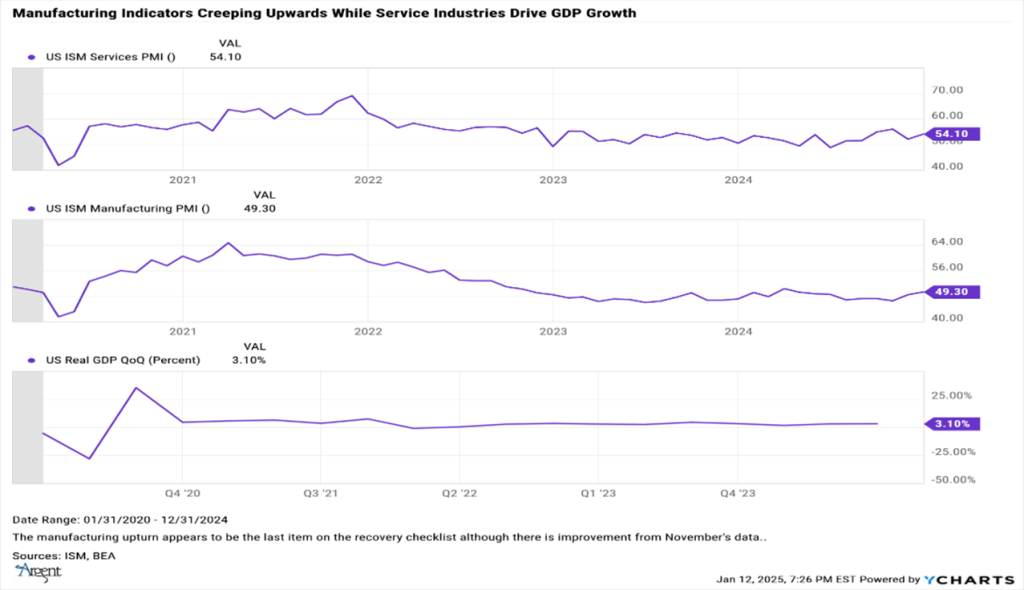
The services sector, measured by the Services PMI, also expanded for the sixth consecutive month in December, registering 54.1%. This marks the 52nd expansion in 55 months since the recovery from the pandemic-induced recession. December’s reading also represented the 10th time the index has been in expansion territory during 2024.
Further, the services industry has been a major driver of the nation’s GDP growth post-COVID. This category includes industries such as Finance, Entertainment, Retail, Healthcare, Transportation, Food Services, Wholesale Trade, and Utilities—all critical industries collectively fueling economic activity and ensuring essential services. These consumption activities account for approximately 68% of GDP, making it a cornerstone of economic growth, and much of the economic recovery post-COVID lockdowns can be attributed to the robust consumer spending as individuals returned to public spaces and took out their checkbooks.
Maintaining this economic growth through the next administration will be key to incoming President Trump’s success. Most recent Q3 GDP growth posted an annual rate of 3.1%, while Q4 GDP estimates suggest a growth rate of 2.7%. To sustain this level of growth, the critical focus will require revitalizing the manufacturing labor force. The incoming administration has emphasized this as a key priority, with strong pledges to support manufacturing jobs and bolster industrial activity.
Consumers Keep Spending
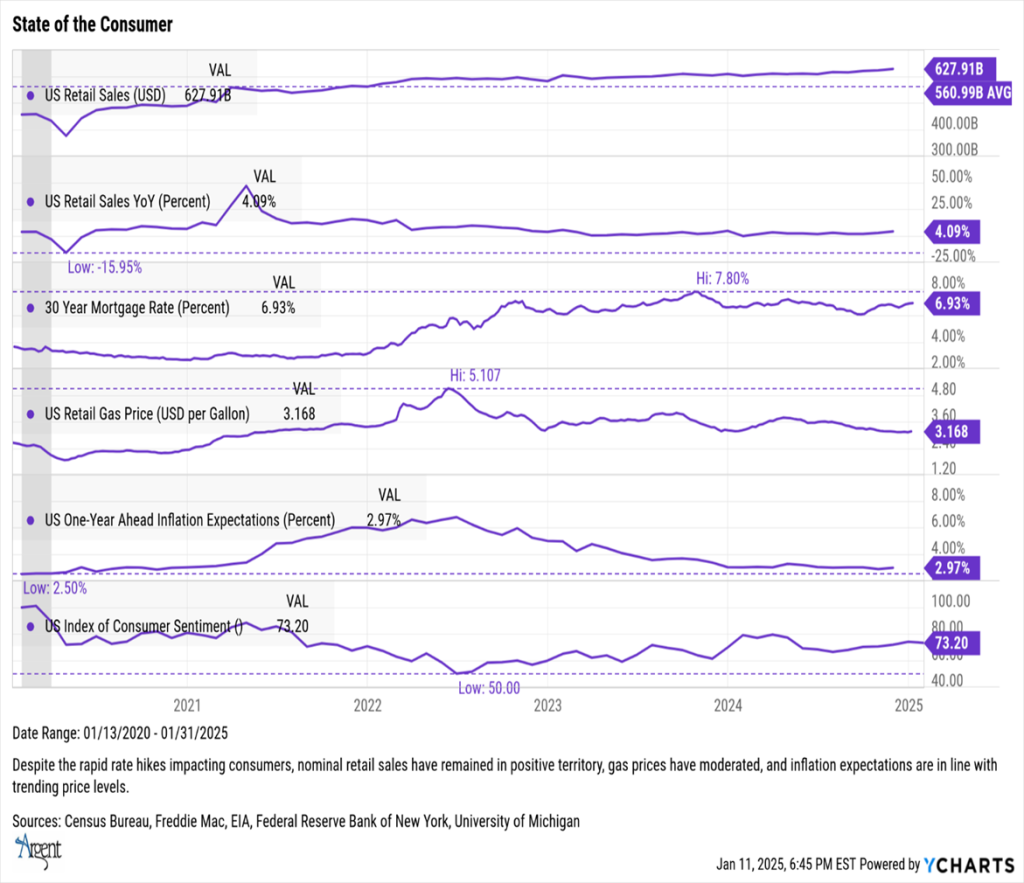
The Federal Reserve Bank of New York’s Center released the December 2024 Survey of Consumer Expectations, highlighting mixed trends in consumer sentiment. The report shows that inflation expectations were unchanged in the short-term, although consumers were more optimistic over the longer term.
Additionally, survey-takers have become more positive regarding potential job loss, voluntary job separation, and finding a new job in the event of lay-offs.
There was also a reported drop in household income growth, down to 2.8%, the lowest since May 2021. Despite this decline, however, it remains slightly above the pre-pandemic level of 2.7% recorded in February 2020.
While year-ahead household income growth expectations dropped slightly to pre-pandemic levels, spending growth expectations increased and remained well above pre-pandemic readings. Other key expectations included:
- The probability of losing one’s job in the next 12 months declined by 1.6 percentage points to 11.9%.
- The probability of finding a new job after a job loss fell sharply to 50.2%, down from 54.1% in November 2024. This marks the lowest reading since April 2021.
- Spending growth expectations increased by 0.1 percentage points to 4.8%, significantly higher than pre-pandemic levels.
- Perceptions of households’ current financial situations are improving, with fewer respondents reporting they were worse off and more respondents stating they were better off compared to a year ago.
A Still Vibrant Job Market
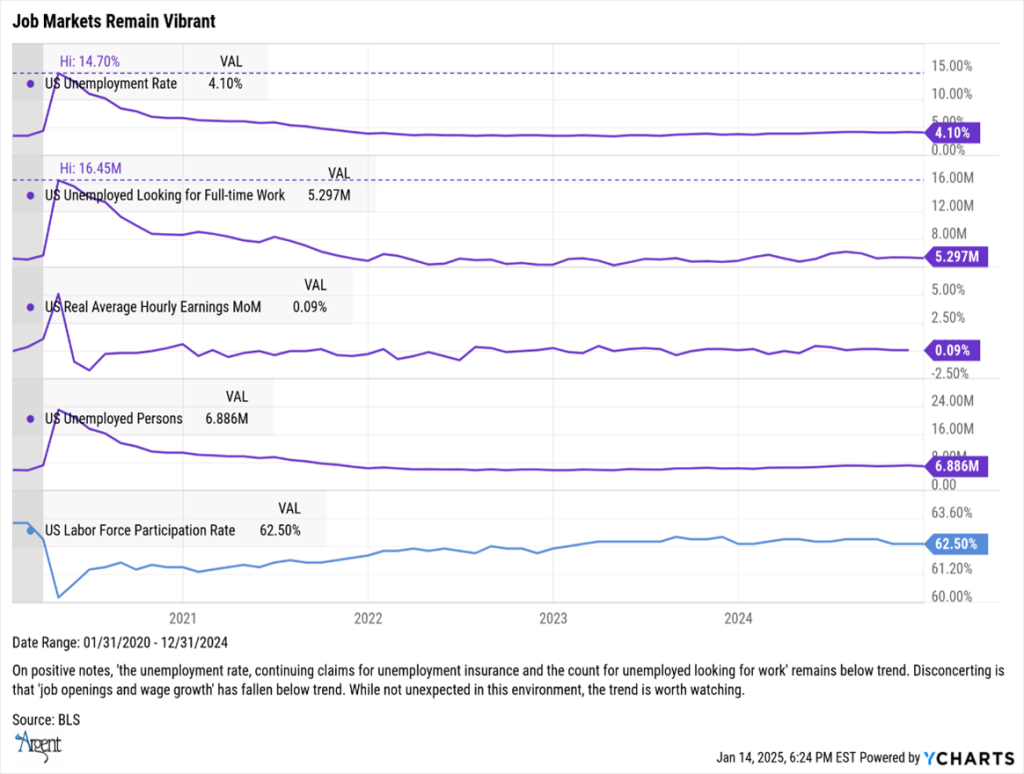
The December 2024 jobs report provided a strong finish to the year. The economy added 256,000 new positions, exceeding estimates by nearly 100,000 jobs. Unemployment levels fell slightly to 4.1%, and the three-month payroll growth averaged just over 170,000. The labor participation rate also remained unchanged at 62.5%, staying within the narrow range of 62.5% to 62.7% since December 2023.
Comparing this year’s data to 2023, nonfarm payrolls grew by more than 1%, from 157.3 million to more than 159 million, from Dec. 2023 to Dec. 2024. This is in contrast to U.S. companies announcing the second-most job cuts since 2009 last year, trailing only 2020, according to Challenger, Gray & Christmas.
As for the industry breakdown of new jobs, the surge in payroll growth was primarily concentrated in the healthcare, social assistance, and government sectors. The healthcare industry added 46,000 jobs, social assistance added 18,000 jobs, and government saw an increase of 33,000 jobs. Most surprising, retail employment jumped by 43,000 jobs, following a decline of 29,000 in November. Perhaps not surprising, employment in leisure and hospitality also increased by 43,000 jobs.
As for the impact of December’s job data, the market’s take was that the Fed may take January’s expected rate cut off the table-for now.
Closing Perspectives
Two weeks into the new year, heightened volatility in the markets has provided a stark contrast to the relative stability observed throughout most of 2024. This shift signals that achieving further market gains in 2025 may become more challenging.
As already noted, Federal Reserve commentary and speaking circuits have raised concerns that the Fed may have paused its rate-cutting cycle, diminishing the likelihood of additional rate cuts in January or the near future. Simultaneously, economic growth is showing signs of re-acceleration, the 10-year Treasury yield has risen to nearly a one-year high, and escalating tariff threats from the Trump administration have led to deteriorating market sentiment since early December.
With continued Fed rate cuts now in question, economic growth nearing “hot” levels, the 10-year yield approaching 5.00%, and headline-driven volatility tied to Trump’s policies increasing-market sentiment faces significant headwinds. Nevertheless, strong economic fundamentals and (hopefully) a still-easing monetary policy remain supportive of stocks.
In simpler terms, the market has already priced in many future positives. As a result, merely meeting those expectations will not be enough to drive stocks significantly higher. The broad index, S&P 500, is expensive today at roughly 22 times earnings, but the estimates for earnings growth for this past quarter are at three-year highs of 11.7%. For 2025, growth estimates begin ratcheting upwards towards 15%, well above the 10-year average of 8% —potentially adding more fuel for market momentum, which, given the recent broadening out of the market, provides a reason for investors to remain optimistic.
Key Factors Influencing the Economy and Market
Monetary Policy
In 2024, markets welcomed rate cuts and now anticipate more. However, two additional Fed rate cuts may not be sufficient to drive significant growth, and more aggressive action might be necessary. The unfortunate California wildfires could potentially serve as a catalyst for further easing of interest rates. Likewise, the wildfires may also prove to be an inflationary catalyst as the real cost of rebuilding begins and demand for resources once again rattles the supply chains and drives up prices.
Political Landscape
The market had priced in a “Red Sweep” in the elections, which came to pass. Now, the new Congress and administration must deliver by enacting pro-growth policies and avoiding the distractions of trade tensions and other headwinds. Currently, however, distractions seem to dominate the economic narrative across various sectors. Another significant potential risk is President Trump’s “DOGE” efforts to reduce federal headcounts and deportation policies. How the economy reconciles a mass exodus of federal workers to the unemployment rolls is uncertain, as is the potential impact of deporting millions of immigrants—likely creating shortages in various industries. Once again, it will be an interesting year.
The Economy and Conditions for Improvement
A soft landing was anticipated and achieved in 2024, but sustaining it is crucial. Any signs of economic slowing could reignite fears of a hard landing, while unexpected acceleration might reduce the likelihood of further rate cuts.
The market outlook could improve if the following occurs:
- The Federal Reserve clarifies that it has not paused rate cuts, supported by moderation in economic data, including inflation.
- The 10-year Treasury yield stabilizes in the mid-to-low 4.00% range.
- Trump’s tariff threats prove to be more rhetoric than action, avoiding significant disruptions to global trade.
- Geopolitical conflicts, including those in Ukraine and the Middle East, move toward resolution.
Not Investment Advice or an Offer -This information is intended to assist investors. The information does not constitute investment advice or an offer to invest or to provide management services. It is not our intention to state, indicate, or imply in any manner that current or past results are indicative of future results or expectations. As with all investments, there are associated risks and you could lose money investing.

