

Fourth Quarter Market Recap
The U.S. economy and the stock market proved much stronger than many had anticipated in 2024. There are always reasons for worry, and in 2024, some of the largest concerns included geopolitical tensions, elevated valuations, stubborn inflation, interest rate uncertainty, slowing growth in major foreign economies, and, of course, the U.S. presidential election. Undoubtedly, investors will have plenty to watch for in 2025. Front and center will be the Trump administration’s policies, which will likely have ripple effects both here in the U.S. and abroad.
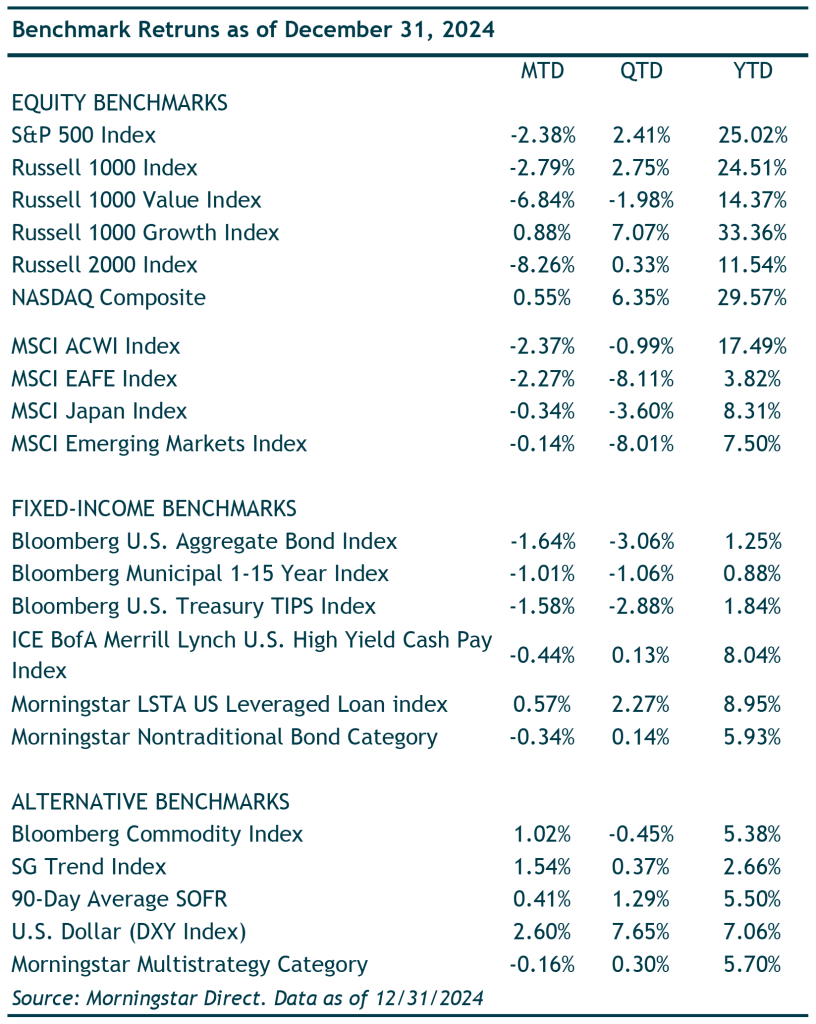
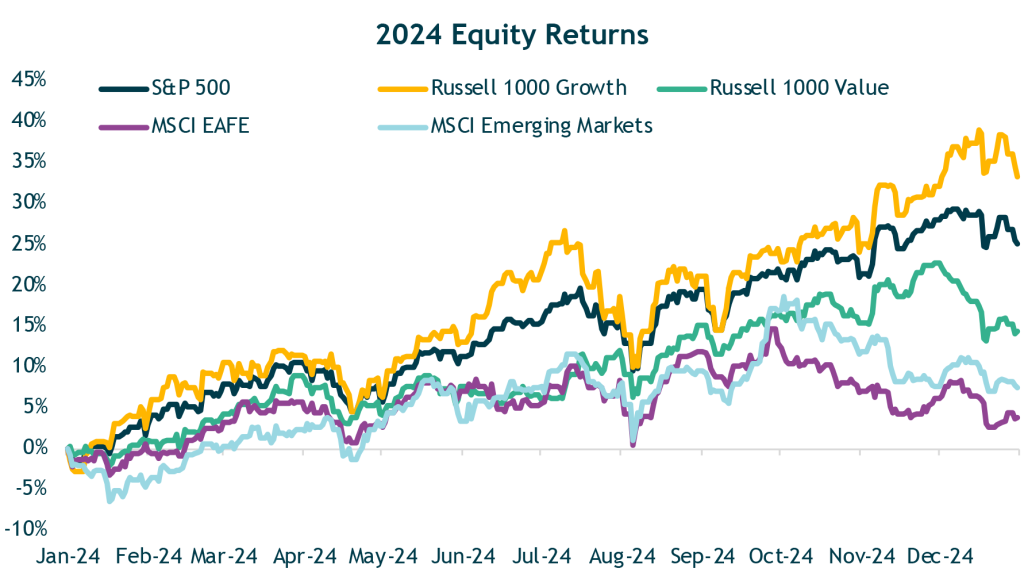
For the year, domestic stocks delivered strong returns with meaningful disparities across the market. Large-cap stocks posted a gain of 25%, widely outperforming small-cap stocks, which rose 11.5%. Growth-oriented stocks, led by technology names were the biggest winners, posting a 33.4% gain. Value-oriented stocks were up 14.4% in comparison.
Overseas, returns were not nearly as strong. Developed international stocks posted a modest 3.8% gain. Calendar-year returns for most foreign markets were dragged down by fourth-quarter losses following the Trump presidential victory, which sparked fears of a widespread economic slowdown due to tariff risks and a stronger U.S. dollar. Emerging markets stocks had a volatile year, finishing the year up 7.5%. Much of that volatility can be attributed to China. The Chinese stock market had a strong year (up 19.4%) but it was tumultuous, marked by significant swings in investor sentiment. Early-year optimism over government stimulus efforts and reopening momentum faded as economic growth fell short of expectations. Later in the year, the Chinese government jolted the stock market sharply higher with a stimulus package aimed at supporting real estate prices and weakening consumer confidence. Early in the fourth quarter, Chinese stocks were up over 60% off their January lows, but ultimately, high debt levels, underwhelming fiscal support, ongoing property market troubles, weak consumption, and international trade pressures weighed on the market.
Within the bond markets, calendar-year returns were mixed across fixed-income segments. The benchmark 10-year Treasury yield experienced significant volatility throughout the year amid concerns around inflation, interest rates, the budget deficit, and the impact of potential tariffs under Trump. After starting the year with a yield of 3.88%, the 10-year Treasury finished the year higher, at 4.58%. Against this backdrop, the interest-rate-sensitive Bloomberg U.S. Aggregate Bond Index was slightly positive at 1.3%. Conversely, short-term and credit-sensitive sectors of the bond market—both areas we emphasized in portfolios—performed well during the year. The Bloomberg Short-Term Treasury rose 5.3%, and high-yield bonds were up 8.2% in the year.
Portfolio Performance and Key Performance Drivers
Overall, for the year, our active portfolios delivered solid absolute returns across the range of risk profiles, though they did slightly trail their portfolio benchmarks. Performance was driven by a full strategic weighting to stocks, underweighting international markets, and maintaining more exposure to shorter-duration, higher-yielding bond strategies.
After a strong showing in 2023, active equity manager performance, particularly U.S. larger-cap blend and U.S. larger-cap value managers were a headwind to performance this year as they failed to keep pace with the tech-heavy S&P 500 index.
Investment Outlook and Portfolio Positioning
Looking ahead to 2025, our base case is that the U.S. economy will continue to grow, albeit slower, with a low probability of recession. This should be a supportive backdrop for both bonds and stocks, although we expect the pace of gains to slow. We continue to think it’s likely that the market will broaden out beyond large-cap growth stocks to include small-and mid-caps and non-tech sectors of the market. At the same time, we anticipate bouts of volatility caused by central bank policies, slowing global growth, geopolitical tensions, and elevated stock market valuations.
As of year-end, our portfolios have a full strategic weighting to stocks, and we remain diversified across geographies, including the U.S., developed international, and emerging markets. In fixed-income, we continue to emphasize exposure to flexible, shorter-duration, and credit-oriented fixed-income allocations, which we think will generate better yields over time. Importantly, we are not “stretching” for yield—i.e., taking on excess risk to achieve attractive returns. Many of our exposures are investment-grade or are conservatively positioned within the non-core, higher-yielding space. As always, we are weighing a range of shorter-term risk scenarios against each asset’s medium- and longer-term return potential and portfolio diversification benefits, assuming different macro environments (inflation/disinflation, growth/stagnation).
U.S. Stocks
The S&P 500 marched higher throughout 2024, ending the year up 25%. The index notched 57 all-time highs in 2024. The S&P 500 also recorded consecutive annual gains of over 20% for the first time since the late 1990s.
Once again, the performance of large-cap growth/technology stocks led the way. The often-quoted Magnificent 7 stocks generated returns of nearly 70%, while the remaining 493 stocks clocked in with a 16% return (a respectable figure, to be sure, but well behind the Mag-7). Standout performers included semiconductor companies such as NVIDIA (+170%) and Broadcom (+113%).

The strong performance of large-cap growth stocks in recent years has resulted in one of the most concentrated stock markets on record. There are now eight companies in the S&P valued at greater than a trillion dollars, and the weight of the top-10 stocks in the S&P 500 index has reached an all-time high of 39% (see chart, left). While this narrow market leadership could persist for some time, the generals cannot lead the market higher into perpetuity. The infantry must join the battle for a healthy bull market to continue. Otherwise, failure of a few companies to meet extremely optimistic expectations will drag down market cap weighted indexes (like the S&P 500).

Looking ahead to 2025, we think the economic backdrop is still favorable for stocks, and we believe the market rally can broaden outside of large-cap tech. The U.S. economy continues to grow (albeit more slowly), inflation is back to normal-ish levels, profit growth is expected to broaden, and there are growth-oriented themes (AI) that could continue to drive investment and productivity, while Trump’s business-friendly policies could further support growth.
While our economic outlook is generally positive, there are plenty of risks. For starters, equity valuations are historically expensive and reflect a significant amount of investor optimism. Current valuation levels — particularly for larger-cap growth stocks — suggest that there is less room for upside and there is more downside risk if expectations are not met. As mentioned previously, the high level of concentration in the S&P’s top-weighted stocks could magnify volatility if any of these companies disappoint. In addition, there is a list of usual risks to the equity market, including macroeconomic developments, inflation, central bank policies, and the risk that some of the anticipated Trump policy tailwinds don’t pan out and turn to headwinds.
However, if the economy continues to grow, we think a broadening out of the market beyond the largest-cap stocks could benefit our allocations to mid-caps. The composition of the mid-cap index has higher exposure to domestically focused sectors than the S&P 500, such as industrials, financials, and consumer discretionary. By comparison, information technology stocks, which derive a larger percentage of their revenues globally, make up nearly 30% of the S&P 500. Being more domestically oriented, mid-caps are less exposed to geopolitical risks and currency fluctuations that can affect large multinational corporations. This could make mid-caps relatively attractive in periods of heightened global uncertainty.
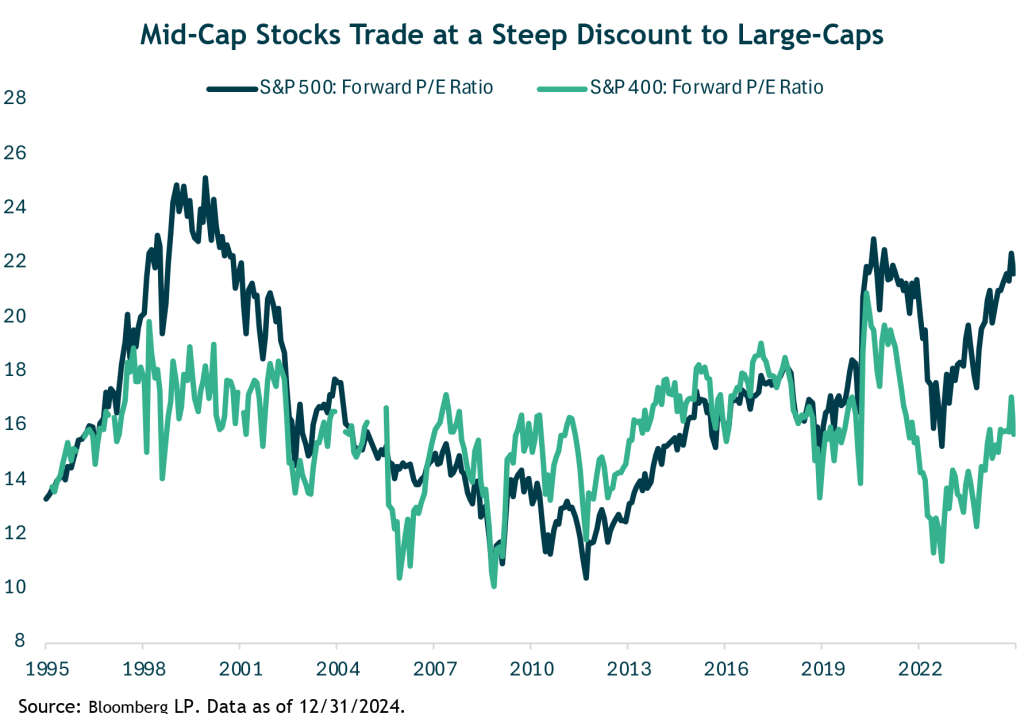
Mid-caps strike a balance between growth potential and stability, offering the potential for fast growth while also having the operational flexibility that can come with a mature business in the event of an economic slowdown. For now, our active portfolios already have an implicit overweight to smaller businesses and underweight to mega-cap growth stocks. Given the nature of the markets, our active managers already own less than index exposure to mega-cap growth companies. Today, active investing is, by its nature, largely tilted away from the largest growth companies. For now, we are comfortable with exposures in active models, but we will continue to evaluate mid-caps as an option.
We will continue our evaluation and explore opportunities for our portfolios. Looking ahead, we think investors should be prepared to weather occasional storms in 2025.
Foreign Equities
While the U.S. economy has remained strong, economic growth elsewhere in the world has been relatively weak. The European economy, for example, was much more impacted by the recent rate hikes than in the U.S.—likely due to massive U.S. fiscal programs and the boom in domestic AI-related investments. A stronger U.S. dollar was another headwind for foreign equity returns, which moved even higher after the U.S. election. Better prospects in the U.S. resulted in another year of significant outperformance. This has been the case for the past 15 years—the U.S. has enjoyed structurally higher economic and earnings growth. This has not gone unnoticed by investors as the market is now paying upwards of 22x for U.S. earnings compared to just over 13x for European earnings. This P/E multiple discount is at a historically wide differential.
In fairness, European equities have performed decently since the bull market that started in October 2022. The main reason for the underperformance relative to U.S. stocks is the lack of mega-cap technology companies. Analysis from Ned Davis Research shows that since mid-October 2022, the S&P 500 has been up 22.6% annually, easily outpacing MSCI Europe’s return of 16.1%. However, when removing the eight large tech leaders from the S&P 500 (Alphabet, Amazon, Apple, Broadcom, Meta, Microsoft, NVIDIA, and Tesla), the index returned 13.8% annualized. While one cannot simply remove the best performers from an index, it does highlight the significant impact these technology giants have had in recent years.
Throughout 2024, emerging market economies faced uncertainties around the weakness in China and potential tariffs from a second Trump administration. Both factors helped push the dollar higher and weighed on emerging-markets equities.
Much like developed international stocks, emerging markets trade at a historically wide discount to their U.S. counterparts. However, on a stand-alone basis, they trade at a slight premium to their own historical average. Given elevated geopolitical uncertainties, we will not consider an overweight in emerging markets until valuations are discounted in absolute terms and we are in a world that’s less favorable to the U.S. dollar.
The Federal Reserve and the Fixed Income Market
Throughout 2024 the bond market has been hyper-focused on every economic data release, ranging from inflation and employment reports to GDP growth and consumer strength. Each data point has been heavily scrutinized for its potential impact on central bank policy, driving heightened volatility as investors attempt to project the likelihood of interest-rate changes and the implications on returns. Investor guesswork has led to a very volatile year for the 10-year U.S. Treasury bond, reflecting the market’s sensitivity to economic conditions in an uncertain environment.
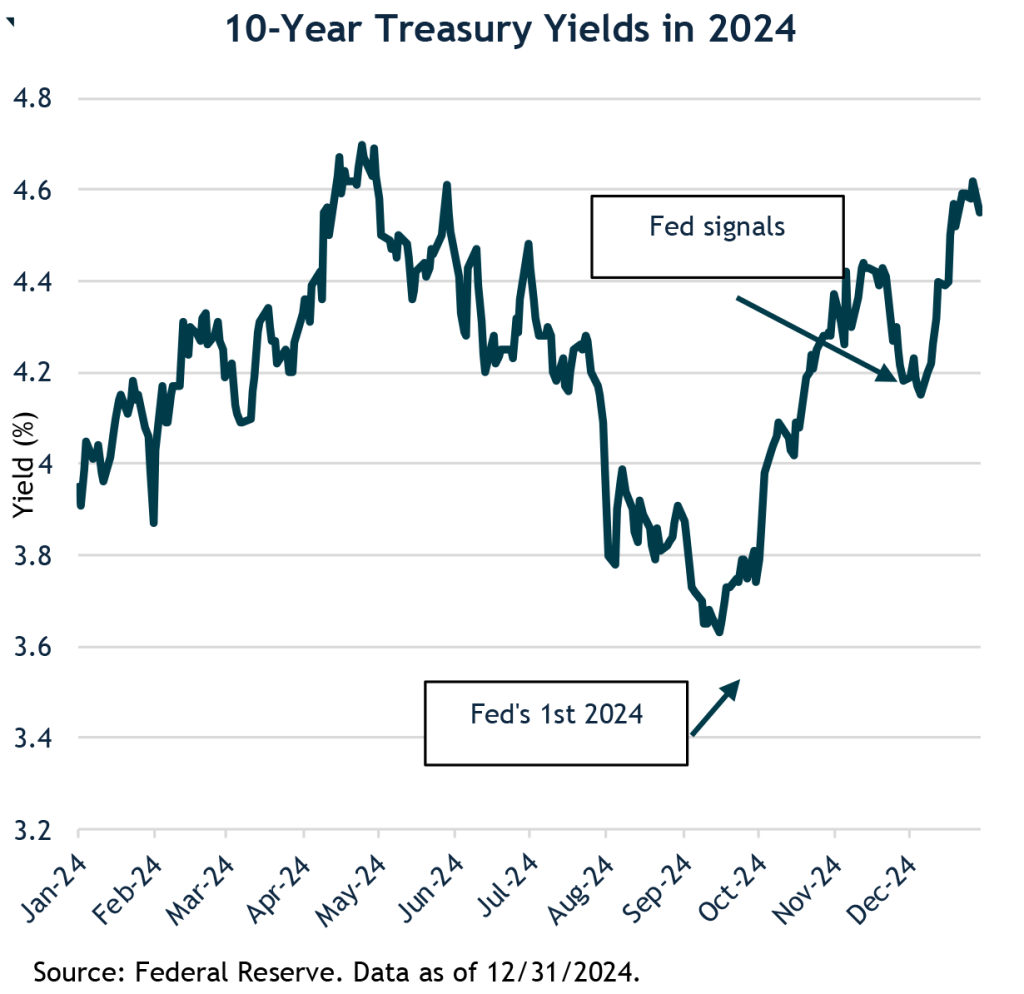
In the first three months of the year, inflation pressures proved persistent, prompting the Fed to keep interest rates elevated. This led to higher interest rates (lower prices) across bond maturities. However, as the year progressed, inflation began to trend lower, and the Fed delivered its first rate cut in September. The September cut was significant for two reasons. It was the first cut in over four years, and it was a more aggressive 50- basis point reduction, compared to the typical 25 basis point cut. This was followed by a 25 basis point reduction in November, and another widely expected 25 basis point cut in mid-December, the final Fed meeting of the year.
Although the December cut was expected, the Fed added a bit of a twist, and the market did not like the news. Specifically, the Fed showed a renewed concern over slowing disinflation momentum. The Fed’s median inflation estimates, as measured by core Personal Consumption Expenditures (PCE) for 2025 and 2026, increased from 2.2% to 2.5% and 2.0% to 2.2%, respectively. The following day, stocks fell sharply, and long-term bond yields increased. In fact, since the Fed started cutting rates in mid-September, 10-year Treasury yield rates have increased by roughly 100 basis points, and the yield curve has finally uninverted after slightly more than two years.
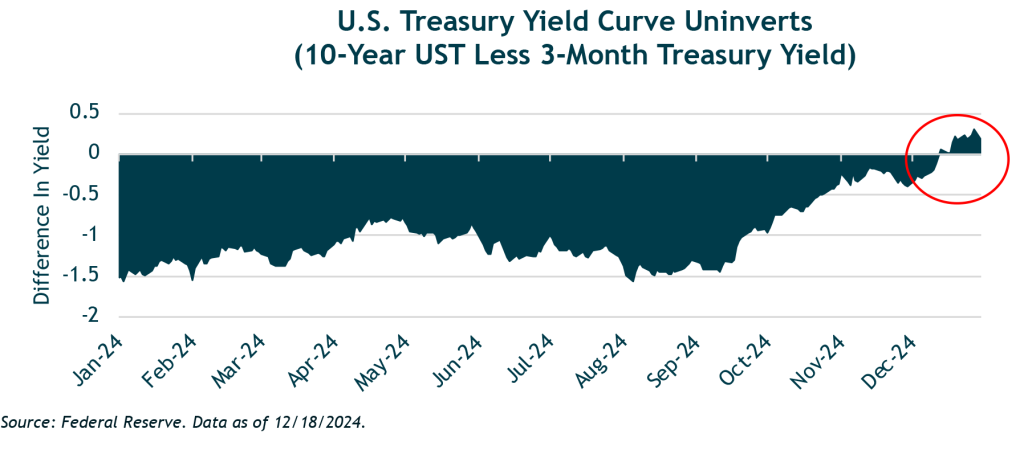
Looking ahead to 2025, the U.S. bond market is stuck between the Fed’s plans to cut interest rates (to some degree) and the risk of higher inflation and increasing federal deficits. As has been the case in 2024, we think 2025 will be another bumpy ride for fixed income. Our approach has been, and continues to be, focused on shorter-term, high-yielding bonds over those with more interest-rate risk. But that could start to change, especially if volatility creates opportunities. Regardless, today’s starting higher yields will result in better bond returns over the long run.
Conclusion
We remain cautiously optimistic as we enter 2025. While there are promising signs of growth and resilience in the economy, we are also acutely aware of the potential risks that could negatively impact market stability. For example, the U.S. economy will likely downshift into a slower gear. We do not believe this slower growth, in and of itself, will cause a recession, but it does leave the economy more vulnerable to shocks, including significant policy changes from the new administration. Furthermore, the past two years of strong returns leave valuations elevated. Our focus will continue to be on identifying opportunities to improve long-term returns while being vigilant of the risks we are taking. By staying disciplined and opportunistic, we aim to navigate the complexities of the market and position our investments for long-term success.
As always, we appreciate your trust and wish you and yours a wonderful new year.
Certain material in this work is proprietary to and copyrighted by Litman Gregory Analytics and is used by Argent Financial Group with permission. Reproduction or distribution of this material is prohibited, and all rights are reserved.

