
4th Quarter 2024 and Annual Fixed Income Review
- The Federal Open Market Committee (FOMC) cut its fed funds target rate a total of 100 basis points in 2024, ending in a range of 4.25% to 4.50%
- Due to stronger economic growth, stickier inflation, and continued strength in employment, Fed officials indicated that they expected only two 25 basis point cuts during 2025 at their December meeting, a more shallow path for rate cuts than signaled at their meeting in September
- Following what was considered by the market as a “hawkish cut” from the FOMC at their December meeting, longer term yields rose much more than shorter term yields to close out the year (yields move in the opposite direction of prices)
- The core rate of inflation has declined but is still higher than the Federal Reserve’s stated target of around 2%. The Federal Reserve’s preferred measure of inflation, Core PCE, stood at 2.80% at the end of November
- After more than two years in an inverted state, the U.S. Treasury market slowly began “disinverting” at the end of Q3, with rates beginning to normalize toward the end of the year
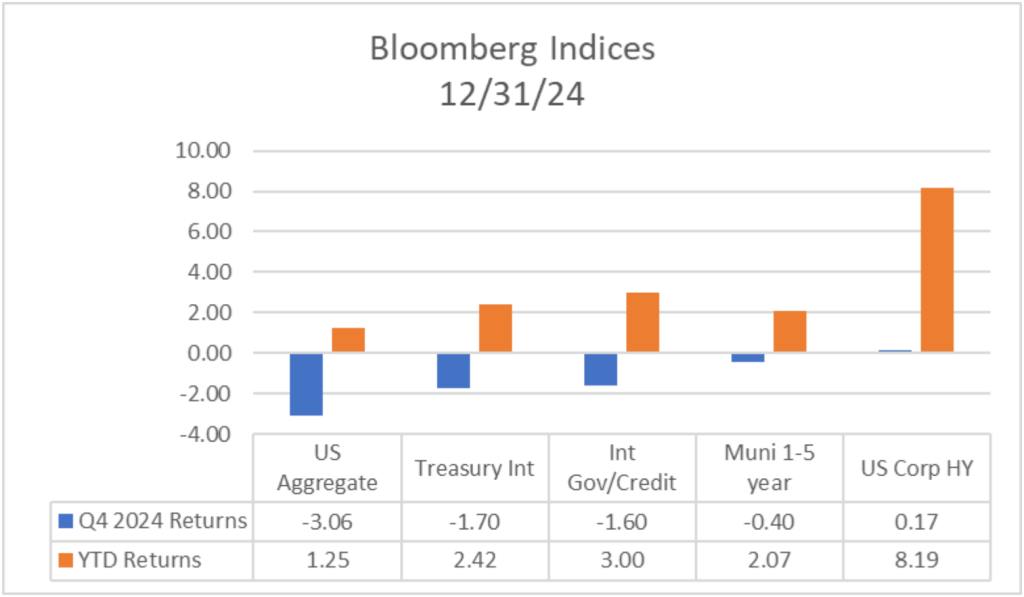
Below are select Bloomberg fixed income index returns for Q4 2024 and year-to-date:
The Fed
As the chart above indicates, fixed-income markets suffered indigestion from more “hawkish” than anticipated information released in the Summary of Economic Projections (SEP) following the December FOMC meeting. In the SEP, projections for GDP growth were upgraded for Q4 2024, as well as all of 2025, with trend growth slowly dissipating to 2% by the end of 2026. The most important change from the previous SEP was the indication of a more shallow path for rate cuts and a suggested “pause” at the January meeting, with the “optionality” of leaving rates unchanged all year, depending upon the evolution of data. Additionally, both core and headline projections for PCE were, once again, raised and the long run federal funds rate projection was raised to 3%. As a result, most fixed-income sectors experienced negative total returns for the fourth quarter. Most sectors of the U.S. bond market did, however, experience positive total returns for the year.
Higher coupons available in riskier sectors of the fixed-income markets continued to attract yield hungry investors in 2024. As a result, the U.S. Corporate high yield sector turned in a strong year of relative performance, once again, as spreads over U.S. Treasuries (UST) drifted near their tightest levels in twenty years. Other higher-risk sectors such as bank loans, lower quality asset-backed securities (ABS), and high-yield municipal bonds also outperformed higher quality sectors for similar reasons.
Fixed-income markets were extremely volatile in 2024. With higher-than-anticipated economic growth and labor strength, the 2-year UST note hit an apex yield of 5.04% during April with a low yield of 3.54% in September. The aforementioned Treasury sell-off backed the 2-year yield to 4.24% at the end of 2024. Similarly, the benchmark 10-year UST note’s high-water mark was 4.70% in April, with a low yield of 3.62% in September. The 10-year ended 2024 with a rate of 4.57%. The UST yield curve ended the year with a positively sloped yield differential between the 2-year and 10-year of 33 basis points.
The Yield Curve
In normal times, the UST yield curve should be modestly upward sloping, reflecting the “neutral rate” plus a “term premium” for investors accepting the uncertainty of lending over a longer period of time- the longer the term the higher the rate. Historically, yield curve “inversion,” where short-term rates are generally higher than longer-term rates, has been considered a fairly accurate harbinger of a pending economic slowdown. Notably, the UST market was in an inverted state for a period of more than two years and “disinverted” this past September as a resilient US economy simply outlasted those solely using history as their guide. It’s also important to mention the FOMC began unwinding some of the extraordinary measures implemented during the pandemic, removing some key support for rates in the Treasury and mortgage markets during the year.
Of interest, duration risk (buying longer maturities to gain exposure to higher interest rates normally expected for taking credit risk over a longer period) was once again a losing strategy in 2024. The Bloomberg Aggregate Bond Index, a longer duration index widely used as a proxy for the US bond market, was the worst performer of the major indices we follow at Argent Trust. It’s important to note the lack of a material “term premium” in the longer dated UST markets has essentially increased the normal risk of duration and diminished the hedging attractiveness for quite some time.
What We Think
Inflation and economic growth clearly exceeded expectations during 2024. With progress on inflation slowing in recent months and continued resilience in the labor market, the possibility of a higher than currently discounted terminal rate in fed funds is highly likely. Further, an aggressive foreign trade policy implemented by the incoming administration and the possibility of tax cuts and added deficit spending to stimulate growth have many observers concerned about the fiscal position of the United States in the long term. These worries negatively impact Treasury prices and pressure yields in all sectors of the fixed-income markets.
We will know more about policy and actions of the new administration in coming months- but significant policy uncertainty invites caution. Our current recommendation is to continue to embrace high quality and avoid longer duration in core portfolios. For added total returns, we also continue to recommend a diversified selection of actively managed strategies utilizing lower credit quality, asset backed securities (ABS), bank loans, private credit, and high yield, in appropriate amounts. At Argent Trust, we maintain a curated list of excellent active managers in all of these fields, and we hope you will contact your portfolio manager for additional information. For questions or more information regarding this commentary, we hope you will contact a member of our fixed-income team.
For additional information, please contact one of the commentary contributors below:
Sam Boldrick: sboldrick@argenttrust.com
Hutch Bryan: hbryan@argenttrust.com
Matthew Kimbrough: mkimbrough@argenttrust.com
Not Investment Advice or an Offer | This information is intended to assist investors. The information does not constitute investment advice or an offer to invest or to provide management services. It is not our intention to state, indicate, or imply in any manner that current or past results are indicative of future results or expectations. As with all investments, there are associated risks and you could lose money investing.
Sam Boldrick, Hutch Bryan and Matthew Kimbrough all contributed to this commentary. No artificial intelligence or ChatGPT were used in the collection of information or production of this content. For additional information please contact one of the following:

