


BY: Tom Stringfellow, CFA®, CPA®, CFP®
Chief Investment Strategist
The Holiday Countdown
- Presidential elections have set stage for the Trump 2.0 Administration, with markets positioning towards new policies and economic drivers.
- Major equity benchmarks, including, Nasdaq, S&P 500, Dow Jones Industrial Average, and the Russell 2000 are all flirting with new market highs.
- Although consumers are reporting an improving outlook on inflation and job security, total household debt has increased by $147 billion in the third quarter.
- The “Christmas Price Index”—which tracks the cost of the gifts mentioned in the carol, The Twelve Days of Christmas—has risen by 6% compared to 2023-or in real terms, is now over $47,000.
Navigating Markets Amid Inflation, Trade Wars, and Investment Opportunities
With this year’s presidential election now behind us, investors can shift their focus back to familiar topics—TV, sports, and, importantly, economic data and corporate earnings. Donald Trump’s re-election and the Republican sweep of Congress are expected to usher in significant policy changes, reversing Biden Administration spending programs and reshaping global trade, economic growth, and investment markets. While details remain uncertain, higher tariffs, reduced immigration, tax cuts, and another wave of deregulation are likely to be key priorities.
In recent weeks, headlines have highlighted the “Trump trade,” as investors and businesses reposition to align with expected policy shifts. Markets quickly priced in expectations for reduced regulatory hurdles, tax cuts, and protectionist measures. The small-cap Russell 2000 index jumped 7. 5% following election day through Thanksgiving Eve, while the financial sector, particularly banks, saw notable gains driven by optimistic policy and economic assumptions.
The S&P 500, now setting new highs, reflects this positive sentiment but faces ongoing scrutiny from investors over Federal Reserve rate trends, earnings growth, and political uncertainties in Washington. Although volatility persists, strong market momentum has propelled an already bullish market. By Thanksgiving, the year-to-date returns of the S&P 500 were up by approximately 27%, supported by improving economic data. Recent job reports, adjusted for the impacts of strikes and hurricanes, have shown resilience, signaling a stable labor market.
Although manufacturing surveys (ISM) remain in contraction territory, the services sector continues to expand. The Atlanta Fed’s GDPNow model projects fourth-quarter annualized growth of 2.7%, further supporting investor optimism. Additionally, the Empire State Manufacturing Survey’s general business conditions index surged to 31.2 in November, its highest level in nearly three years. This 43-point increase from the prior month reflects robust growth in New York’s manufacturing sector, with sharp rises in new orders and shipments alongside stable labor market conditions.
In contrast, the National Industrial Production Index declined by 0.3% in October 2024, following a 0.5% drop in September. This decline was primarily attributed to a strike at Boeing and the disruptions caused by hurricanes Milton and Helene, which collectively reduced production by an estimated 0.3 percentage points.
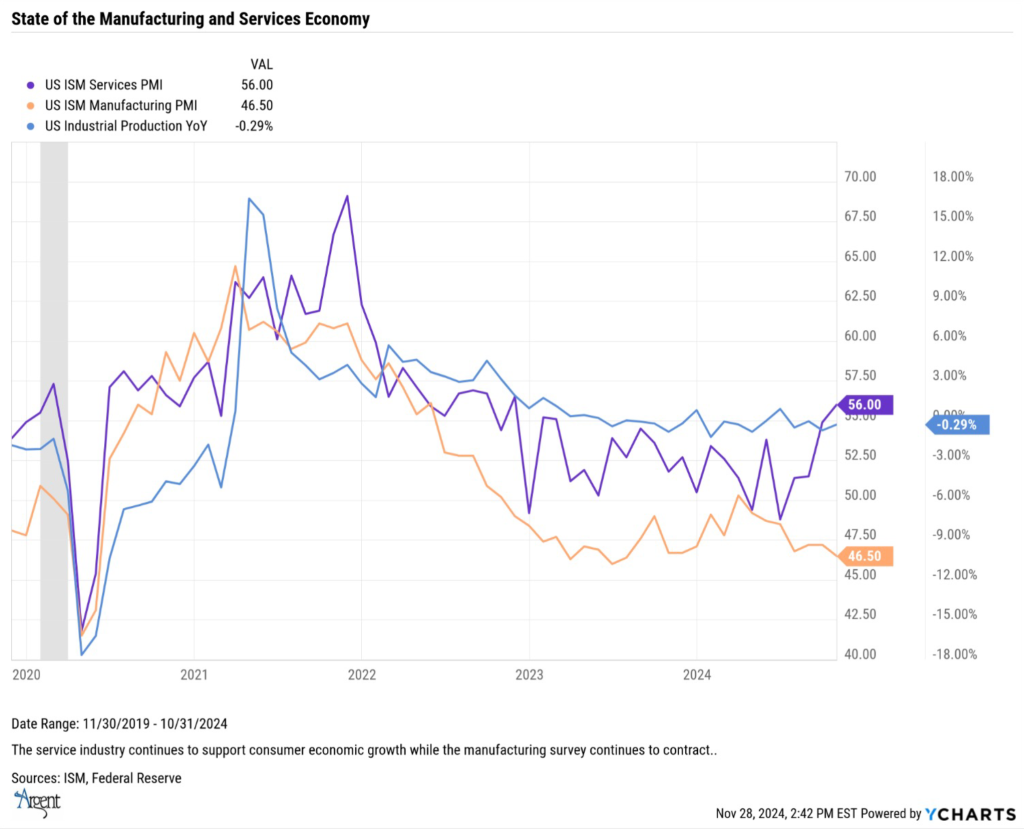
Overall, the data continues to paint a “Goldilocks” picture of the economy—steady but not overheated—supporting the potential for an economic soft landing. This outlook aligns with the Federal Reserve’s ability to continue easing monetary policy. Futures markets currently estimate a 66% probability of a 0.25% rate cut following the Fed’s December 18th meeting.
Pushing Towards Neutrality
The Federal Open Market Committee (FOMC) is actively working to lower interest rates from last year’s highs of 5.25%–5.50%, but uncertainty remains about the appropriate “neutral rate”—the level that neither stimulates nor restricts economic activity. Which, echoing past Fed officials, including Fed Chair Powell, would be +/- 2.5%.
However, in a November 13 speech, the President of the Dallas Federal Reserve Bank President, Lorie K. Logan, suggested that the current neutral rate may be closer to a range of 2.74% to 4.60%, cautioning that further rate cuts in the near-term could risk reigniting inflation. Her closing comment was that “Economic activity is strong; inflation is coming down and the economy is approaching a point that can sustainably deliver both maximum employment at stable prices.”
On the inflation front, progress is evident, though some costs remain persistently high. Headline CPI inflation has eased to a year-over-year growth rate of 2.6%, while core CPI, which excludes food and energy, posted a higher rate of 3.3%. Shelter costs have been a particularly “sticky” contributor to inflation, though many analysts believe this is a temporary factor inflating CPI. Nonetheless, considering that headline CPI peaked at 9.1% in June 2022, current levels have provided substantial relief from forward inflationary pressures.
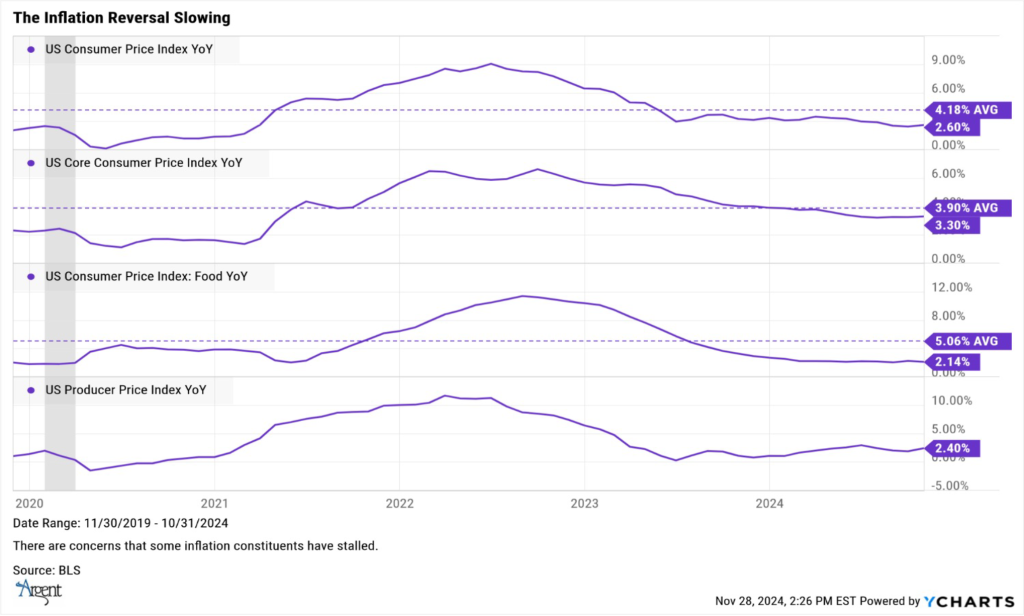
Despite polls to the contrary, consumers are becoming more optimistic about future inflation trends. According to the Federal Reserve Bank of New York’s October 2024 Survey of Consumer Expectations, respondents expect inflation to decline to 2.9% over the next 12 months, the lowest forecast in four years. Over a three-year horizon, the inflation outlook is narrowing and is anticipated to stabilize at 2.5%.
And while there has been progress on the inflation and economic outlook, financial challenges persist. The latest Quarterly Report on Household Debt and Credit reveals that total household debt rose by $147 billion in the third quarter, reaching $17.94 trillion. Mortgage balances increased by $75 billion to $12.59 trillion by the end of September. Although income growth has outpaced debt in some areas, high debt levels still signal financial stress for many households. Credit card balances also climbed by $24 billion to $1.17 trillion, while auto loan balances rose by $18 billion to $1.64 trillion.
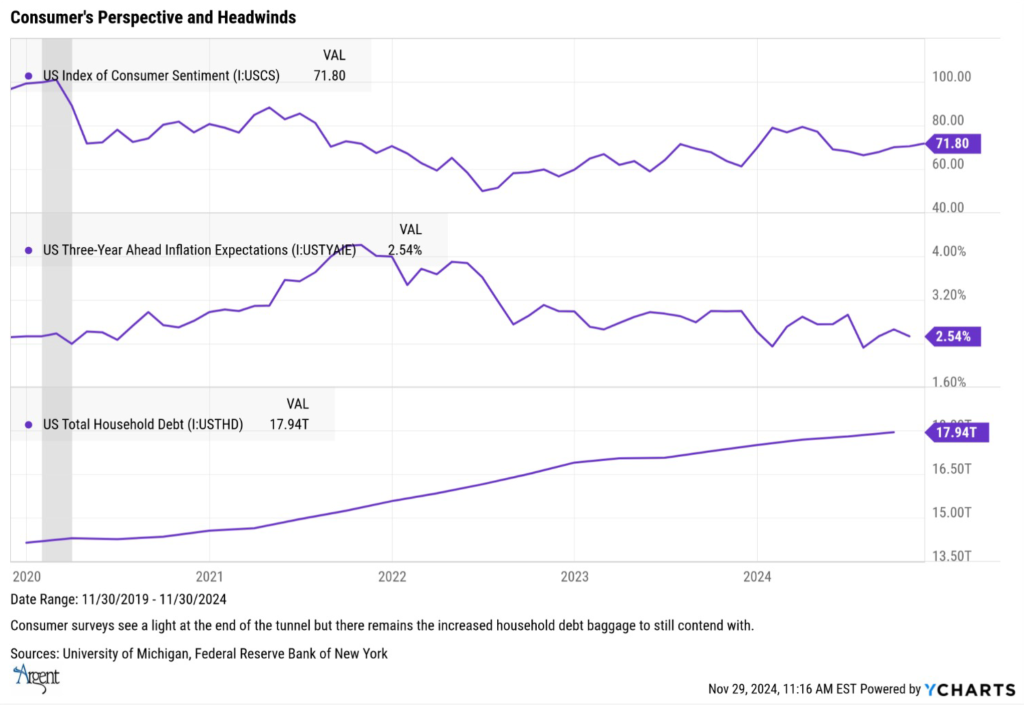
Nevertheless, consumer sentiment is showing signs of cautious improvement. The University of Michigan’s Consumer Sentiment Index rose to 71.8, up from July’s low of 66.4, reflecting a measured sense of optimism. Similarly, the Federal Reserve’s quarterly survey highlights growing confidence in employment prospects, with fewer households perceiving a high likelihood of unemployment. The probability of job loss within the next 12 months has declined, and the likelihood of missing a minimum debt payment within the next three months fell by 0.3 percentage points to 13.9%, the first decrease since May 2024.
Adding to the positive momentum, the Conference Board reported that its consumer confidence index rose to 111.7 in November, up from 109.6 in October. While the increase is modest, it builds on October’s significant gain, reflecting an underlying optimism among U.S. households. The report also shows a sharp decline in concerns about a potential economic downturn, with the proportion of respondents expecting a recession within the next year dropping to its lowest level since the question was first asked in July 2022. Optimism about hiring has also reached a three-year high, further reinforcing public confidence in the job market.
This month’s labor report supports the consumer outlook, holding at still historically low unemployment rates, currently at 4.1%. However, some vulnerabilities persist, including the deceleration in job growth this year, averaging 150,000 new jobs per month compared to 300,000 per month in 2023. Real income, though, appears to be rising at a level above 3%, but consumer spending is leveling off at about 3%. As noted by Bespoke Research, the current level of consumer spending should be sufficient enough to support similar GDP growth.

Retail Spending and Holiday Outlook
Consumer spending this holiday season is projected to grow by 2.5% to 3.5% year-over-year, reaching an estimated $980–$990 billion, according to the National Retail Federation (NRF). The growth is driven by expected spending on winter holiday items—including gifts, food, decorations, and other seasonal purchases—which is projected to reach a record $902 per person. An increase of approximately $25 compared to last year and $16 more than the previous record set in 2019. These figures underscore robust consumer spending despite challenges such as rising interest rates and inflation.
Holiday travel is also making a strong comeback, with air travel projected to increase by 9% over last year—assuming no additional significant disruptions from severe weather.
For fans of The Twelve Days of Christmas, the “Christmas Price Index”—which tracks the cost of the gifts mentioned in the carol—has risen by 6% compared to 2023. This increase is driven by several factors:
- Labor Costs: Higher wages for skilled performers such as drummers and pipers.
- Commodity Prices: Rising costs for gold rings and other precious items.
- Transportation Costs: Increased shipping rates for animals like geese and swans.
To put it in perspective, fulfilling the Twelve Days of Christmas list would now cost over $47,000, illustrating the lingering effects of supply chain disruptions. Those looking for a simpler gift might consider just the “partridge in a pear tree,” which PNC Bank estimates at $370.18 (or $350 for just the pear tree). On the other hand, hiring “Ten Lords-a-Leaping” would cost a staggering $15,579.65 for the day.
Market’s Reboot
The post-pandemic economic recovery in the U.S. certainly contributed to the market surge beginning again in 2023 and continuing into this year. The post-election rally amplified the existing momentum. This rally stands out for its potential to engage a broader range of stocks, signaling a more diversified market upswing. With Donald Trump’s pending return to the presidency approaching, markets have responded to economic policy expectations and concerns.
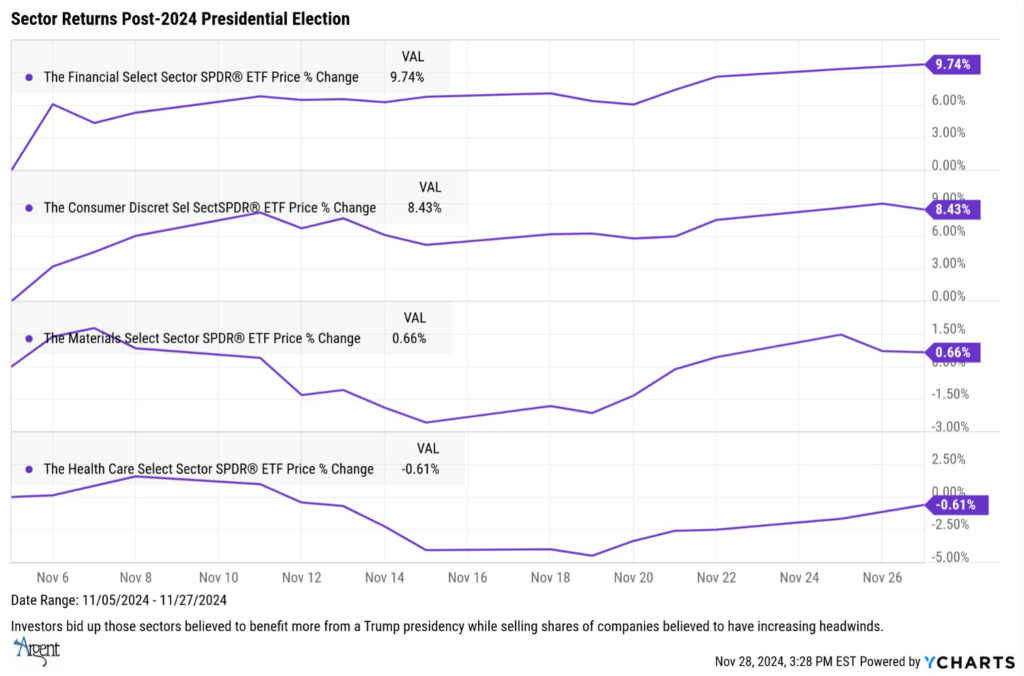
Best-Performing Sectors (Post-Election, 11/5–11/28)
- Financials: Up 9.74%, driven by the promise of reduced regulatory hurdles and optimism about an improving economy.
- Consumer Discretionary: Up 8.43%, with strong performance from consumer stocks, including Tesla, which comprises 18% of the sector’s weight.
Worst-Performing Sectors
- Materials: Up 0.66%, with concerns over potential tariff threats and retaliatory measures have led investors to reassess the sector’s profitability and growth.
- Healthcare: Down 0.6%, with sector performance declining amid fears of Robert F. Kennedy Jr.’s potential nomination as Health Secretary.
A Cautiously Optimistic Outlook
It has been a year of both challenges and opportunities for global markets. U.S. equity markets have delivered strong performances through November 22, buoyed by easing interest rates from central banks. While some global central banks are also adopting looser monetary policies, not all markets share the underlying capital strength or have experienced the momentum of the markets here at home.
As U.S. companies adapt to the evolving market environment, Q4 earnings growth is now projected at 12%, nearly double the final growth rate estimated for Q3, according to FactSet. If realized, this would represent the highest earnings growth since Q4 2021. Looking ahead to 2025, quarterly earnings growth is currently forecasted at 12.7%, 12.1%, 15.3%, and 17.0%, respectively. These projections are subject to change as analysts adjust to improved visibility on financial, economic, and policy developments throughout the year.
Sectors Expected to Drive Q4 Earnings Growth per FactSet analyst estimates:
- Financials (Banks): Expected earnings growth of 38.9%.
- Communication Services: Anticipated growth of 20.7%.
- Information Technology: Projected growth of 13.9%.

Trade Concerns and Market Perspectives
While investors have embraced Trump’s renewed focus on “America First” policies, it has heightened trade tensions with major partners like China, Canada, the European Union, and Mexico. Proposed tariffs on technology components, automobiles, and agricultural products are poised to disrupt global supply chains, particularly in sectors like semiconductors and auto manufacturing. These disruptions could lead to higher input costs for companies, lower profit margins, and dampened investor sentiment, particularly in trade-sensitive sectors.
Thus far, the market has had a muted reaction to incoming President Trump’s recent tariff threats. In all likelihood, there is some skepticism that he would carry out the threats for a few reasons, including:
- Trump similarly threatened 25% tariffs on Mexico during his first administration to address migration issues but did not follow through after Mexico pushed back. Markets ultimately view these policy threats as negotiation “invitations.”
- Implementing such tariffs may face legal challenges. The USMCA (U.S., Mexico, and Canada trade agreement), which Trump himself negotiated in 2020, complicates unilateral actions.
- Trump closely monitors markets and understands that 25% tariffs on Mexico and Canada could trigger a pullback or even a correction and is unlikely to pursue policies risking a market reversal and undermining investor confidence.
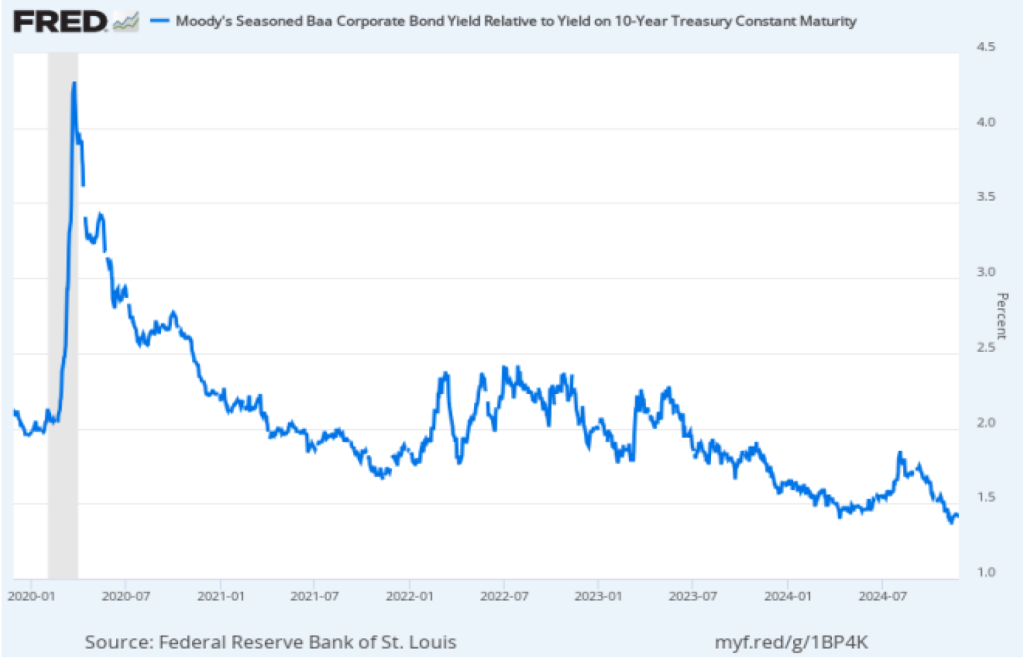
Bond investors have also taken a more ‘relaxed’ posture in their fixed-income portfolios, expecting a lessening of market and economic risk. If investors become concerned about possible corporate defaults, the reaction would be to sell corporate bonds (sending their yields higher) and purchase safer U.S. Treasuries (sending their yields lower). This would, in turn, result in an increase in corporate bond yields and a decline in Treasury yields, creating a spread (credit spread) increase between the two security types.
With the recent spread between the 10-year BAA bond yield over the 10-year Treasury yield at a near historic low of 1.43%, it signals that, at least for now, bond investors are not worried about an economic slowdown.
New Year and New Administration Expectations
With still one more key month left in 2024, investors are beginning to strategize or reposition their portfolios, anticipating a new year and a new administration. We do have quite a bit of history to gauge potential market impacts under the Trump Administration, but the economy is still dependent on future decisions from Chair Powell and the Fed voting committee members. Earnings growth is tracking positively for this quarter and next year, but the market has already priced expectations with little room for error. We should probably expect an increasing level of market volatility in 2025, given the confluence of economic, political, and market factors, but any market volatility will likely signal opportunities versus recession calls.
Subject to any substantive changes from the Fed outlook and interest rate decisions in December, key market trends and concerns in 2025 include:
- Supportive Economic and Market Policies:
- Stable and strong labor markets.
- A still accommodative Federal Reserve.
- Broader market participation, with potential opportunities for small-cap companies and emerging markets.
- Lower rates and a pro-business environment are critical drivers of market growth.
- Potential Risks to Monitor:
- Trade Threats and Inflation: Escalation of trade tensions impacting consumer and material imports could rekindle inflation fears.
- Rising Treasury Yields and Dollar Strength:
- Higher yields and a surging U.S. dollar, driven by strong growth, firm inflation, Fed policy uncertainty, and fiscal concerns, are pressuring stocks.
- Political Influences:
- President-elect Trump’s tariff focus could increase market volatility, particularly in emerging markets. However, unless tariffs are broad and impactful, they are unlikely to cause significant economic harm, as evidenced from 2016–2020.
- Economic Growth Concerns:
- The resilience of economic growth remains the most crucial factor for sustaining the bull market.
- A slowdown or hard landing could pose serious risks, as the Fed may struggle to cut rates quickly enough to prevent a recession.
- AI and Technology Sector Performance:
- AI-related optimism remains a key market driver, particularly in the tech sector. While market breadth has improved this year, any disappointment in earnings growth could weigh on the broader market.
Not Investment Advice or an Offer -This information is intended to assist investors. The information does not constitute investment advice or an offer to invest or to provide management services. It is not our intention to state, indicate, or imply in any manner that current or past results are indicative of future results or expectations. As with all investments, there are associated risks and you could lose money investing.

