

The Month At-A-Glance
- After a heightened downside to start the month, global stocks rallied nearly 10% to close out August up 2.5%
- Within the US, large cap value stocks outpaced growth stocks, but smaller cap stocks lagged
- At the Fed’s annual Jackson Hole symposium, Fed Chair Powell signaled that policy rates are headed lower starting in September
- The Fed’s shift in focus to the labor market has investors dissecting any and all jobs market reports
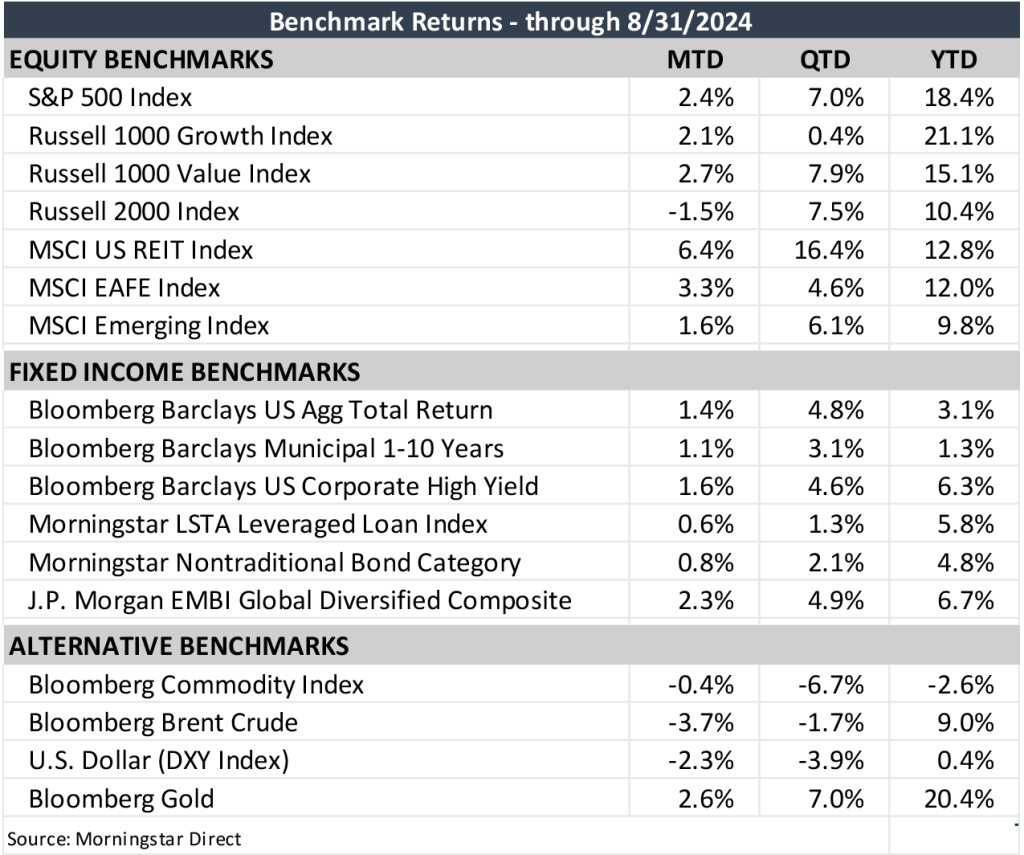
Market Recap
A sharp sell-off to start August was ignited by disappointing economic data in the U.S., and a hawkish Bank of Japan at the end of July resulted in the unwind of the massive USD/JPY carry trade.
However, global stocks quickly recouped those losses and worked their way back close to all-time highs. Despite two modest pullbacks during the year, global stocks continue to grind higher and have positive double-digit returns so far in 2024.
The sell-off in early August was set off by a weaker-than-expected increase in nonfarm payrolls for July. Nonfarm payrolls grew by just 114,000 in July, well short of the expectation of 175,000. The unemployment rate rose for the fourth straight month to a nearly three-year high at 4.3%. The early August jobs report triggered the Sahm Rule—a widely-followed recession indicator—which further put investors on edge that the economy was slowing faster than expected.
As the rest of August played out, economic data releases signaled a more resilient US economy and that the “soft landing” scenario was still attainable. The second quarter’s GDP was revised upwards to 3%, and the Atlanta Fed’s GDPNow estimate for the third quarter remained above 2% throughout the month. Additionally, July retail sales accelerated at 1%, which was well ahead of the 0.3% estimate—giving credence to a still strong US consumer, the most important driver of the economy.
The Federal Reserve helped risk assets finish higher following the release of the July FOMC meeting minutes and Chair Powell’s Jackson Hole speech that clearly signaled a rate cut at their September meeting. In his speech, Powell said, “the time has come for policy to adjust” and that the Fed “will do everything we can to support a strong labor market.” The Fed is clearly shifting its focus to both sides of its dual mandate (price stability and maximum employment) after spending the last couple of years fighting inflation.
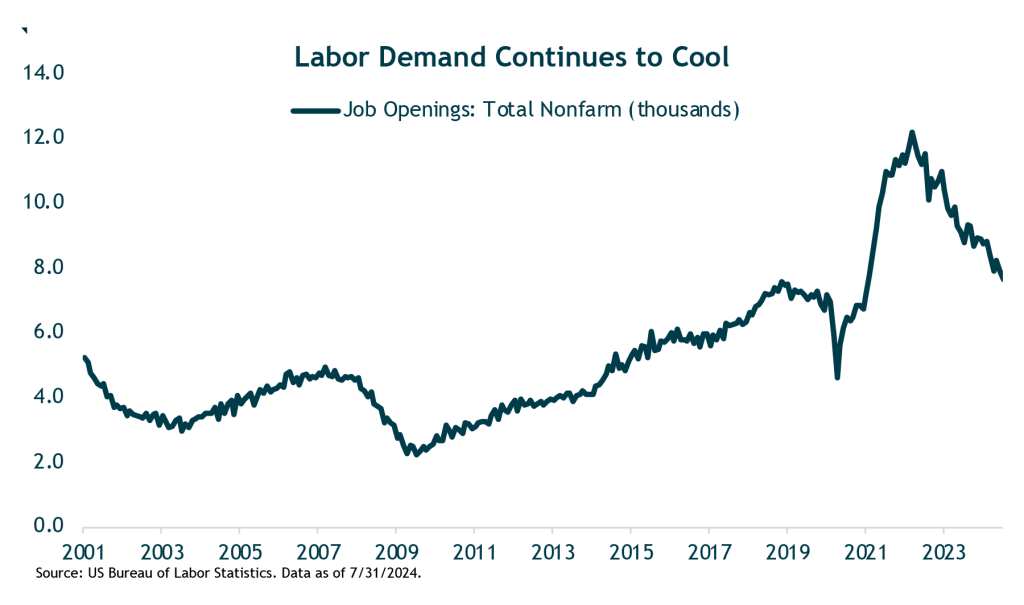
The labor market has weakened but has not fallen off a cliff. Job openings continue to normalize at a lower level following significant labor shortages during the pandemic. July’s job openings fell to 7.7 million, which was below the consensus estimate of 8.1 million.
The bond market has largely front-run policy rate cuts. The policy sensitive two-year interest rate fell from 4.71% at the end of June to 3.91% at the end of August. US core bonds (as represented by the Bloomberg U.S. Aggregate Bond Index) posted a solid 1.4% return in August—bringing their return since the start of the quarter to 3.8%. August marked the fourth consecutive month the U.S. core bond index was positive, the longest streak in three years.
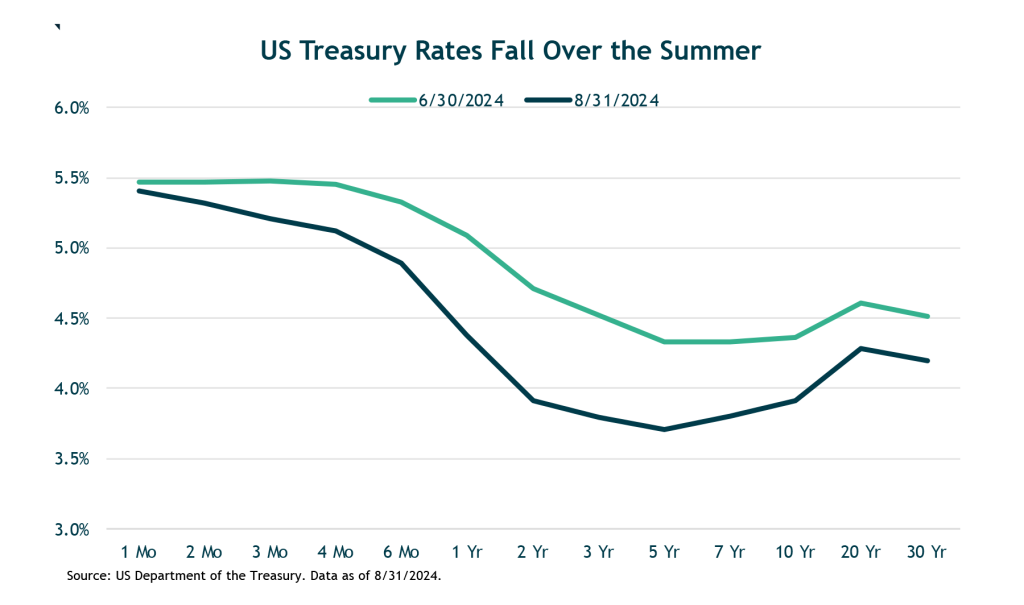
The yield curve has moved closer to normalizing. The two-year, 10-year U.S. Treasury spread has turned positive—as the 10-year rate is again above that of the two-year. This section of the yield curve has been inverted since the summer of 2022. There are some studies that show recessions typically occur after the inverted curve “uninverts” and not when it first goes into inversion.
Whether or not the economy can skirt a recession will have implications on risk assets. Historically, if the Fed is cutting rates and the economy does not go into a recession, assets can continue to appreciate. However, if Fed cuts precede a recession, asset prices stand to fall in value. Clearly, investors are positioned and expecting the former scenario to play out. Stock indexes are near all-time highs, valuation multiples are stretched, and credit spreads are historically tight.
We continue to weigh the risks of both scenarios. While a recession could be in the cards over the next 12 months (it certainly has higher odds of happening today than it did a year ago), we are not positioning portfolios with the expectation of a significant air pocket in the economy. We would expect more volatility as the year comes to close. However, we have not shifted our view on the economy and risk assets.
Certain material in this work is proprietary to and copyrighted by Litman Gregory Analytics and is used by Argent Financial Group with permission. Reproduction or distribution of this material is prohibited, and all rights are reserved.

