


BY: Matthew Kimbrough
Portfolio Manager
Not Quite There Yet?
Leading up to the conclusion of the FOMC meeting today, the predominant question at hand is whether the threshold has been reached that will provoke the Fed to cut the Fed Funds Rate… in September.
Yes, you read that correctly. Since the last FOMC meeting in mid-June, Core PCE (the Fed’s preferred inflation measure) has fallen from 2.8% to 2.6%. Additionally, the unemployment rate ticked up from 4.0% to 4.1% earlier this month. At this point, some would say (and some FOMC members have said) that now is the time to act… i.e., the combination of these two pieces of information, taken in conjunction with other data pointing towards a potential slowdown in the U.S. economy, would lead them to the conclusion that a 25bp rate cut is warranted sooner rather than later.
Yet all other indications, including Powell’s own comments around two weeks ago, are pointing towards no action at the present meeting, and a continuation of the Fed’s data-dependent wait-and-see approach. In fact, as of this morning, futures market participants assigned only a 3% probability of a 25bp rate cut occurring today.
There won’t be another update to the Fed’s Statement of Economic Projections until the FOMC meeting in mid-September. But right now, the market’s expectations of monetary policy activity for the remainder of 2024 and the economic data received in the past six weeks are out of line with both the Statement and the projections we received in June. This leaves us in desperate need of better signaling by the Fed.
Where does the FOMC’s collective opinion lie on the Scale of Greater Confidence Achievement?
Will Powell signal that he’s leaning towards a rate cut in September at today’s press conference?
Or will he continue waiting-and-seeing until his address at the annual Jackson Hole Economic Symposium later in August?
While we understand that the good ol’ days of Forward Guidance are long gone, the precipice on the other side of the Fed Funds Rate plateau will soon be reached. Surely it’s better if we see the cliff coming.
The Decision
The Fed Funds rate remains unchanged. It has been held at its present plateau of 5.25 – 5.50% since the July 2023 FOMC meeting.
The Statement
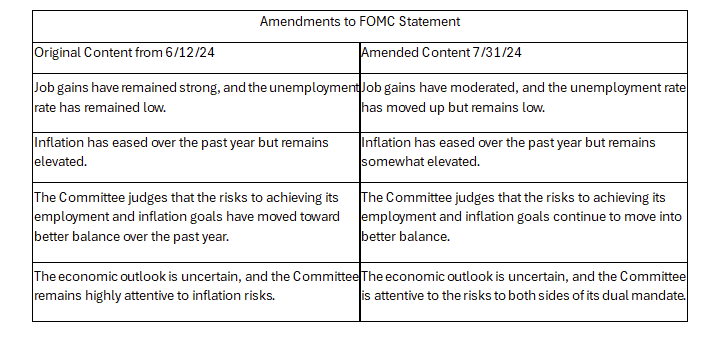
This meeting’s Statement contained several amendments that are highlighted in the below chart.
The Press Conference
Going into the press conference today, the sentiment at hand was that the Fed’s official Statement was more hawkish than expected. Specifically, the sentence about the need for “greater confidence” on inflation remained unchanged. However, one of the first things Powell covered in his opening press conference remarks was the fact that the Q2 inflation readings have in fact added to their confidence that inflation is trending in the right direction (yet more good data is needed to strengthen it further).
The very first question in today’s press conference was from a reporter at the New York Times, who asked – if markets expect a rate cut in September, is this reasonable? And if so, why not just cut today?
Powell’s response was that “We have made no decisions on future meetings, and that includes the September meeting. The broad sense of the committee is that we are moving closer to the point at which it will be appropriate to reduce our policy rate. In that we will be data dependent, but not data point dependent…The question will be whether the totality of the data, the evolving outlook, and the balance of risks are consistent with rising confidence on inflation and maintaining a solid labor market. If that test is met, a reduction in our policy rate could be on the table as soon as the next meeting in September.”
When asked by Nick Timiraos at the WSJ whether more softness than expected in the labor market would change the Fed’s calculus on inflation, Powell clarified that the FOMC is now weighing both sides of their dual mandate equally. They look at wages, participation, surveys, quits, and hires to determine the position of the labor market. Powell doesn’t think of the labor market as a significant source of inflationary pressure; however, he would not like to see material further cooling in the labor market.
When asked how this year’s progress on inflation compares with last year, Powell stated that last year’s progress on inflation was mostly due to goods prices coming down, but this year there is a broader disinflation involving both housing-related services and non-housing services.
“The downside risks to the employment mandate are real now… We have a restrictive policy rate, it’s clearly restrictive and it’s been the rate we’ve had in place for a full year… The time is coming at which it will begin to be appropriate to dial back that level of restrictiveness.”
Powell characterized the Sahm Rule as a “statistical regularity, not something telling you that something (i.e., a recession) must happen.”
Additionally, on the proximity of Fed meetings to the upcoming election, Powell clarified, “We don’t change anything in our approach to adjust to other factors like the political calendar. Congress has ordered us to conduct our business in a non-political way at all times, not just some of the time. We never use our tools to support or oppose a political party, a politician, or any political outcome.”
The Market Reaction
Treasury yields were essentially flat after the Statement was released, but reacted favorably during the press conference, rallying 4-5bp across the board, reflecting the signal that Fed Chair Powell gave that a rate cut could be on the table in September.
Not Investment Advice or an Offer | This information is intended to assist investors. The information does not constitute investment advice or an offer to invest or to provide management services. It is not our intention to state, indicate, or imply in any manner that current or past results are indicative of future results or expectations. As with all investments, there are associated risks and you could lose money investing.

