

First Quarter Market Recap
In the first three months of 2024, the U.S. economy remained resilient despite short-term rates sitting near 20-year highs. The continued strength in the labor market, better-than-anticipated corporate earnings, and an anticipated forecast of rate cuts were noteworthy in the quarter. Retail sales pulled back, but the trend remains positive.
These factors contributed to optimism around a soft-landing scenario and provided a supportive backdrop for stocks. The S&P 500 Index continued to reach new highs throughout the quarter, gaining 10.6%. Large-cap stocks ended the quarter over small-cap stocks, with growth stocks again bettering value stocks.

Developed International and emerging-market stocks also posted gains but did not keep pace with the U.S. market. Developed International stocks gained 5.8%, while emerging-market stocks posted a 2.4% return. Japanese stocks were the standout performers in the quarter, gaining over 11%.
In the bond markets, returns were mixed in an environment where the benchmark 10-year Treasury yield rose from 3.88% to 4.20% as markets reduced their expectation of Federal Reserve rate cuts from more than 150 basis points to just shy of 70 basis points (as of April 3) for the year 2024 and adjusted the start of this easing cycle from March to June. In this rising-yield environment, the more interest-rate sensitive Bloomberg U.S. Aggregate Bond Index declined 0.8%. Credit performed relatively well in the quarter, as high-yield bonds were up nearly 1.5%.
With three consecutive months of positive returns, some believe this bodes well for stocks in 2024. At the same time, there are some increasing concerns about investor complacency, as a few indicators are hinting at the possibility of a recession. All eyes continue to be on the Federal Reserve, with an increasing—but still low—possibility of an alternate scenario where rate cuts will not occur in 2024.
Macroeconomic and Investment Outlook
The U.S. economy has continued to prove resilient despite the Fed maintaining a higher level of interest rates for longer than most expected. A main driver of this better-than-expected economic growth has been the continued strength of the U.S. consumer. The combination of robust job gains and steady positive real income growth has allowed consumers to continue spending despite higher rates. The resiliency of the economy has also benefited corporate earnings. After a decade of near-zero interest rates, companies are generally well-positioned financially with healthier balance sheets than they have been in past tightening cycles.
The Fed, Inflation and Rates
Inflation has been stubborn and remains above the Federal Reserve’s 2% target. That said, inflation (CPI) has declined meaningfully over the past year, falling from nearly 6% to just over 3%. Our expectation has been and continues to be that inflation will trend lower over the remainder of 2024, although likely not in a straight line. Shelter has been a primary factor in keeping inflation elevated, and we expect this input to decline, leading to lower headline rate inflation.
We currently believe that Fed policy is borderline restrictive given current inflation levels. In the chart below, we can see that since the 1960s, an inverted curve combined with sharply higher real Fed Funds preceded a recession. In the most recent cycle, however, we can see that while the yield curve has been inverted since July 2022, Fed policy was very accommodative for most of that time, i.e., the real Fed Funds rates were sharply negative when the curve first inverted. It’s only recently that Fed policy has started to move toward restrictive levels. In prior cycles, real Fed Funds proved restrictive at the 3.5% (or higher) level. To the extent that inflation continues declining and the Fed keeps rates unchanged, Fed policy will become proportionately tighter and could reach a level that significantly slows the economy. So, if inflation continues to decline the Fed will need to incrementally cut rates to keep the same degree of tightness in monetary policy.

The Federal Reserve will be cautious with the timing and magnitude of rate cuts. The consensus expectation is that the Fed will cut by 25bps in June, with two more cuts later in the year. However, with inflation remaining above the 2% target, cutting too early could create a second wave of inflation, while waiting too long could put pressure on the consumer and lead to a recession. Further, it’s possible, but unlikely, that the Fed may not cut rates this year and will maintain the current range of 5.25%–5.5% for the rest of 2024. If this latter scenario does occur, the bond market would need to reset and longer-term interest rates would very likely move higher.
Interestingly, the Fed seems to be singing a slightly different tune around inflation and rates. For quite some time, Fed Chair Powell has said that he wants to see inflation reach the 2% level and have confidence it will remain at or near that level before cutting rates. In a recent speech, however, he expressed the expectation of cuts, although the Fed’s preferred measure of inflation, the Personal Consumption Expenditures (PCE) Price Index remains above its 2% target at 2.4%. These two statements don’t fully line up, which we think is creating some ambiguity and we think this will likely keep longer-term bond yields in a trading range until there is some clarity around rates and inflation.
As we mentioned in the past, transitions from one economic regime to the next can be challenging. For example, economic data can present mixed signals, while the timing and magnitude of monetary or fiscal policy and how it flows through to the economy can create uncertainty and lead to volatility. Furthermore, while there are often similarities from cycle to cycle, there are unique aspects to each.
While some recent economic results imply modest economic growth and not an outright contraction, we continue to closely monitor economic data. Factors that we are monitoring are numerous but include those that typically accompany a recession such as rising unemployment, falling retail sales, declining manufacturing activity, and contracting income. For now, U.S. economic data seems supportive of growth, not contraction.
Equity Markets
U.S. Stocks
U.S. equity markets rose in the quarter as earnings growth exceeded expectations. The growth was mainly due to large-cap technology, communication services, and consumer discretionary names, a trend that has been in place since 2023. Confidence in earnings did not sour despite rising rates, which could have had a negative impact on stock valuation. Smaller-cap stocks were again not able to keep pace with larger-cap companies and remain relatively cheap.
We think it’s quite possible that U.S. stocks can continue to climb the wall of worry. At the same time, we fully acknowledge there are metrics to suggest some caution, mainly valuation. Looking ahead, we think equities will need better earnings growth to move much higher, as the benefit of multiple expansions may be running out of gas. We know valuation is an unreliable timing tool and that predicting the timing and magnitude of stock market decline is difficult, if not impossible. As we consider our equity exposure, we seek to control the risks we take.
We currently maintain a neutral stance on equities. Absent a very strong conviction that a recession is imminent, we think it’s prudent to maintain a full allocation to equities. As the chart below shows, bear market drawdowns in equities typically occur during recessions, which is when earnings take a hit. After dipping in 2022, S&P 500 earnings have recouped the levels they hit at the end of 2021. Where earnings go over the next year will have a big impact on equity returns. Should growth reflate, earnings have room to the upside, and prices can grow into currently elevated valuations and even go higher. If earnings remain at current levels, meaningful returns will be hard to come by, given valuations bumping up their ceiling. If a recession occurs, equity prices could be hit with the double whammy of falling earnings and contracting multiples. Given the current economic data indicating a reaccelerating economy, we do not believe a recession is imminent. However, we are cognizant that the lag effect of the Fed’s tightening policy could still be working through the system—just with a longer lag than many anticipated.
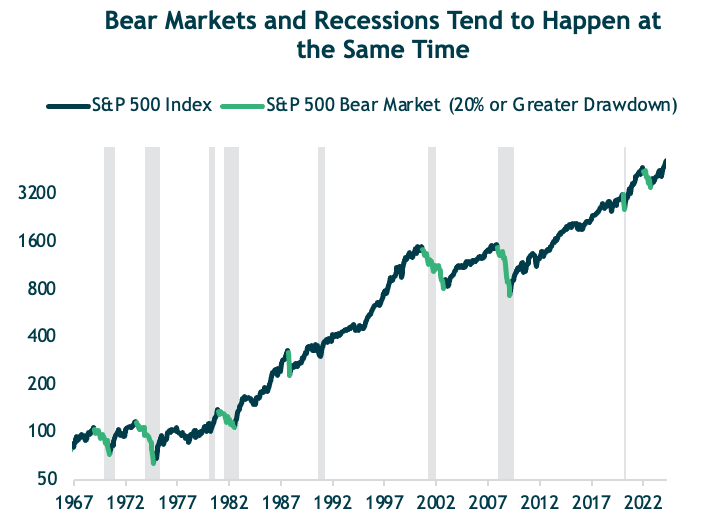 Source: Bloomberg LP, iM Global Partner, BCA Research. Shaded regions are NBER-defined recessions. Data as of 3/31/2024.
 Source: Bloomberg LP, iM Global Partner, BCA Research. Shaded regions are NBER-defined recessions. Data as of 3/31/2024.
Fixed-Income/Bond Markets
As we stated earlier, all eyes are on the Fed, especially when it comes to fixed-income. At the Fed’s late March meeting, Chair Powell announced that the overnight federal funds rate would remain unchanged at the current range of 5.25% to 5.5%, keeping it at the highest level in over two decades. This was the fifth consecutive meeting in which rates were held steady, and this outcome came as no surprise, particularly after the most recent inflation and employment data, both of which came in stronger than expected. Powell reiterated the Fed’s commitment to bringing inflation down to its 2% target. He also highlighted that inflation has eased substantially while the labor market has remained strong, which is in line with the Fed’s dual mandate of stable prices and maximum employment.
The Fed’s latest forecast is for three rate cuts over the remainder of 2024, but the timing of the cuts remains uncertain. The current consensus is that the first cut will occur in June. As we touched on above, if cuts do begin this summer, it remains to be seen whether inflation will reach the 2% target by then. In the scenario where inflation remains above 2%, but the Fed still cuts, we suspect their message will be that monetary policy is sufficiently restrictive and that rate cuts in proportion to declining inflation are simply a means to prevent the policy from getting even more restrictive. We suspect the Fed would also emphasize they believe inflation will decline to the 2% long-run target over time.
We do have to consider the scenario where inflation settles in at 2.5%, not the anticipated 2.0% level. If this higher-inflation scenario occurs and the Fed has made a cut or two in the summer months, we would expect them to pause further cuts. We do not expect the Fed to start hiking rates again. Instead, we believe the central bank would leave rates at that current level, saying that by keeping policy restrictive for long enough, they can credibly forecast inflation returning to the 2% target. In this scenario, the bond market would have to recalibrate expectations, and we would expect longer-term yields to increase.
In terms of fixed-income portfolio positioning, not much has changed since our year-end commentary. We believe that inflation is under control for now and that short-term interest rates have peaked and will likely decline slightly over the course of the year. Regarding corporate bonds, we do not foresee a near-term risk of a spike in default rates, given the still attractive corporate fundamentals. In this environment, we continue to take advantage of the inverted yield curve, emphasizing shorter-term, higher-yielding securities, which can also provide protection in the event of a stock market downturn. We do have some exposure to below-investment-grade securities. While the yield spreads in this space are currently below average, the portfolio exposure we have is of higher quality with shorter-term maturities than the high-yield market, and we are only giving up incremental yield. We think we are being appropriately compensated for this targeted exposure.
Conclusion
The U.S. economy currently appears to be in decent shape. The stock market continues to hit new highs as economic growth continues to benefit corporate revenues and earnings. Stock market concentration in the U.S. remains elevated, with the Magnificent Seven representing over 25% of the S&P 500. With such a narrow focus on a small number of higher-valuation stocks and one theme in particular (Artificial Intelligence), this carries risks. There’s no doubt that the other 493 stocks of the S&P 500 have struggled on a relative basis, but they could be set to move higher if the key economic drivers outlined above continue to fuel the economy. That said, fears of a recession haven’t completely abated. However, our near-term view is that the U.S. will avoid a sharp downturn due to its strong labor market, strength in consumer spending, and elevated corporate earnings. Looking out to the end of the year and into next year, the question remains whether a recession will be avoided or delayed.
As we look ahead, we anticipate there will be pockets of choppiness given headline risks related to Fed policy, geopolitical events such as the ongoing wars in Europe and the Middle East, and the upcoming U.S. presidential election (election years have historically been more volatile for the equity markets). In the event of volatility, we are keeping our pencils sharp and will look to be opportunistic, taking advantage of any attractive risk/reward opportunities that arise.
We thank you for your continued confidence and trust.
Certain material in this work is proprietary to and copyrighted by Litman Gregory Analytics and is used by Argent Financial Group with permission. Reproduction or distribution of this material is prohibited, and all rights are reserved.

