


BY: Tom Stringfellow, CFA®, CPA®, CFP®
Chief Investment Strategist
Resilience Has a Price
Markets have an interesting way of making investors uncomfortable no matter which direction the economic data moves. Weak numbers quickly become recession stories; strong numbers become inflation and interest-rate stories. Friday’s employment report was a good example. The economy added 162,000 jobs in August, unemployment remained at 4.1%, and prior-month revisions improved the picture further. Rather than celebrating stronger employment, investors immediately began recalculating the probability of another Federal Reserve rate increase. That reaction gets us to the central issue for September: the economy continues to demonstrate considerably more resilience than many expected, but that resilience increasingly comes with a price.
Five Things to Pay Attention To:
- Economic Resilience: Employment, private demand, business activity and corporate earnings continue to argue against an imminent recession, although strength is becoming increasingly uneven beneath the surface.
- The Price of Money: Long-term rates may be telling us more than simply what the Federal Reserve will do next. A higher neutral rate, massive public borrowing and extraordinary private capital demand could mean that the economy’s definition of a “high” interest rate has changed.
- The Consumer Gradient: Aggregate spending remains resilient, but income, wealth, housing costs, credit quality and exposure to necessities are producing very different economic experiences across households.
- The Hurdle Rate: Cash and fixed income once again offer meaningful returns. That does not make equities unattractive, but it raises the importance of earnings quality, free cash flow, balance-sheet strength and valuation.
- Perspective Over Panic: September seasonality, oil, inflation and Federal Reserve uncertainty deserve respect, but none should be viewed in isolation. The crosscurrents in today’s economy tell us more than any single headline.
Resilience Without Relief
The August employment report was considerably stronger than anticipated. Payrolls increased by 162,000, and the unemployment rate remained at 4.1%. Average hourly earnings increased 0.3% during the month and 3.1% over the past year, while the average workweek edged higher to 34.4 hours. Labor-force participation improved slightly to 61.6%, although it remains subdued by historical standards, and approximately 1.9 million Americans have now been unemployed for 27 weeks or longer. At the same time, the number working part-time for economic reasons fell by 414,000 to 4.4 million, hardly what we would expect if labor conditions were deteriorating rapidly. The picture increasingly resembles a low-hire, low-fire labor market in which employers remain selective without broadly eliminating workers.
The industry details reinforce that conclusion. Restaurants and drinking establishments added 59,000 jobs, local government education added 42,000, manufacturing added 16,000, construction added 22,000, while information employment declined by 23,000. The economy is still creating jobs, but growth is no longer being distributed evenly across industries. That distinction matters because the headline can remain solid even as segments of the labor market become noticeably softer.
The business surveys tell a similar story. August’s ISM Services PMI increased to 55.4, with Business Activity at 61.7 and New Orders at 60.9. Manufacturing remained firmly in expansion territory at 54.6, with Production at 58.3. Yet Services Employment registered only 47.8 and has been below the 50-expansion threshold in 13 of the past 18 months. The combination of strong orders and strong activity with restrained hiring is unusual, and one worth watching.
Part of the explanation may simply be caution. Companies remain reluctant to add workers unnecessarily, labor costs continue to matter, and qualified employees remain difficult to find in some occupations. Technology may also be beginning to alter the relationship between activity and headcount. It would be premature to attribute the divergence entirely to artificial intelligence or to declare a productivity boom firmly established, but businesses appear capable of generating considerable activity without adding labor at the rate we would traditionally have expected.
Federal Reserve Governor Christopher Waller added another useful perspective last week. Real GDP grew at a 1.8% annual rate during the first half of the year, but real private domestic final purchases—a cleaner look at underlying private demand—grew at a stronger 3.0% rate. Business investment has remained robust, and Waller specifically cited continued rapid investment related to data centers, AI and technological upgrades. The economy is slowing in some places and changing in others, but underlying private demand continues to look considerably healthier than a recession narrative would suggest.
That is good news economically, but it is more complicated for financial markets. The stronger the economy remains, the less room policymakers have to ignore inflation that is still running above target.
Inflation’s Next Test
Inflation has made substantial progress from its post-pandemic extremes, and any balanced assessment needs to acknowledge that. What has become less convincing is the idea that the final leg back to the Federal Reserve’s objective will occur quickly or without interruption.
The August business surveys provide one warning. ISM’s Manufacturing Prices Index remained at 71.1, while the Services Prices Index climbed to 72.6, its highest level since August 2022. Manufacturers continue reporting higher costs for steel, aluminum, petroleum products, freight, electronic components and a range of other inputs, while services companies cited fuel, gasoline, diesel, software and memory products among areas of rising prices. These surveys do not translate directly into consumer inflation, but readings above 70 indicate that substantial cost pressure remains in the production pipeline.
For investors, that pressure can appear in two places. Companies with sufficient pricing power can pass higher costs to customers, prolonging inflation. Companies without that ability may absorb the increase, protecting the consumer at the expense of margins. Inflation therefore does not disappear simply because a business chooses not to raise its selling price; sometimes it moves from the inflation data into an earnings report.
Energy adds another complication. Higher crude prices eventually move through gasoline, diesel, aviation fuel, chemicals, manufacturing and freight. Gasoline receives most of the attention because consumers see the price every day, but diesel works quietly through the cost of moving food, merchandise, construction materials and industrial goods throughout the economy. For households, higher energy prices reduce discretionary purchasing power. For businesses, they raise input costs. Sustained long enough, they can affect both inflation expectations and monetary policy.
The important qualifier is duration. The United States is a major energy producer, so rising prices also create investment, employment and earnings opportunities in parts of the domestic economy. A short-lived energy spike can be absorbed without materially changing the expansion. A persistent one becomes more troublesome because it places pressure on both consumers and corporate margins just as the Federal Reserve is trying to establish that inflation is moving sustainably lower.
The next inflation reports therefore matter less because any single monthly reading will determine the investment cycle and more because they will tell us whether recent cost pressures are beginning to migrate into broader inflation. With economic activity remaining firm, policymakers have considerably less latitude to dismiss that possibility.
Has the Definition of “High” Changed?
Most interest-rate discussions eventually become forecasts of the next Federal Reserve meeting: hike, hold or cut. Those questions matter tactically, but the strategic issue may be considerably more important. What if the rate of interest this economy can sustainably tolerate has itself moved higher?
Artificial intelligence may ultimately be a software and productivity story, but the investment required to build it is intensely physical. Data centers need semiconductors, servers, networking equipment, cooling systems, land, construction, electricity, power generation and transmission infrastructure—all requiring increasing capital investment. At the same time, the federal government continues to finance unusually large deficits and a rapidly growing debt burden. Public and private borrowers are therefore making very large simultaneous claims on capital markets.
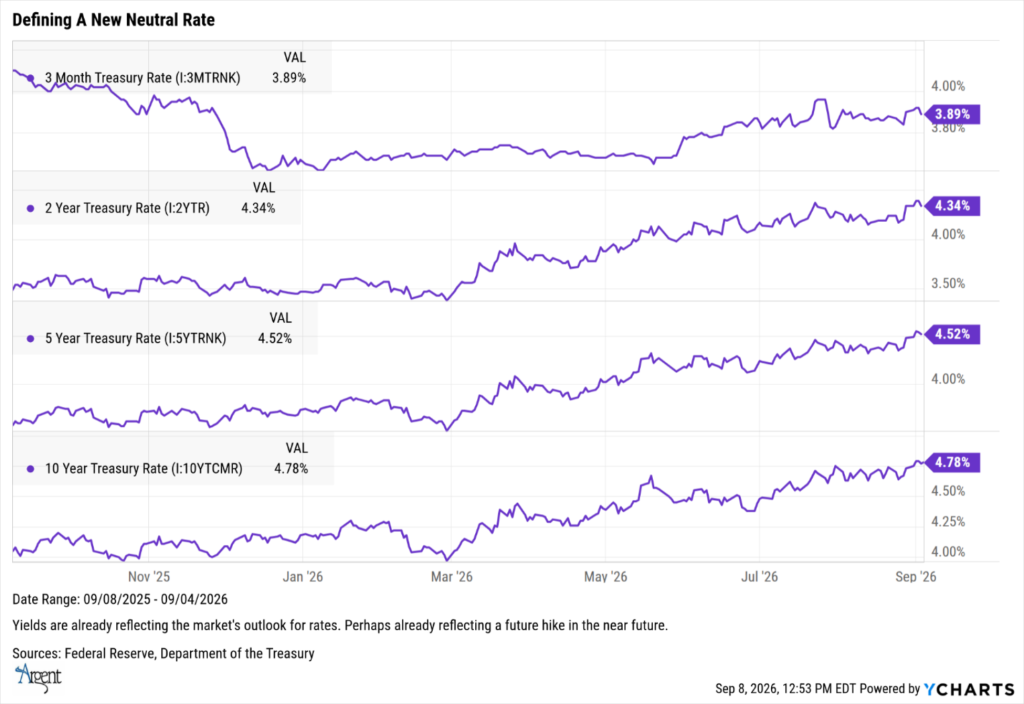
This environment looks quite different from the decade following the financial crisis, when excess savings, relatively weak capital investment and subdued growth helped keep equilibrium rates extraordinarily low. Today we have large government borrowing requirements, substantial private capital formation, resilient demand and the possibility that technology eventually raises productivity growth as well. None of that guarantees a permanently higher neutral rate, but it should make us reluctant to assume that every move toward 5% in the 10-year Treasury represents an approaching economic accident. The price of resilience may, in part, be a higher equilibrium price for money. If that is true, it changes how we should interpret both Federal Reserve policy and the market’s response.
The Fed Hasn’t Moved. The Market Already Has.
The federal funds rate remains at 3.50% to 3.75%, but financial conditions are not determined solely by the overnight rate controlled in Washington. Treasury yields, mortgage rates, corporate borrowing costs and equity valuations can all adjust long before the Federal Reserve changes policy.
Waller made that point explicitly by recalling 2021 and early 2022, when forward guidance helped drive the two-year Treasury yield substantially higher before the Fed made its first actual rate increase. The central bank can tighten financial conditions without changing the federal funds rate because markets anticipate what policymakers may eventually need to do.
Friday’s jobs report offered a smaller version of the same mechanism. Stronger employment did not damage the economy; it changed the expected path of monetary policy, which immediately affected bond yields and other asset prices. The market can therefore do some of the Fed’s tightening in advance.
The harder question is whether it has done enough. Waller currently describes policy as only slightly restrictive of aggregate demand, an important observation given that private demand remains firm and inflation is still above target. If the economy continues to absorb higher market rates without slowing sufficiently to restore price stability, policymakers may conclude that conditions are still not restrictive enough.
That distinction keeps us from making the mistake of equating a higher 10-year Treasury yield with an automatically restrictive economy. Borrowing costs have clearly increased, but the economic effect depends upon who is borrowing, how much leverage they carry and how sensitive they are to the price of money. That is where the aggregate economic story begins to divide into very different experiences.
The Consumer Gradient
Economic commentary often refers to “the consumer,” but American households do not share one balance sheet. They occupy very different positions across income, wealth, home equity, savings, credit quality, debt burden and exposure to necessities. The American consumer is therefore neither uniformly strong nor uniformly weak; financial resilience exists along a gradient.
That distinction helps reconcile data that otherwise appear contradictory. Aggregate spending can remain healthy while surveys show significant financial pressure. Households with appreciated homes, rising investment portfolios and substantial incomes can continue spending on travel, restaurants and discretionary goods, while families devoting a much larger percentage of income to housing, food, transportation and debt service respond very differently to the same increase in prices.
The New York Fed’s research blog, Liberty Street Economics, has found that the rise in real retail spending since 2023 has been disproportionately driven by households earning more than $125,000 annually. That is an important reminder that a strong aggregate consumption number does not necessarily imply broadly shared strength underneath it.
This is also why I prefer the term “Consumer Gradient” to the simpler description of a K-shaped economy. The differences are not merely binary. Households sit at many points along a continuum of income, asset ownership, credit strength and essential spending needs. Recent evidence suggests spending growth among some income groups has begun to converge, but that does not eliminate the much greater ability of wealthier households to absorb higher interest rates, energy prices and housing costs.
Credit markets reinforce that distinction. Overall mortgage performance remains far removed from anything resembling the financial crisis, and conventional mortgage delinquency was only 2.72% in the second quarter. FHA delinquency, however, stood at 11.8%, while year-over-year deterioration was considerably greater among FHA and VA loans than among conventional mortgages. These figures do not suggest systemic mortgage distress; they suggest that financial stress is increasingly concentrated among more vulnerable borrowers.
Housing provides perhaps the clearest bridge from the bond market to household behavior. Higher Treasury yields contribute to higher mortgage rates, reducing affordability and suppressing housing turnover. The consequences extend beyond home purchases to furniture, appliances, remodeling, building products, brokerage activity and a wide range of local services. The bond market eventually finds its way into the kitchen.
For investors, the implication is not that consumer companies should be avoided. It is that “consumer” is becoming too broad a category to be particularly useful. Premium travel can remain strong while value-oriented consumers trade down. Luxury demand can coexist with rising auto or mortgage stress. Businesses serving financially secure households can experience an economy that looks quite different from the one faced by companies dependent upon more constrained consumers. The same differentiation is increasingly visible among corporations.
The Hurdle Rate Has Returned
A company generating substantial free cash flow with little debt experiences a 5% Treasury yield very differently from a business dependent on continuous external financing. That distinction was easy to overlook when the risk-free rate was near zero. It becomes increasingly important when capital once again has a meaningful cost.
In that environment, balance-sheet strength, return on invested capital, pricing power, free-cash-flow generation and debt maturity schedules all deserve greater weight. The point is not that capital-intensive companies are inherently unattractive. Some of the largest capital users in the economy are also among its strongest businesses. The relevant question is whether the return generated by an investment exceeds the increasingly expensive cost of financing it.
Corporate earnings continue to provide substantial support for the constructive side of that argument. FactSet reported last week that analysts increased the bottom-up S&P 500 earnings estimate for the third quarter by 1.2% during July and August, from $88.64 to $89.69. That is unusual because analysts normally reduce estimates during the first two months of a quarter—by an average of 1.7% over the past five years and 2.1% over the past decade. Earnings expectations are therefore not merely holding up; they are improving during a period when they normally deteriorate.
That makes the recession argument considerably more difficult, but it does not make valuation irrelevant. Stronger earnings improve the numerator in the valuation equation, while higher Treasury yields raise the return available from competing investments. For much of the post-financial-crisis period, investors accepted increasingly expensive equity valuations partly because the alternatives offered almost nothing. Today, cash and fixed income provide meaningful income again.
The hurdle rate has returned. Equities can certainly continue to perform in that environment, but they must justify the additional risk through earnings growth, cash-flow durability and ultimately the price investors are being asked to pay.
A More Discriminating Market
Artificial intelligence offers perhaps the clearest example of why selectivity matters. AI adoption can be economically transformative without every AI-related investment producing an attractive financial return. Adoption, capital spending, productivity and valuation are different stages of the story and should not be treated as interchangeable.
The first phase of the AI trade often rewarded association with the theme. The next phase is likely to require more discrimination: which businesses are selling essential infrastructure, which can monetize AI investment, which are producing measurable productivity improvements and spending heavily simply because competitive pressure leaves them little alternative. Technology can change the world without every company attached to it becoming a good investment at every price.
We are beginning to see the same selectivity in the broader market. Intermediate-term participation has broadened beyond a handful of the largest technology companies, while shorter-term breadth has become less consistent and several former leadership groups have grown more volatile. Those developments are not contradictory. A market can broaden over twelve months while becoming more selective over twelve weeks, particularly when the cost of capital is rising.
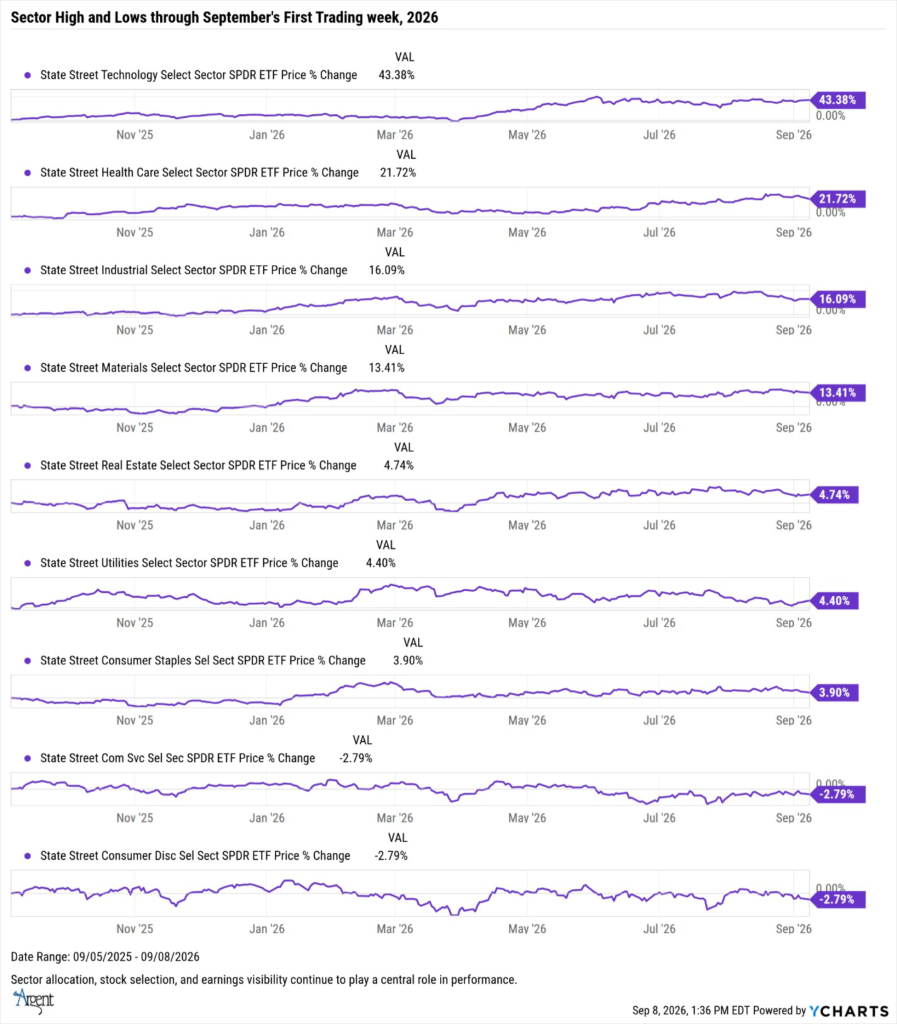
That selectivity is also evident well beyond the largest technology companies. Sector performance has varied considerably over the past year. Technology has remained the clear leader, advancing more than 43%, but Health Care has also gained roughly 22%, Industrials 16% and Materials more than 13%. At the other end of the spectrum, Consumer Discretionary and Communication Services have posted modest declines, while Utilities, Real Estate and Consumer Staples have generated only low-single-digit gains. The important point is not simply that leadership has broadened, but that the market is increasingly distinguishing among sectors according to earnings visibility, capital requirements, economic sensitivity and exposure to higher financing costs.
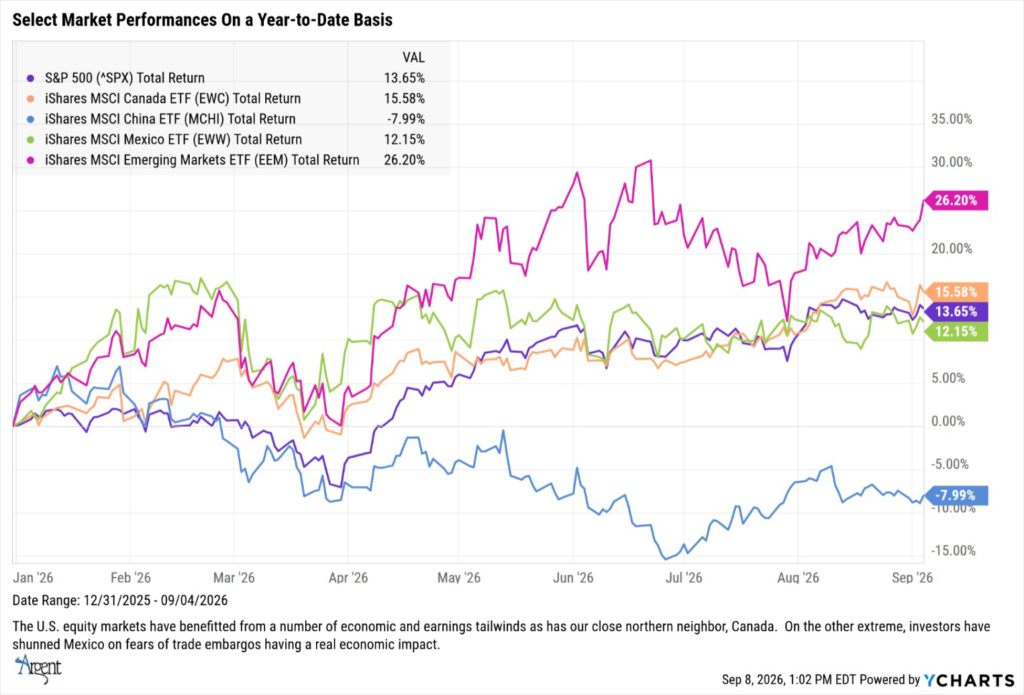
The same differentiation is visible geographically. Through early September, the S&P 500 had produced a total return of approximately 13.7%, but that result has hardly been representative of every major market. Emerging markets were ahead by more than 26%, Canada by approximately 15.6%, and Mexico by roughly 12.2%, while the MSCI China ETF remained down almost 8%. Investors are therefore being rewarded not simply for owning equities, but for making increasingly important decisions about where economic growth, earnings momentum, valuation and policy conditions are most supportive.
Mutual fund flows provide another window into that behavior. Total U.S.-listed ETF assets reached $16.4 trillion at the end of August, up 3.5% from July. Monthly flows told a different story, with August flows of $182.6 billion down 5.5% from the prior month. Equities still captured 54.2% of those flows, but fixed income attracted 33.5% and commodities another 5.8%. Investors are clearly not abandoning risk assets, but they are increasingly combining them with income, liquidity and diversification.
That strikes me as a rational response to the current environment. Investors no longer face a binary choice between earning essentially nothing and owning risk assets. Short-duration bonds and cash equivalents can now provide meaningful returns while preserving optionality. The existence of those alternatives raises the standard every other investment must meet, which should naturally produce more differentiation among securities, sectors and themes.
Perspective Over Panic
September’s reputation as a difficult month for equities is more than market folklore. Since 1928, the S&P 500 has declined an average of roughly 1.2% to 1.3% during September, making it the weakest month of the calendar and the only month in which the index has historically finished lower more often than higher. The recent record reinforced that reputation: the total return for the S&P 500 declined 3.7% in September 2020, 4.7% in 2021, 9.2% in 2022 and 4.7% in 2023, before breaking the pattern with gains of approximately 2.1% in 2024 and 3.6% in 2025. The long-term tendency is real, but a month that has been negative roughly 55% of the time is hardly an automatic market forecast.
As we enter the fall, economic growth remains positive, employment is holding up, private investment remains substantial and corporate earnings estimates are moving higher. At the same time, inflation remains above the Federal Reserve’s objective, energy has reintroduced meaningful cost pressure, long-term interest rates remain elevated, and both consumers and corporations are showing increasing differences in their ability to absorb those costs.
Those crosscurrents are not evidence that the investment story is incoherent. They are what make the current cycle so interesting. Employment can remain healthy while hiring becomes more selective; consumer spending can remain resilient while financially constrained households experience growing pressure; corporate earnings can rise while valuation becomes more demanding; and the Federal Reserve can leave its policy rate unchanged while the bond market tightens conditions on its behalf.
The practical response is discipline rather than defensiveness for its own sake. Balance-sheet quality matters more when capital is expensive. Earnings growth matters more when valuation faces competition from a meaningful Treasury yield. Consumer exposure requires more discrimination when household resilience is uneven. AI remains an extraordinary investment cycle, but enthusiasm does not eliminate the need to distinguish economic potential from the price paid for it.
Perhaps most importantly, investors should resist allowing every economic release to become a referendum on the entire cycle. Friday’s employment report did not suddenly make the economy healthier than it was Thursday, nor did the market’s negative reaction make the economic news bad. It simply illustrated the increasingly delicate relationship between growth, inflation and the price of money.
Not Investment Advice or an Offer -This information is intended to assist investors. The information does not constitute investment advice or an offer to invest or to provide management services. It is not our intention to state, indicate, or imply in any manner that current or past results are indicative of future results or expectations. As with all investments, there are associated risks and you could lose money investing.


